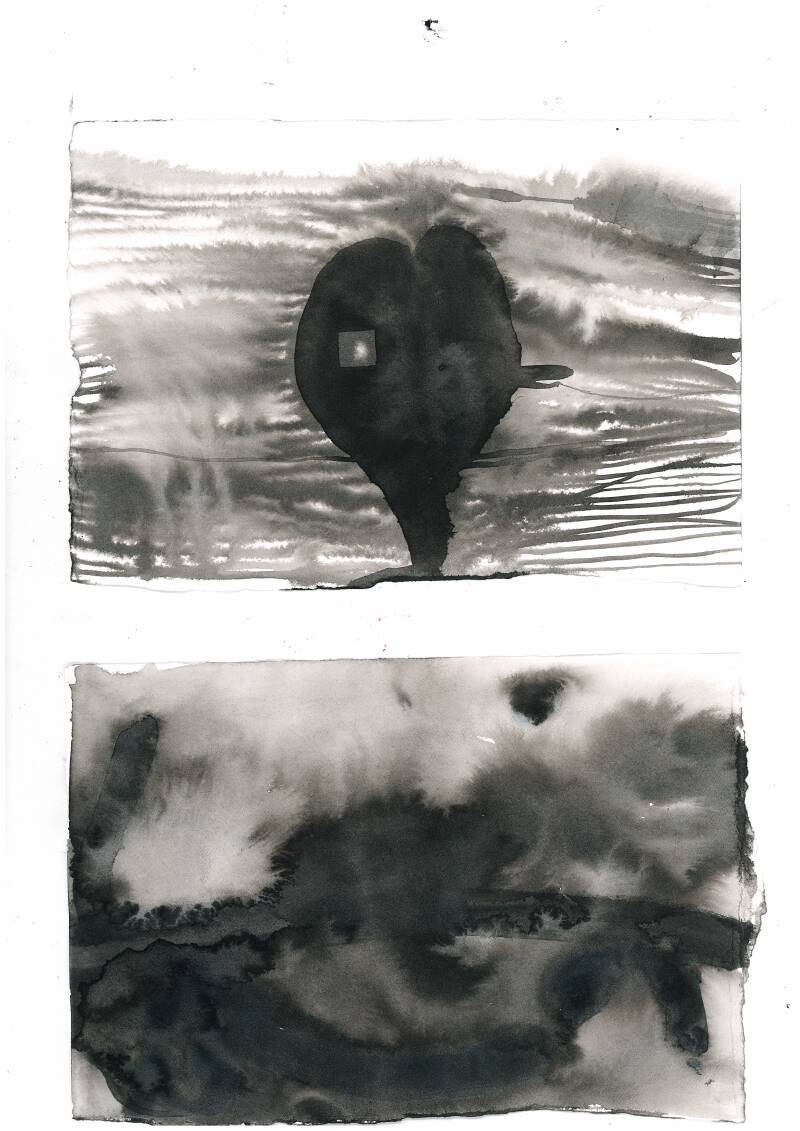
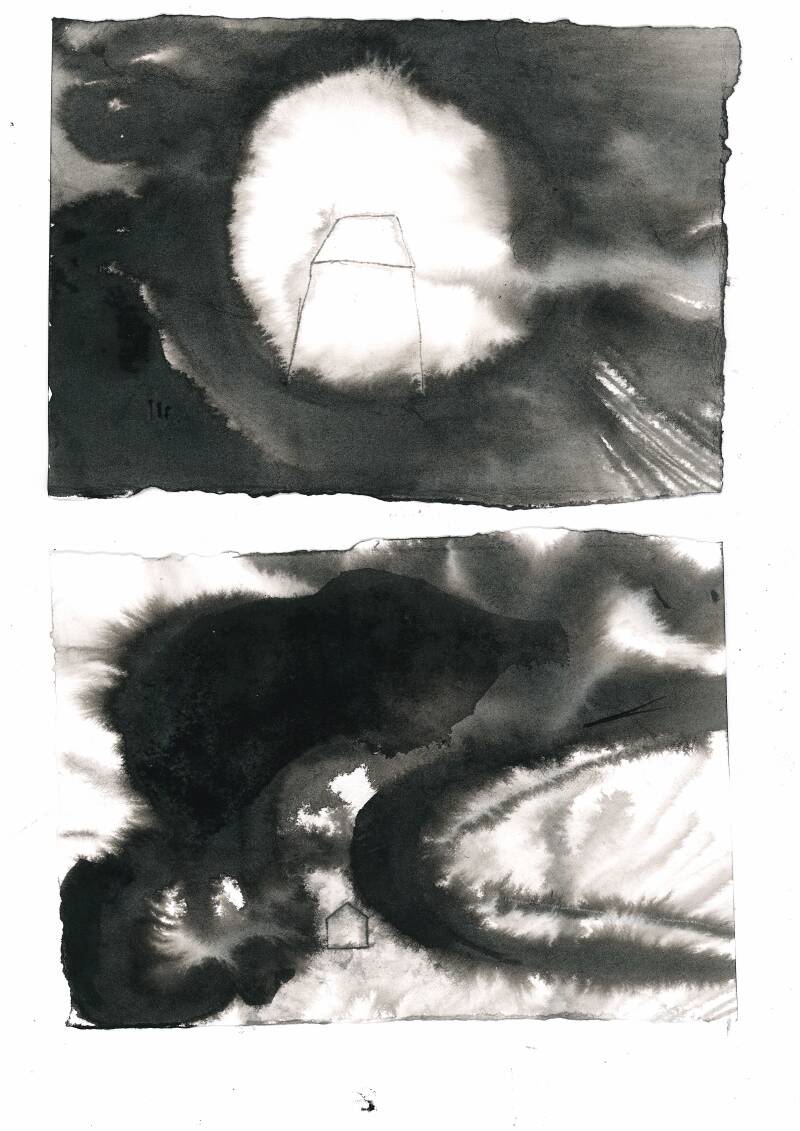
FMP 3 — PLANNING & FABRICATING FINAL WORK
What am I considering for my final piece?
What I found is a visual language by reflecting upon all of my work to date; the stages and processes that I have used.
I am trying to embed the concepts of the sublime into a single form. I have centred my research into the sublime on water. I have been inspired by artists that use water to evoke the sublime in the audience; JMW Turner and Marina Abramovic. I am also very inspired by the work of Alison Wilding and Ai Wei Wei who place dualities and opposites at the forefront of their work.
All of my drawings for this project, have involved either the house that fell apart in my dream, the body, the vessel, and most recently the stealth bomber.
I have decided to make a sculpture for my final piece because it has to have a physical resonance with the audience. I want my sculpture to have a tangible presence that shares a three dimensional space with the viewer. Unlike a painting, which creates an illusion, sculpture inhabits the real world allowing for tactile relationship with the audience.
I want to make a rigid central form that anchors an amorphic swirl of mark making, as I mentioned right at the beginning of this project.
I want to use a material that has transformational qualities; this is why I will gravitate toward using plaster which is a material in flux until it is solidified. I can build anything from plaster, it is incredibly mouldable because it is in transformation between liquid and solid.
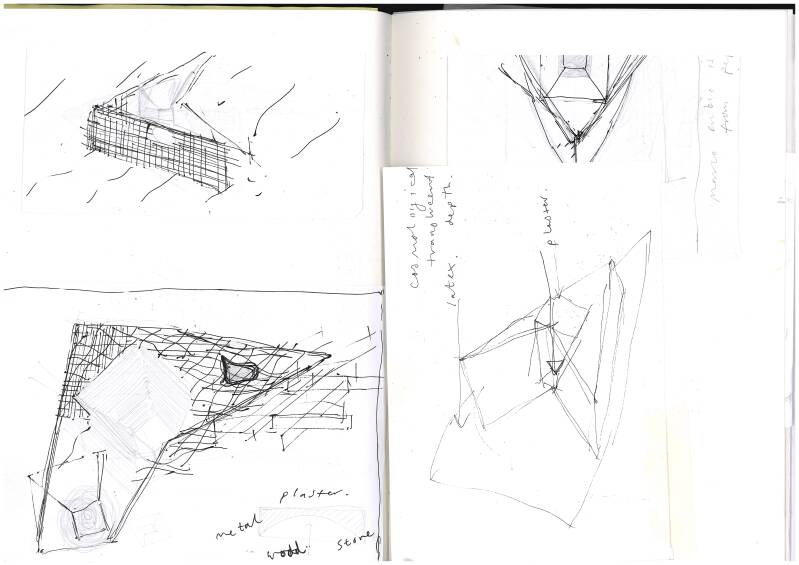
I have decided that my final outcome is going to be 3 dimensional. I start adapting the shapes found in my drawing experiments (laser cutting, folding paper and collage). I realise that the shape of the B2 stealth bomber has been highly influential on my work. I am inspired by the duality it possesses between terror and beauty. This is why I decide to make my drawings resemble its geometry.
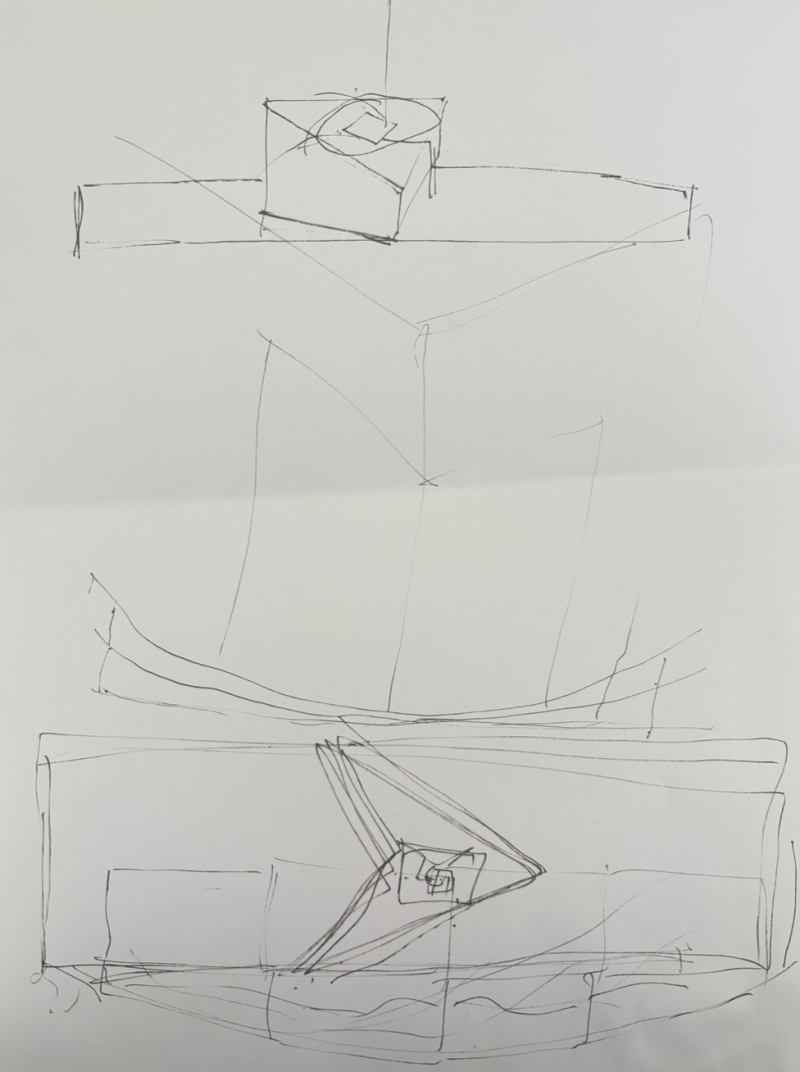
In the centre of my drawings I also place an inverted tower that descends into the object. I am thinking about how something could vanish in this hole / void. I am thinking about how it could become a container of water. This form has been derived from my earlier references to architecture that stores water.
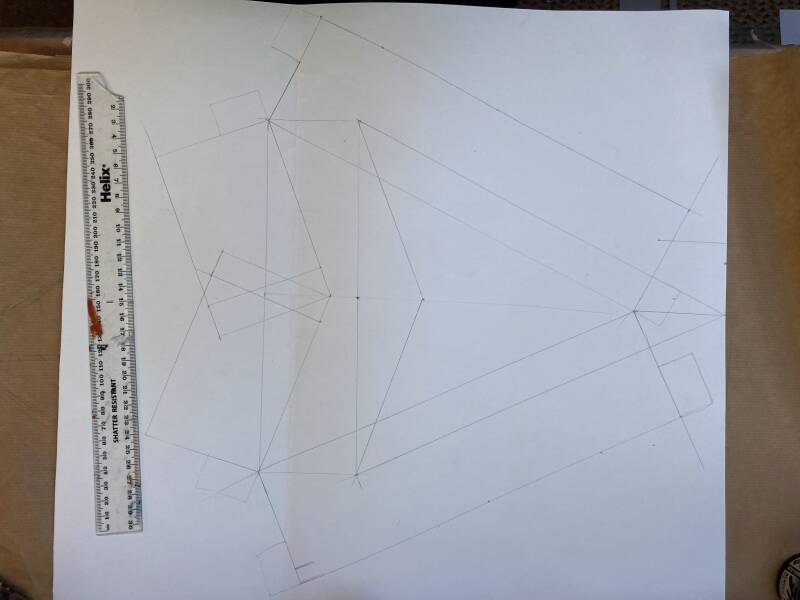

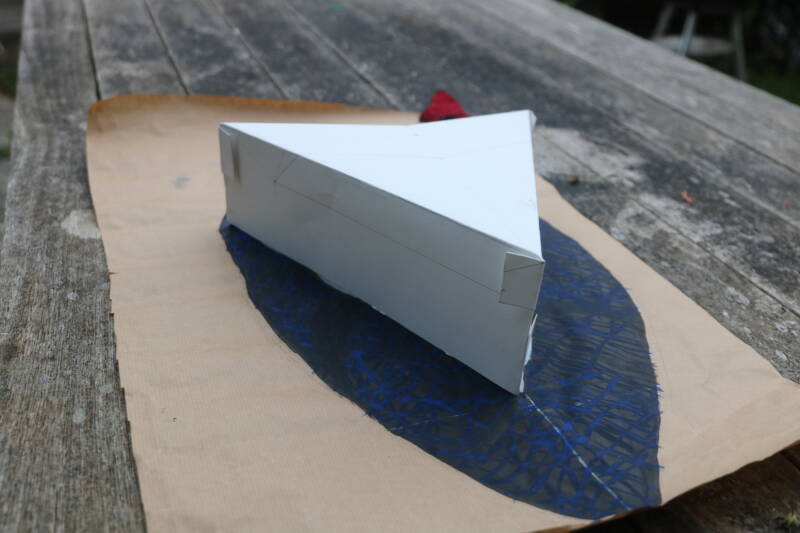
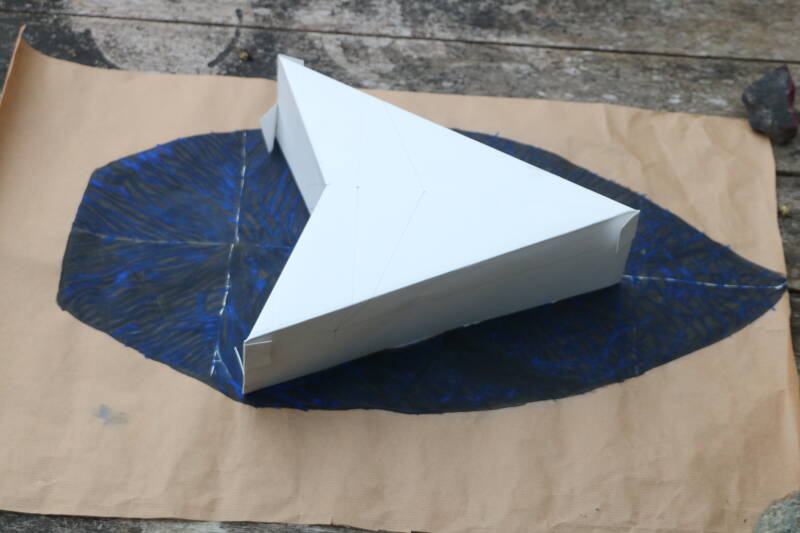
I make a first maquette out of paper. I have made a strong shape, a powerful and directional piece of 3d geometry. I wonder how I can create contrast with this shape. I want to make sure that my fascination with water also has an important place in my final piece. That is why I have placed this piece of geometry on top of a boat shape, reminiscent of a vessel that might float, an echo of my previous sculpture made from paper.
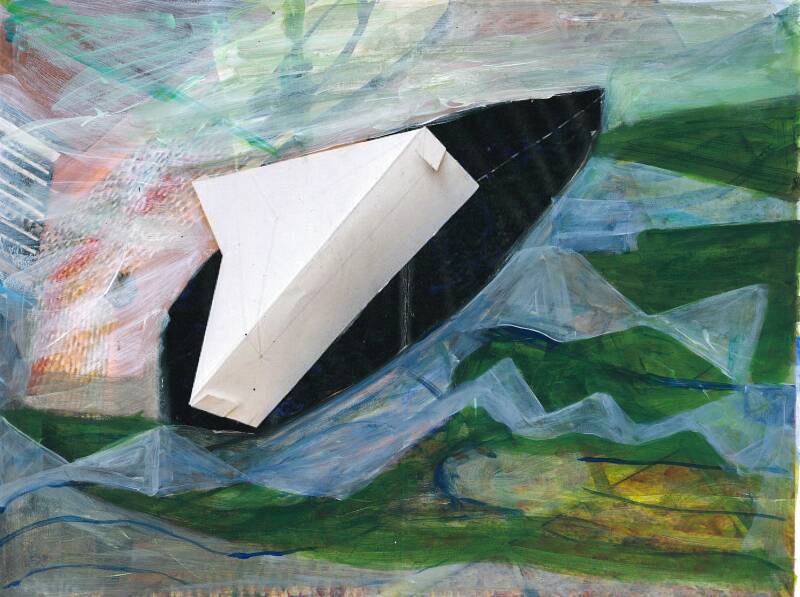
I take photographs of my boat maquette.
I want to explore the area around it — how a fluid shape sits next to this tight and contained geometric form.
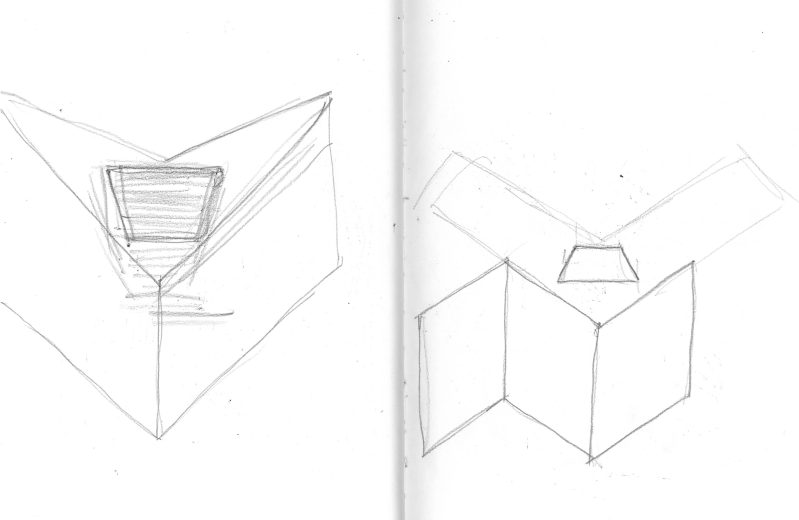
Through my drawings, I play about with the shapes that will sit below my geometric form. It is almost like a bed. Because this bed is in the shape of a boat, these drawings have the connotations of being at sea. They feel like the designs for a warship.
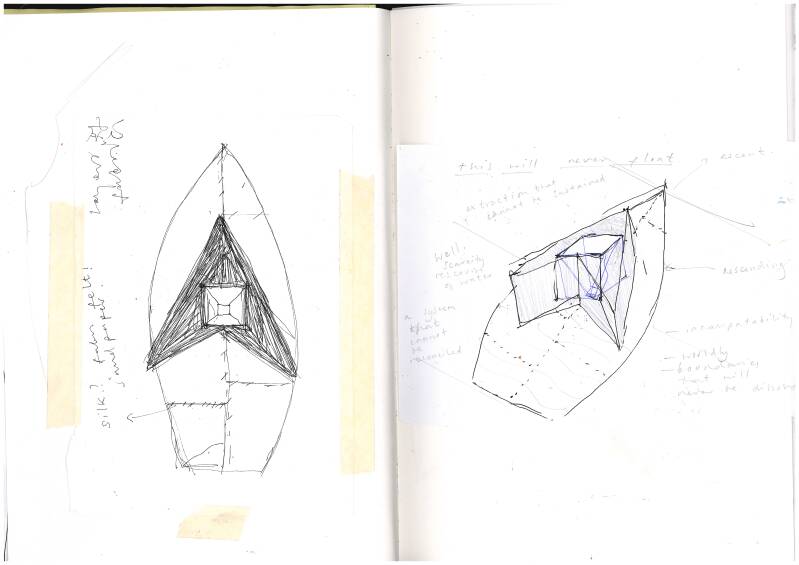
UNDERSTANDING THE DIMENSIONS FOR MY FINAL PIECE
I roll out a large sheet of white paper and draw around my body. I do this because I want the dimensions of my sculpture to be related to the human scale.
I like to use my own body as a reference.
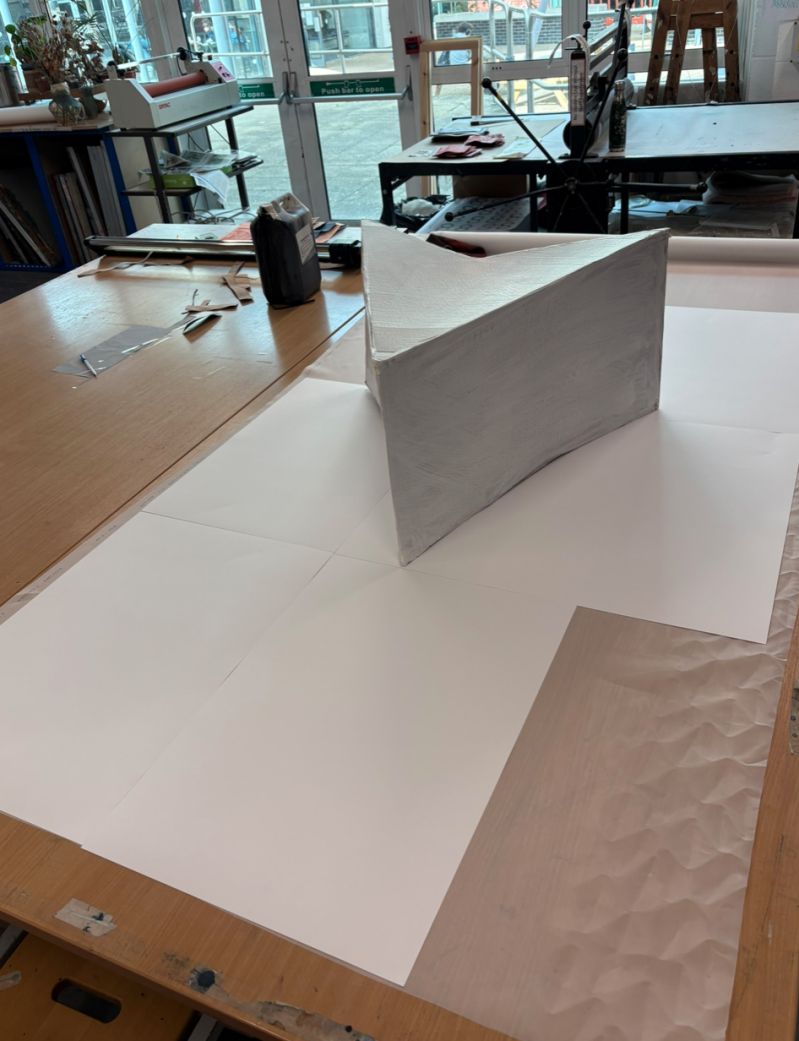
I use cardboard reinforced by masking tape to create the folded and geometric shape.
Building a life size maquette of my idea helps me understand its physicality and scale.
I am asking questions like ... how tall should it be? How big should the angles be? How abstracted from the stealth bomber should I make this form?
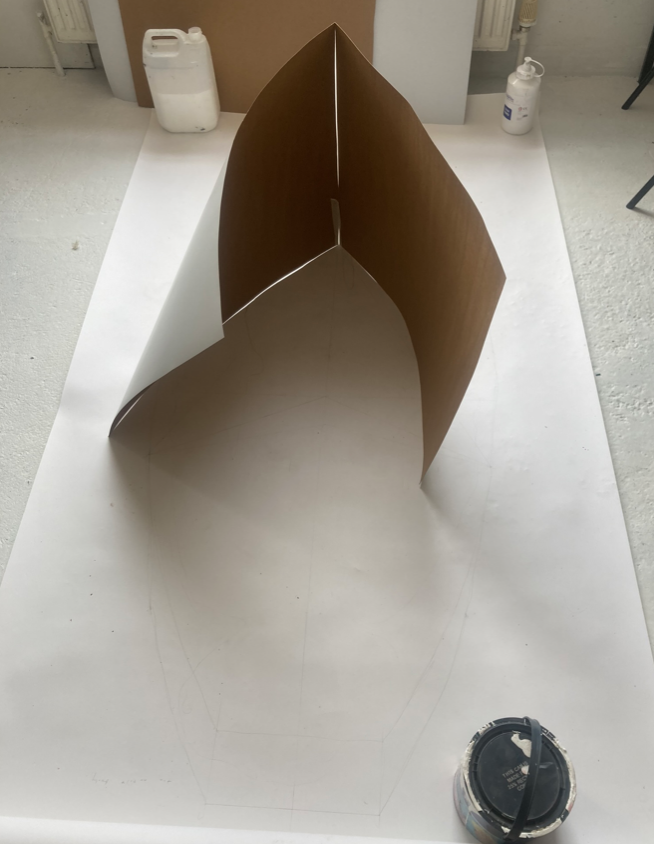
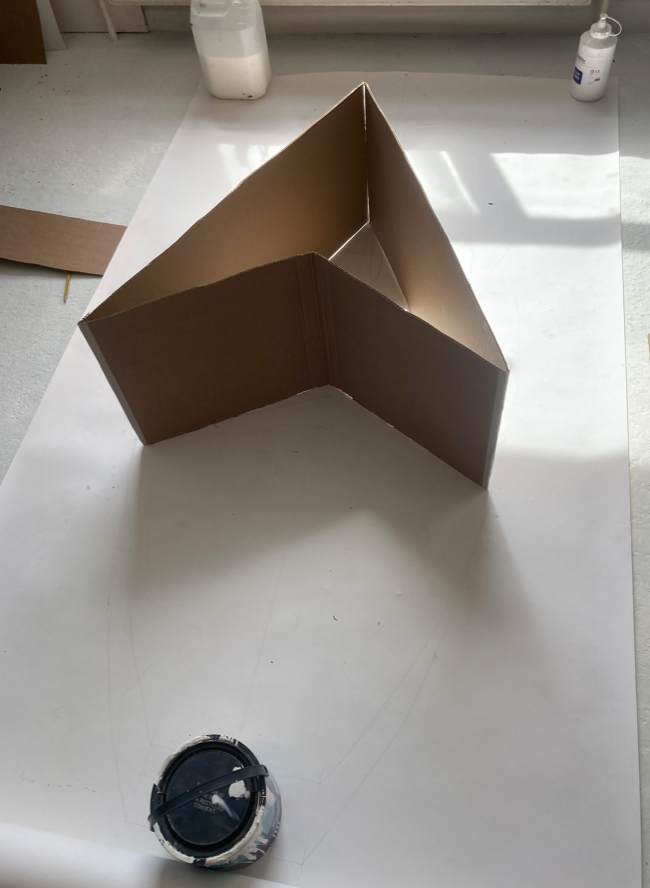
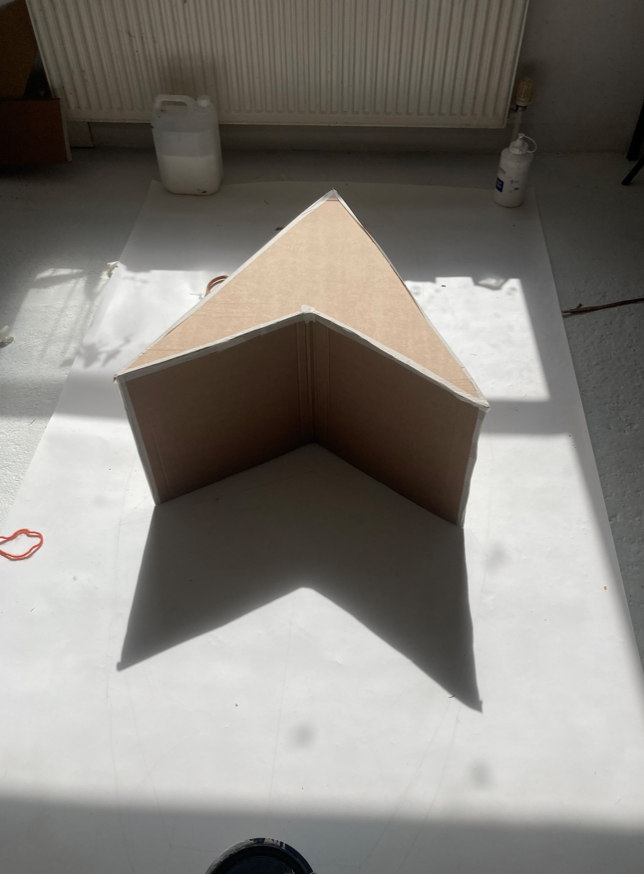
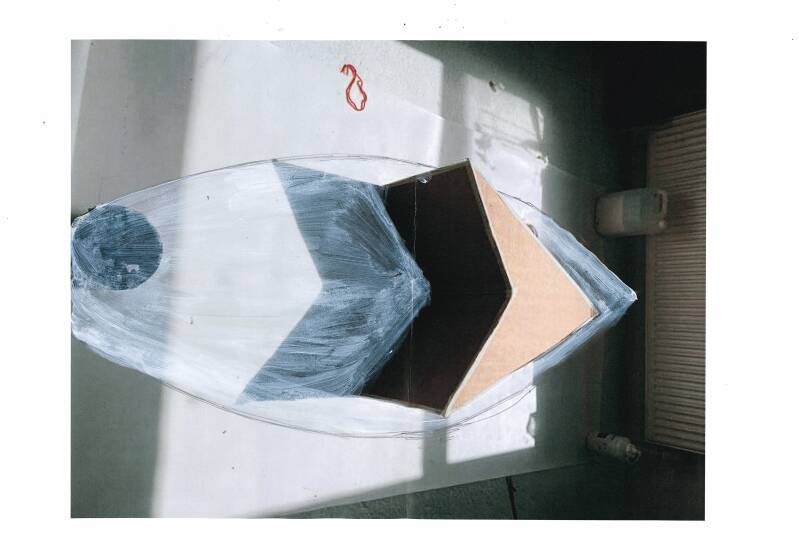
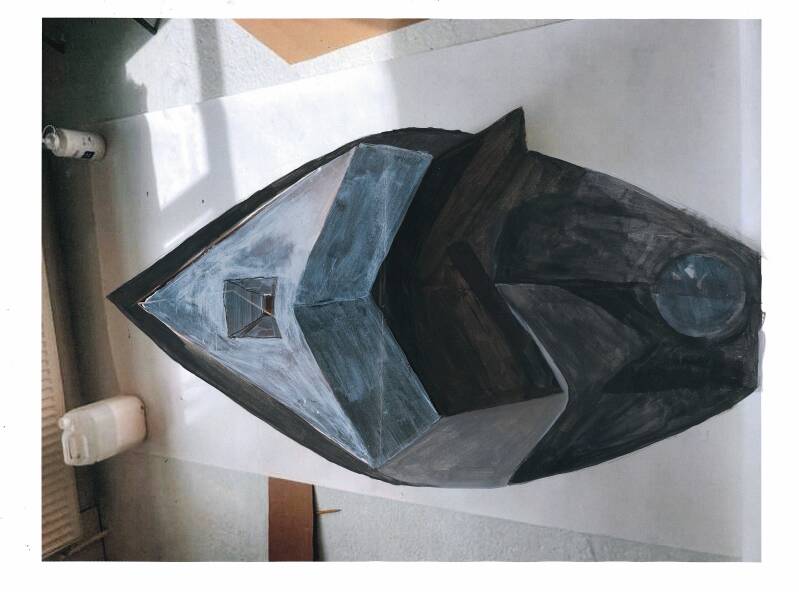
In the paintings above I am trying to work out what the base could look like. Could it be made from many panels or will it be one singular piece of material?
In order to accurately make my plans, I had to have exact measurements of my model. I did this by constructing a model on Sketchup.
SCULPTING PROCESS
Once I had worked out the exact measurements of my sculpture, I found some ply board and cut them to size using the bandsaw.
With the aid of Colin from 3D, I was guided through the making process. It was important to have his guidance because I wanted to ensure that I was following a process that would be successful. It was a learning process to make something of large scale. Now I have more confidence to make something with these materials again. I have gained knowledge and understanding about how these processes and materials work.
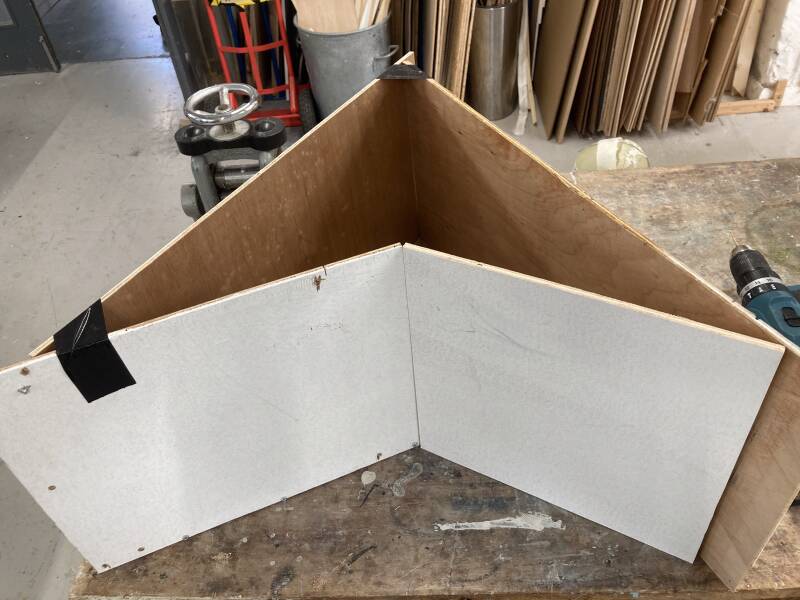
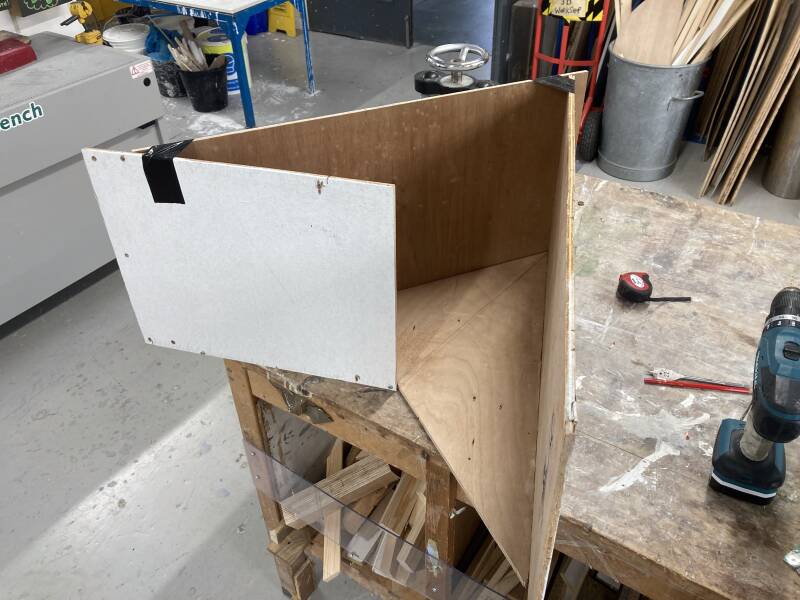
Above is my wooden mould, which I made from wooden planks that were all the same height in order to create level base. This will make sure that the sculpture has smooth surfaces and sits up straight. I held the wooden boards together with screws. It was quite difficult to connect the very steep angles together. Often the screws would not find enough bite or splinter the wood. This was okay as long as it did not damage the interior walls of the mould as every imprint would show up when working with plaster.
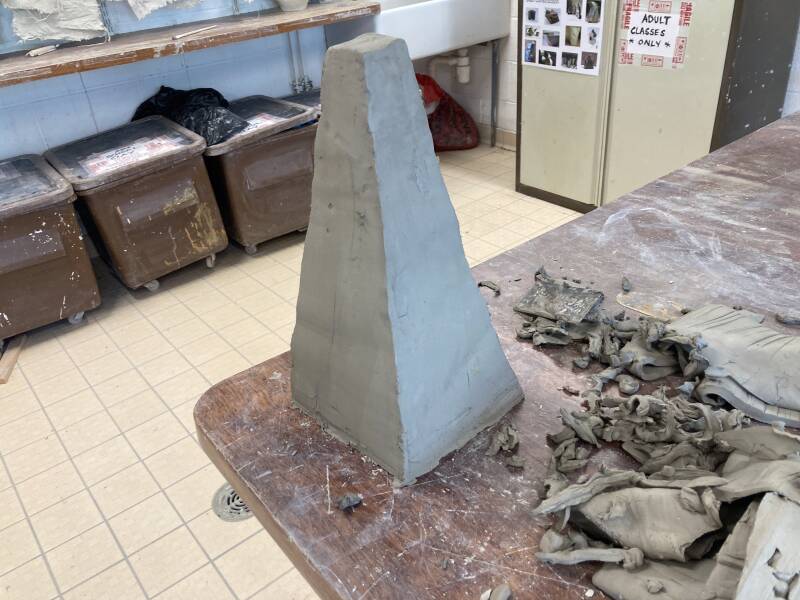
After making the superstructure of the mould out of ply board, I turn my attention to internal cavity that I had planned. Out of clay I form a shape that will ultimate become a cavity. I am building a positive (ascending) form to embed a negative (descending) form into the centre of my sculpture. It was really important to create smooth surfaces to the clay walls and make sure that each side tapered off at precise angles, otherwise my descending tower would look unequal. I place the mass of clay on a rotating wheel to let me see all the discrepancies, helping me make it more equal.
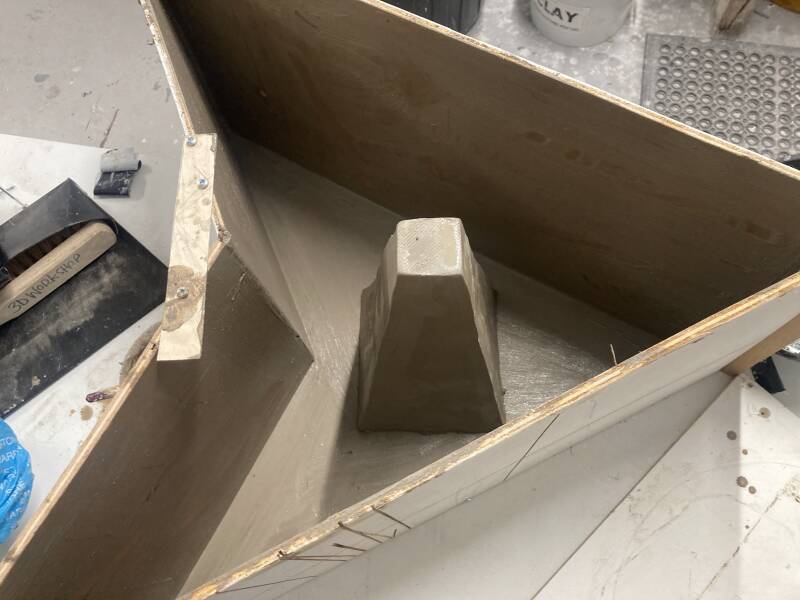
I inserted the internal clay tower into the centre of the ply board mould. This was the point where I could see my sculpture materialising in front of me, even though it only existed in negative form. I was excited to begin the transformational process that will bring this sculpture to reality. I feel like I am really in touch with fundamental forms and materials. Through my interaction with materials I am starting to feel like my ideas are becoming manifest. Before they only existed on bits of paper and now they are starting to take on physical form. This is a thrilling process.
I filled in the edges of the model with wet clay to ensure that there are no air bubbles or gaps for the plaster to leak out of.
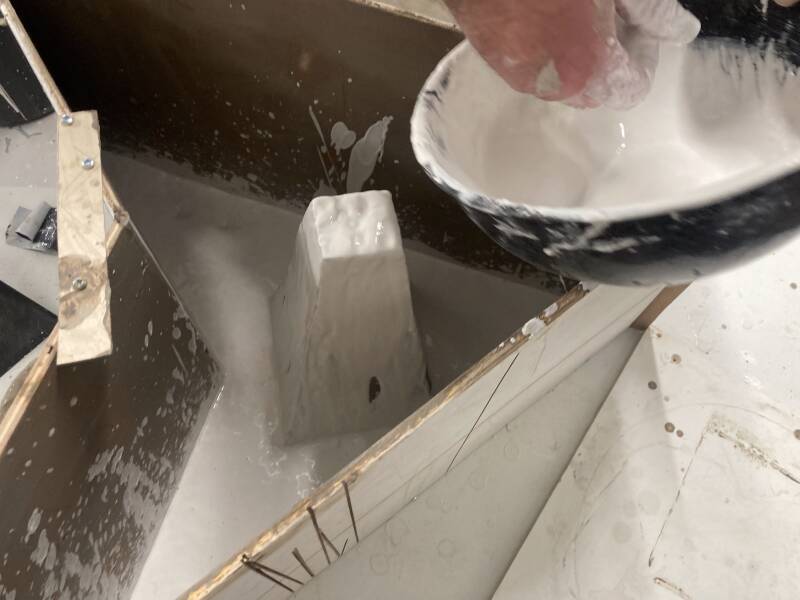
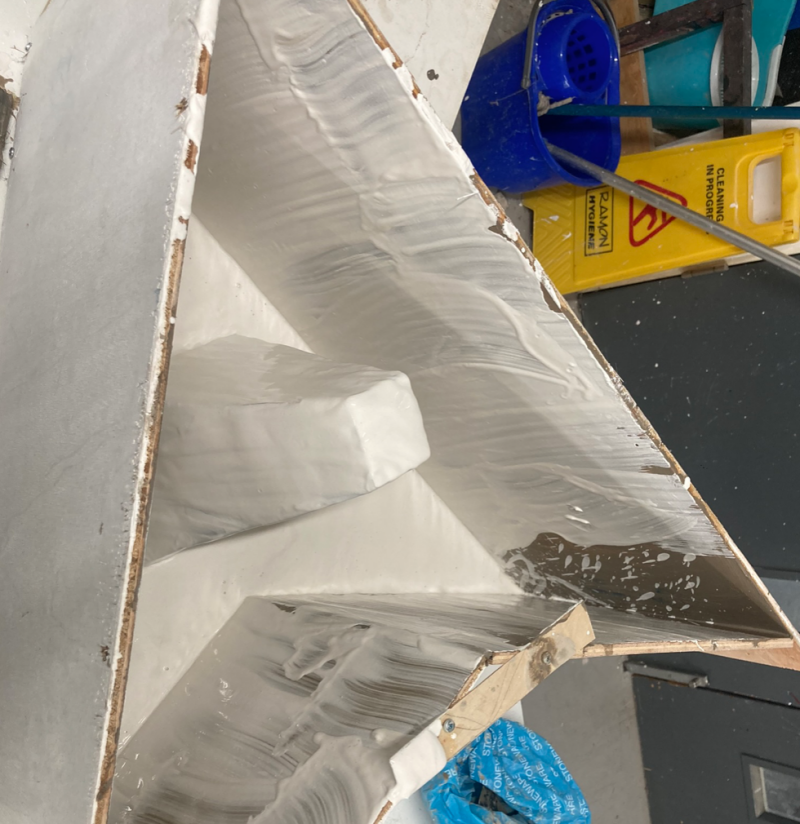
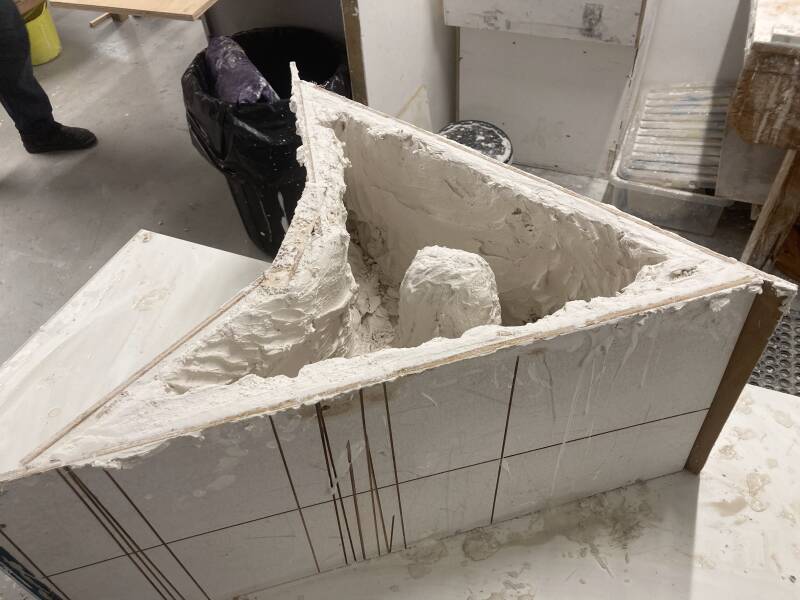
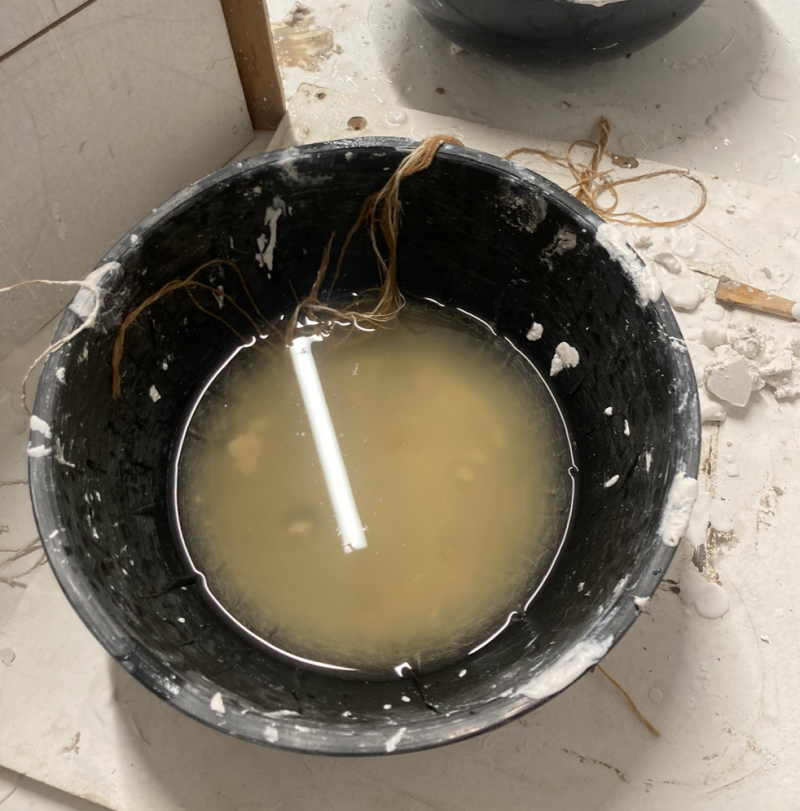
I start mixing the plaster in circular plastic bowls in a 2 to 1 ratio between water and plaster. Initially we pour a very fluid mix of plaster into the mould. We throw it in using our fingers in order to remove any air bubbles that might exist in the mix. I make sure that the edges of the mould have a plaster coating — this is to ensure the next bowl of plaster will have something to stick to.
As the mould is filling up, I allow the plaster to half set in the bowls, allowing it to have a consistency more akin to clotted cream. This way I use my hands to build the walls up, with a reinforcement of hessian scrim. Making the walls this way meant that we did not need to fill up the entire mould, reducing the weight of my sculpture and allowing it to be carried by two people whilst also being structurally sound.
I found myself becoming really conscious of the continually altering state of plaster as it moved from fluid and solid. This gave me particular satisfaction because the ideas in my work deal with transitional materials.
It was very captivating and exciting to work with so much material. The malleability of the clay, the liquidity of the plaster and the solidity of the wooden mould. I know that a powerful solid form will come from this alchemy.
THOUGHTS ABOUT PLASTER
Plaster sculpting is an ancient process of creating objects. It is a material that originates from Ancient civilisations in Syria, hydrated by the rivers Tigris and the Euphrates. By the Renaissance, its rapid drying process and ability to capture intricate detail meant that plaster had become widely used by European artists.
Plaster is a material in transformation. It moves from a powder to a liquid when mixed with water, before solidifying. Water is the catalyst of change. When plaster mixes with water an exothermic reaction takes place, releasing heat.
CaSO4 ⋅ 21H2O + 23H2O → CaSO4 ⋅ 2H2O + heat
It is an almost alchemical process: through rehydration, plaster transforms into a fluid substance before crystallisation gradually returns it to solidity. Mixed in a ratio of two parts plaster to one part water, the material undergoes a chemical change as it cures. The size of my plaster object contracts by about 0.5% as moisture leaves the surface. The water evaporates from the sculpture, shifting from liquid to vapour, it draws heat away from the hand. Once fully dried, the plaster lightens into a more luminous white, its surface becoming softer, chalkier, and dust-like in texture.
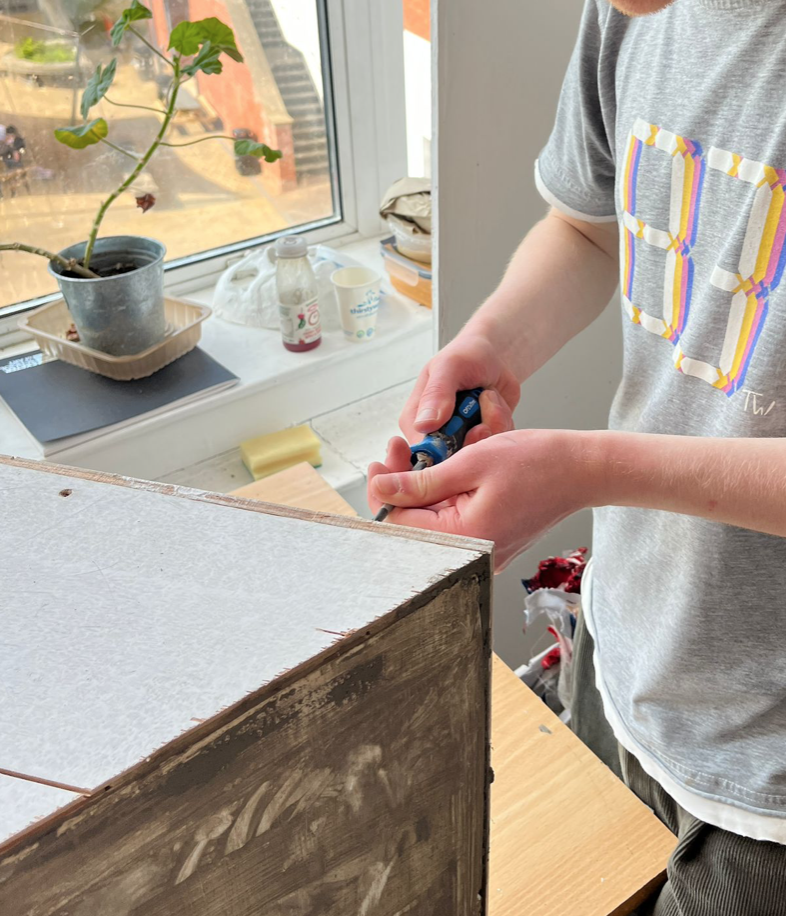
I unscrew and deconstruct the mould. I reveal a clay encrusted surface.
I was worried that I would not be able to get the clay off of the plaster's surface.
I like the way I can see all of the finger prints that smeared the clay onto the mould. They have been engraved onto the plaster's surface. I have captured a moment in time, the moment of making.
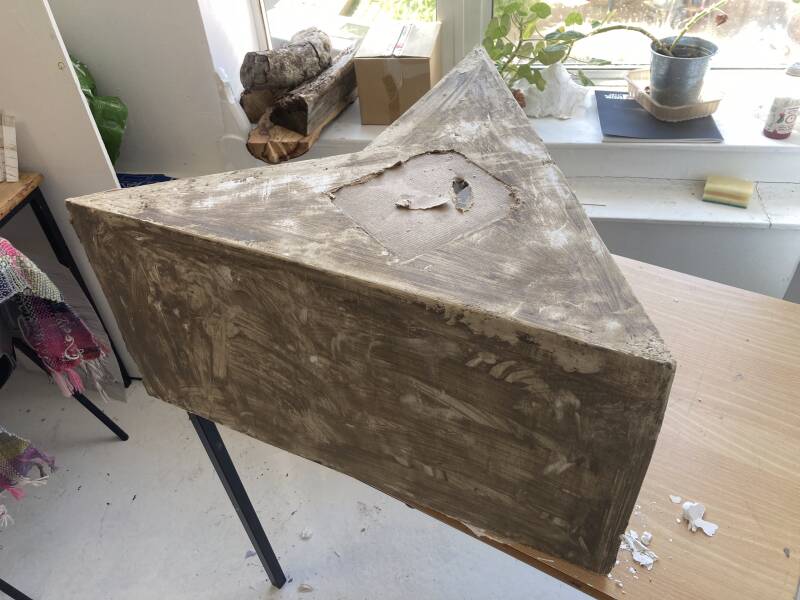
I am really interested in the wooden mould coming apart. It reminds me of some of my drawings.
It is an empty shell, a container that gave life and form to my sculpture, like a bird's egg.
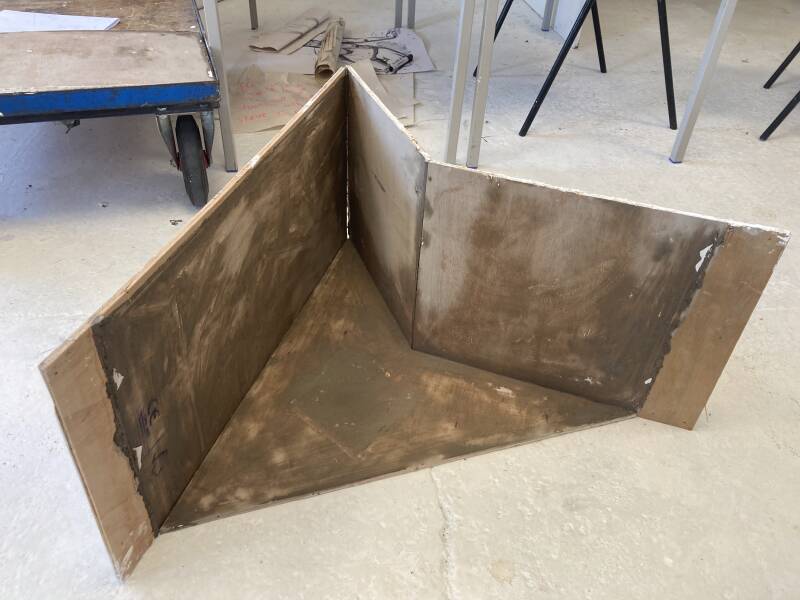
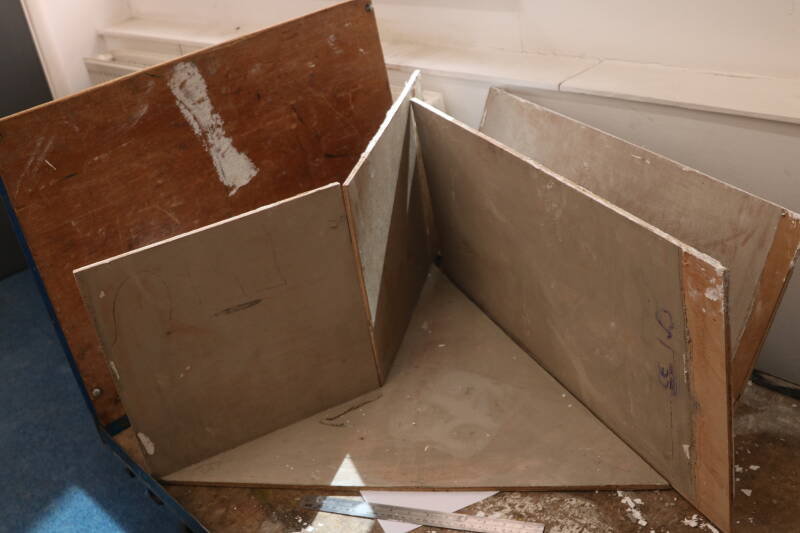
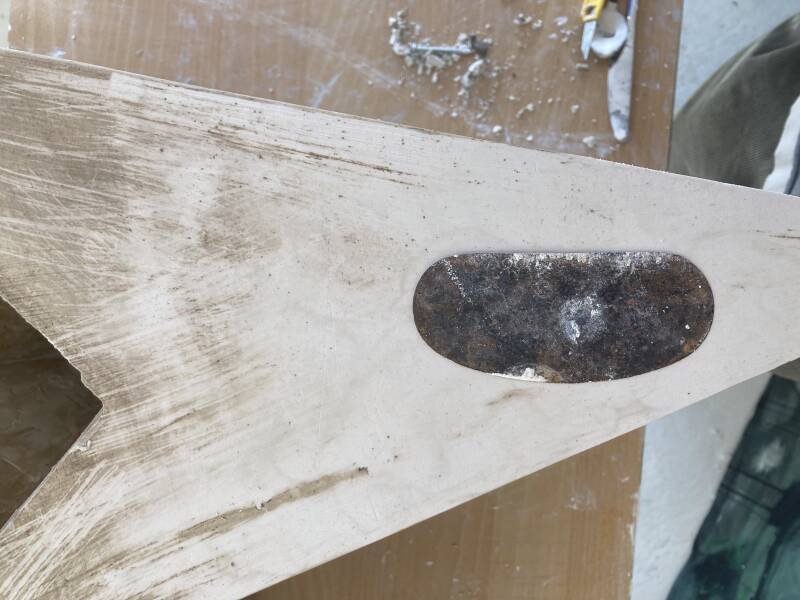
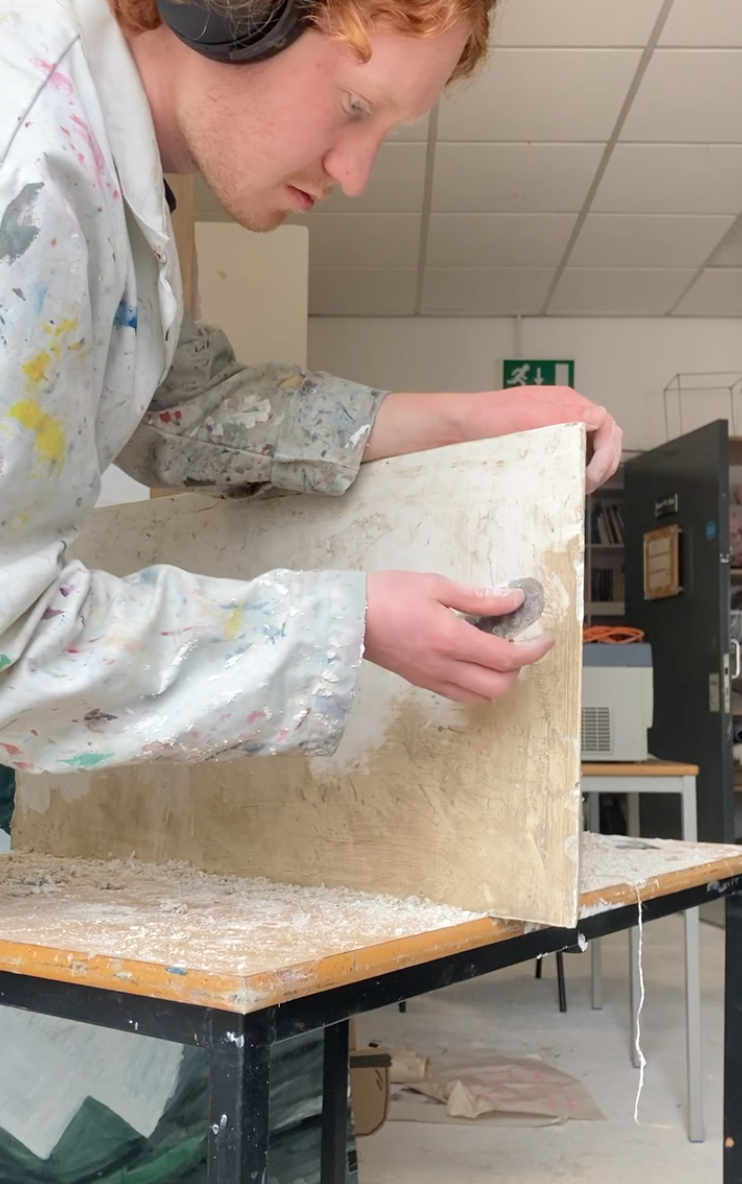
I use a metal kidney shaped scraper to remove the layer of clay from my sculpture. This process made the surface very smooth but it also revealed vulnerabilities in the walls of my sculpture. The pressure created cavities that needed to be patched and filled. These cavities were probably air bubbles.
THOUGHTS ABOUT MY PLASTER SCULPTURE
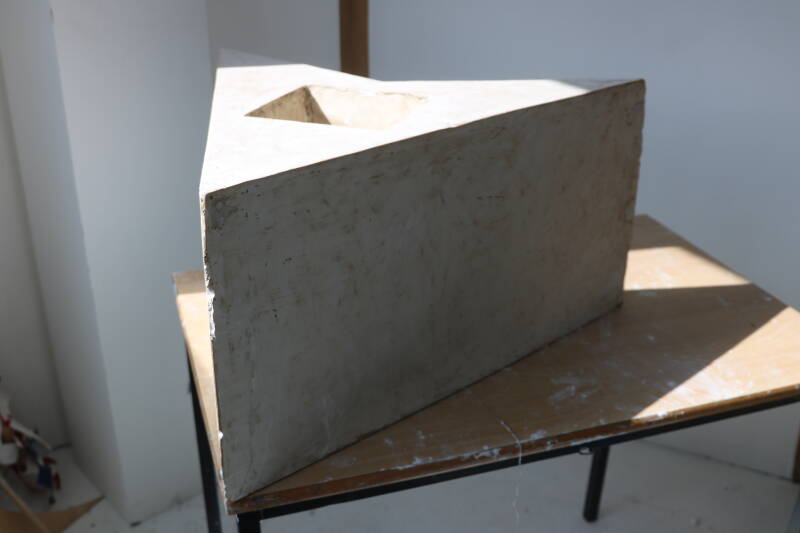
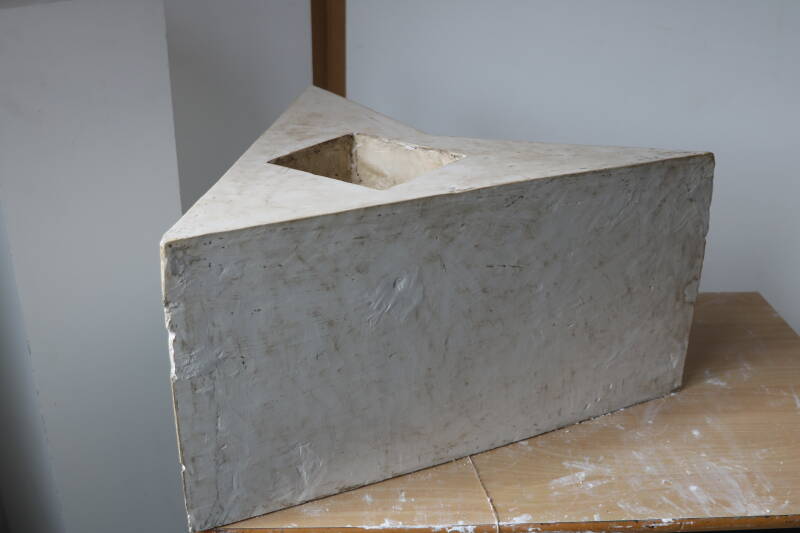
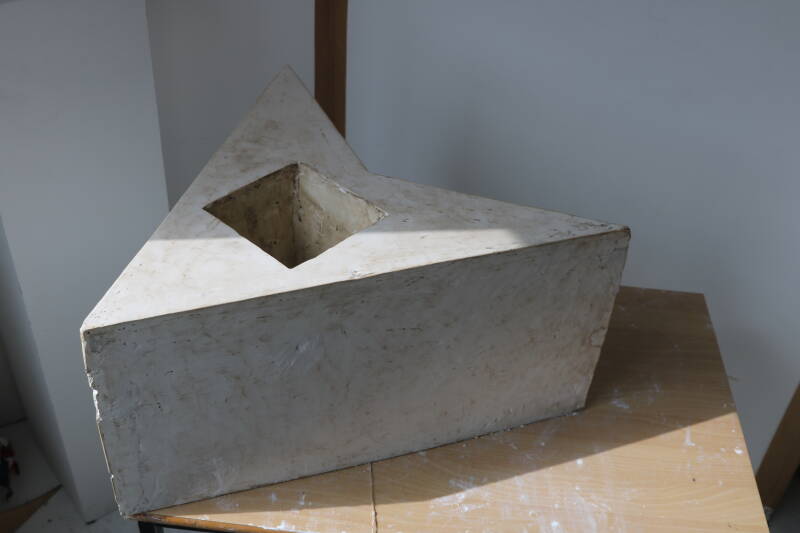
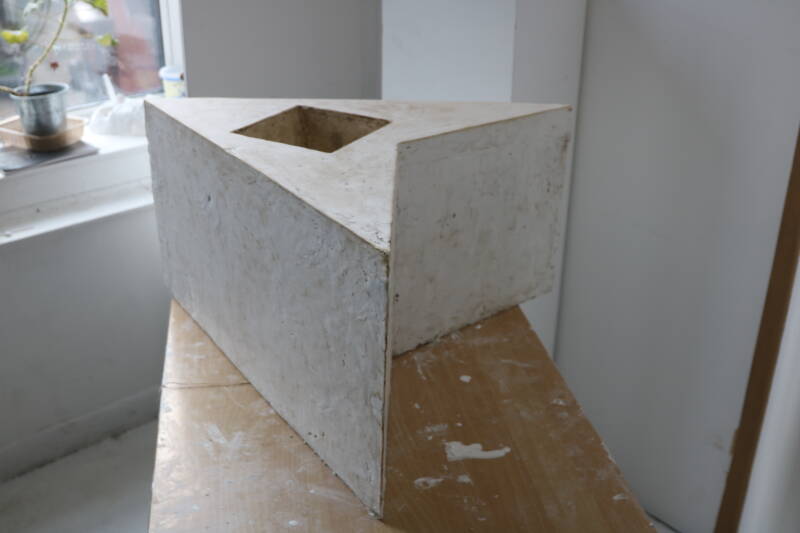
I am taken aback by the presence of what I have built. When I see my plaster sculpture in the sunlight and the sharp shadows that it is casting, I feel very mystified by the solidity of it. I reflect on my process of working with water, fluidity, flooding and submerging. I remember how my initial paintings of my dream, were full of movement, flow and pooling water. I look back at those paintings, from the start of my project, and I see the disruption of flooding water and how it disassembled solid forms. That dream has made an important impression on me. It underpinned the visual language that I started to speak.
And now, I am confronted with something very static and solid. This will not fragment, it will not fall apart, it will not fold outwards. I have created an object that emanates a stillness and a silence.
This object is a direction, it embodies an arrow, it has a visual pull to it. That pull is not just visual, it is also conceptual. I feel like I am being pulled towards the materiality of opposites. I am very pleased with how this sculpture is matching up with my concept and title of 'Two Parts'. I will now be pushed to resolve the final part of this journey; to give this sculpture an equal opposite and to find a material that will express that.
Here are some words that describe the opposites present in my sculpture:
inwardness / outwardness
male / female
soft / angular
liquid / solid
floating / sinking
ascending / descending
inside / outside
container of ideas
THINKING ABOUT MATERIALS THAT CONTRAST WITH PLASTER: LATEX EXPERIMENTS
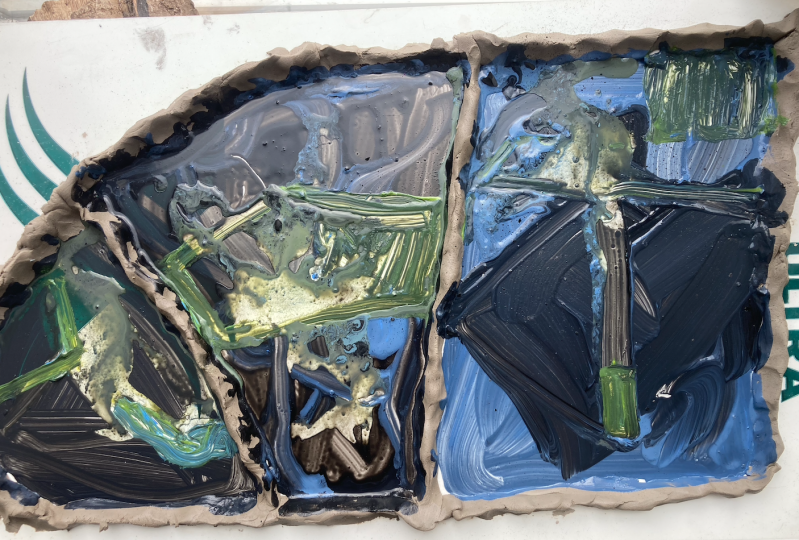
I had visualised that latex would be be good material to contrast with the solidity of my plaster sculpture. This is because my direction became about introducing water and fluidity into the equation of my work.
I began to pour latex into a shallow mould, made from clay.
I began to experiment with liquid latex, mixing it with acrylic paints. I mixed latex with greens, blues and greys; this process created a sense of water. However it felt very surface level and did not possess enough visual depth.
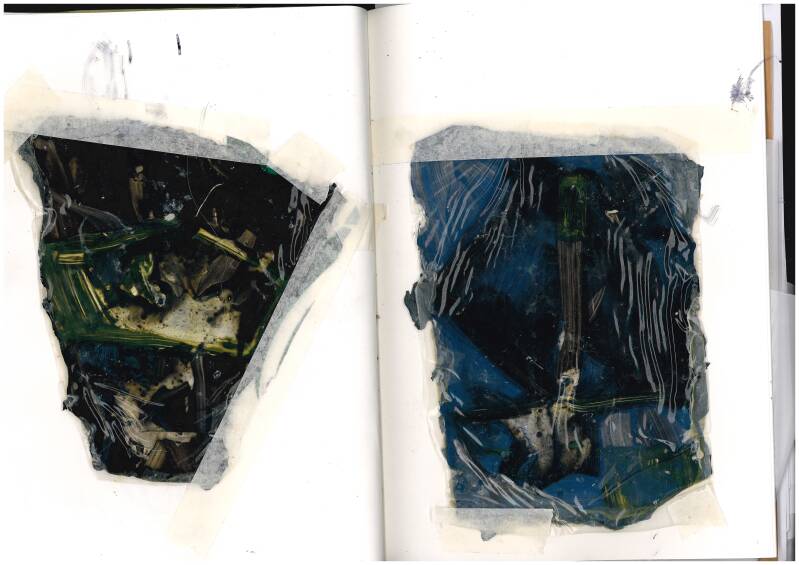
Ultimately, I had to reject using latex because it was not aesthetically going to work in large scales.
I was searching for something that would have an equivalence to the beauty of the plaster sculpture. Latex did not have that beauty. It was discarded because it felt bad to touch and work with. Something deep inside of me rejected working with latex. It would be mucky, it looked like the contents of a sewer. I want beauty.
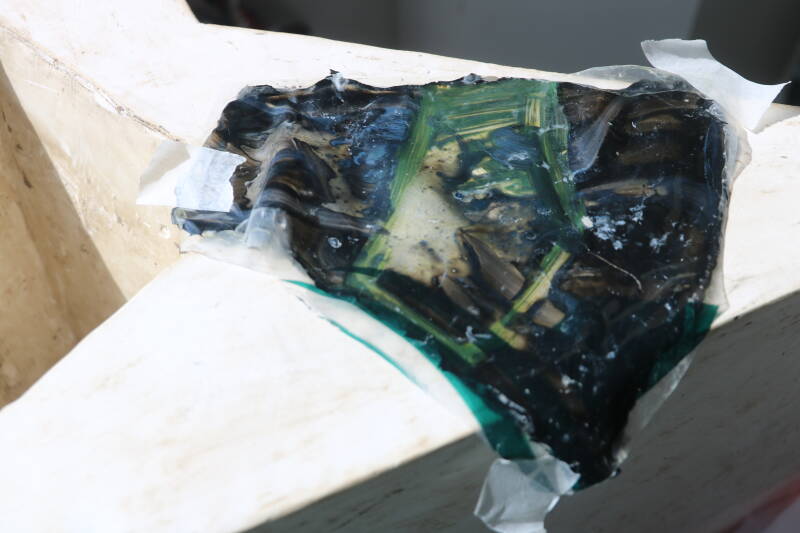
The latex gave me a message to find a material that was more akin to the beauty of my paintings rather than the distressing surface of latex.
MONOSCREEN PRINTING
Mono screen printing is a painterly, experimental technique where ink or paint is applied directly onto an open mesh screen to create unique, one-off prints.
To make a mono screen successfully I had to cover the entire screen with either acrylic paint or medium. This is because any areas that have been left unpainted will smear and bleed, becoming a muddy brown mix of all the colours.
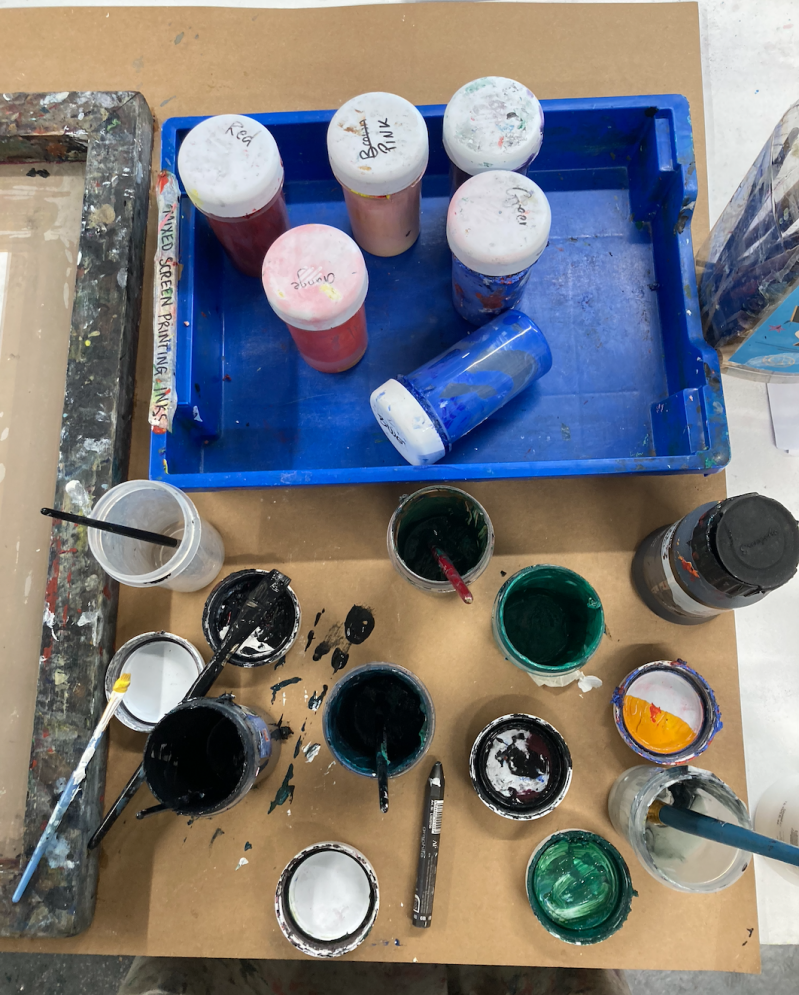
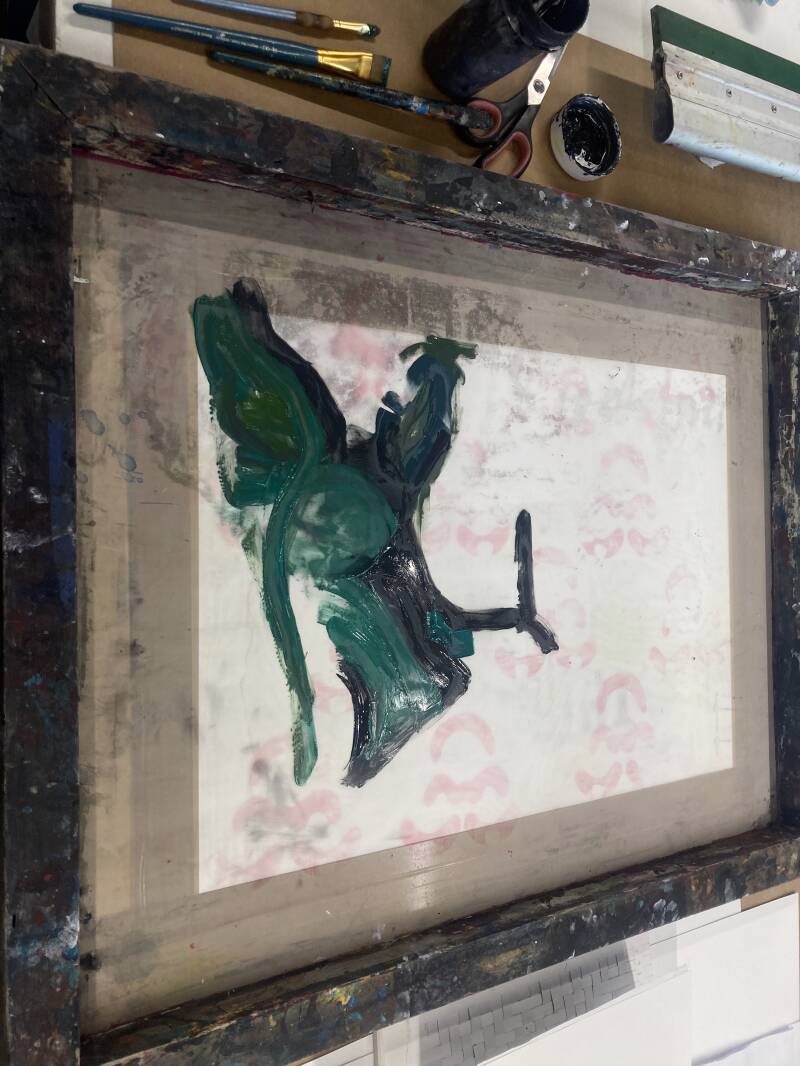
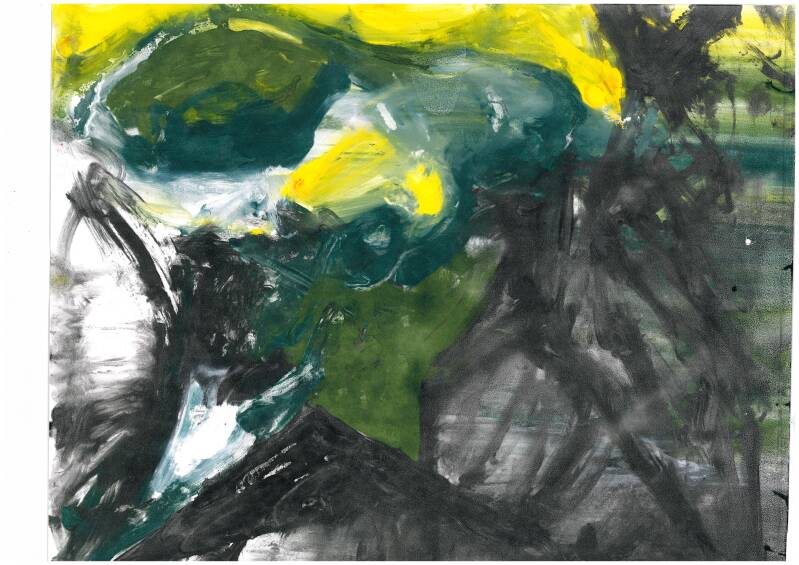
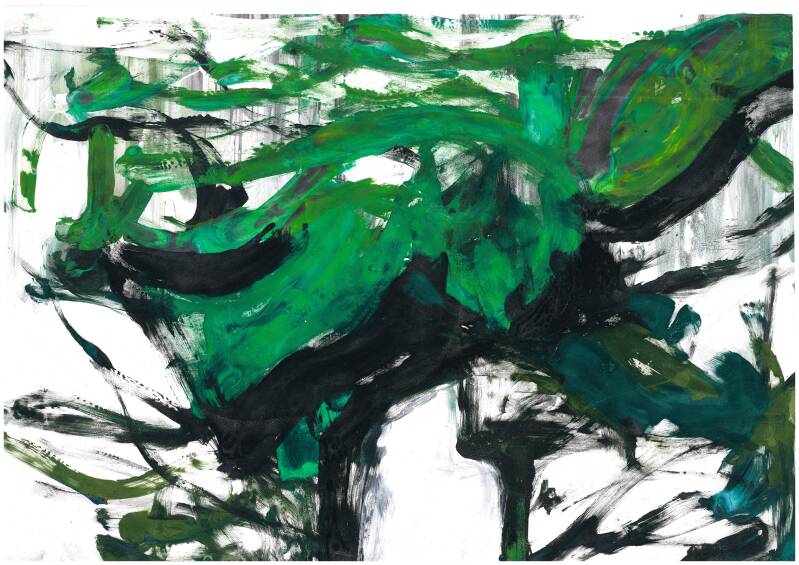
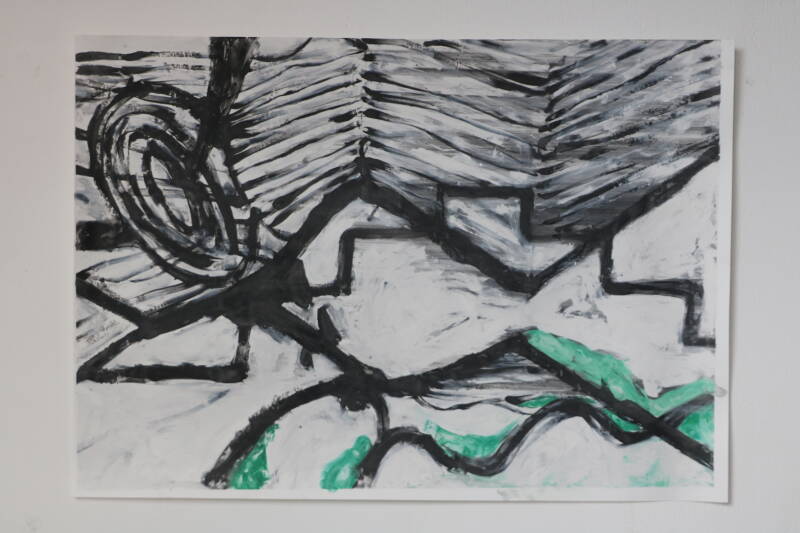
'Surface', acyrlic monoscreen, 420 x 549 cm
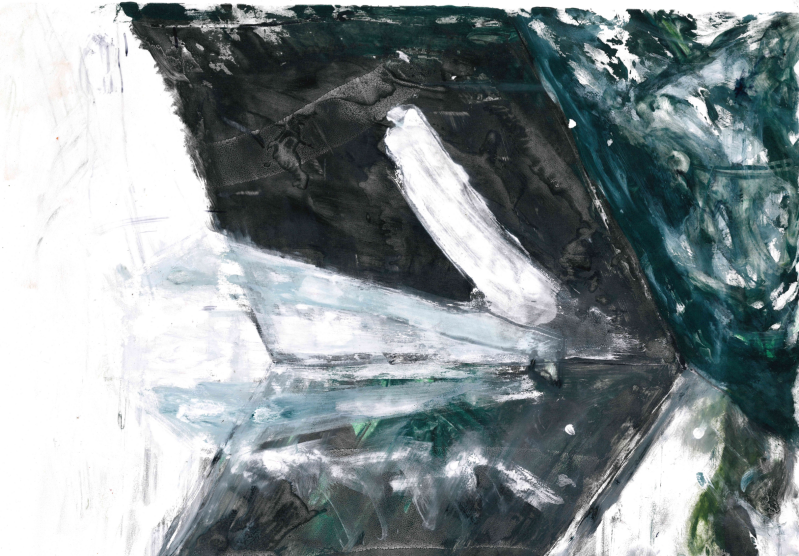
Screen printing and painting has lots of overlap. They are so close to my natural method of painting; very searching and full of movement. I like the tones and mark making in these paintings; the way they move from light too dark. I like the process of pushing pigments through the silk screen.
However, I do not think that they have added much to my visual language. They are quite similar to my paintings albeit just a different method.
Instead I am more interested in the ghost prints that are made by cleaning the silk screens. I enjoyed working with silk screens, pushing and pulling pigment through them felt like a very fluid process. I want to continue working with the material of silk mesh. Perhaps it could have a role in my sculpture?
GHOST PRINTS
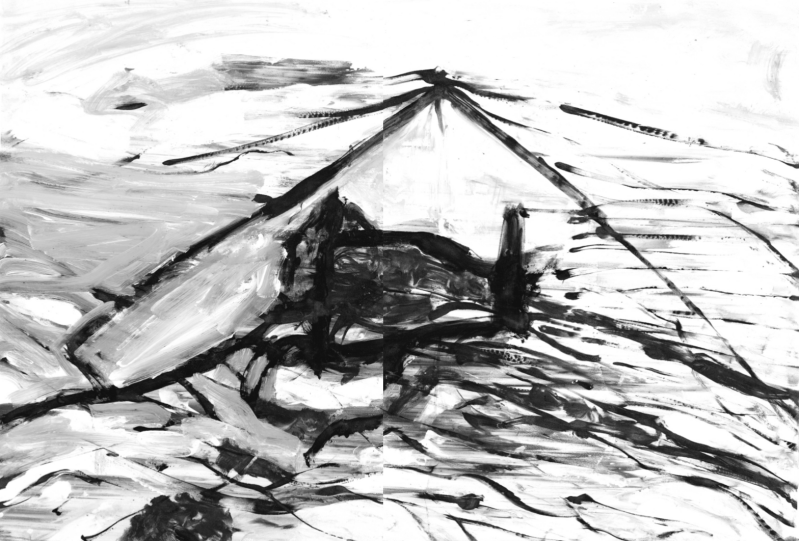

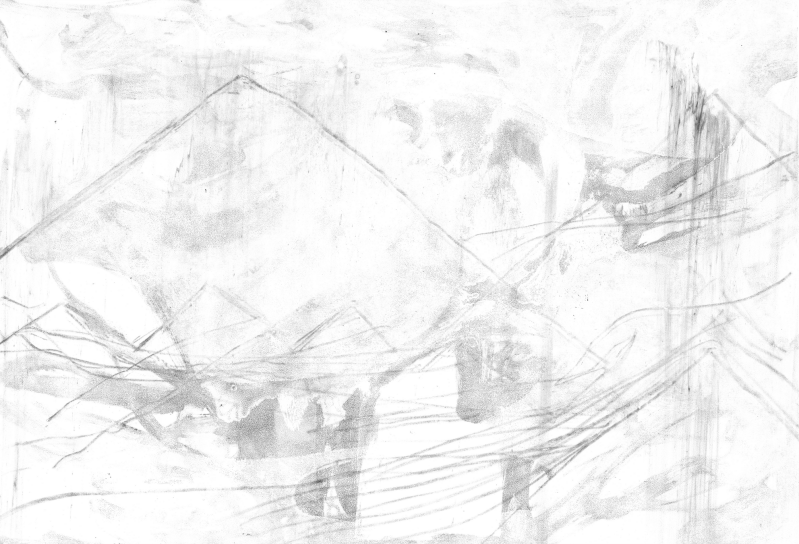
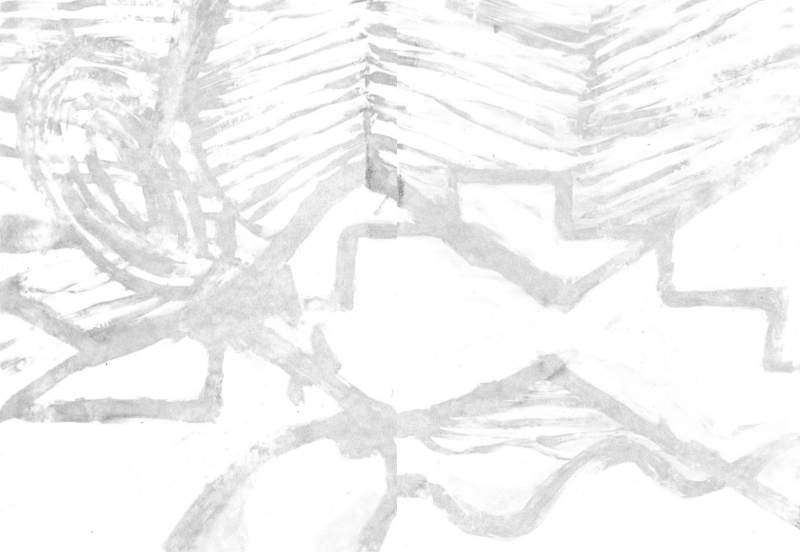
Once I had reduced the colour in these ghost prints, I was much more attracted to the more muted and subtle monochrome outcomes. This meant that the interaction I had between the silk screen mesh, ink, and paper became central to how I wanted it to evolve. All of the elements; paper, mesh and ink exist in equal importance to each other. There is no dominant element.
SILK SCREEN MATERIAL
After a discussion about my work with Laurel, the print and textiles maker at college, she tells me about a large roll of opaque silk mesh that she has had stored since 2009 — that is three years after I was born. Talking to Laurel was very helpful and I now feel much more confident to navigate this material. I feel as though this roll of silk screen has been waiting for me to integrate it into my art.
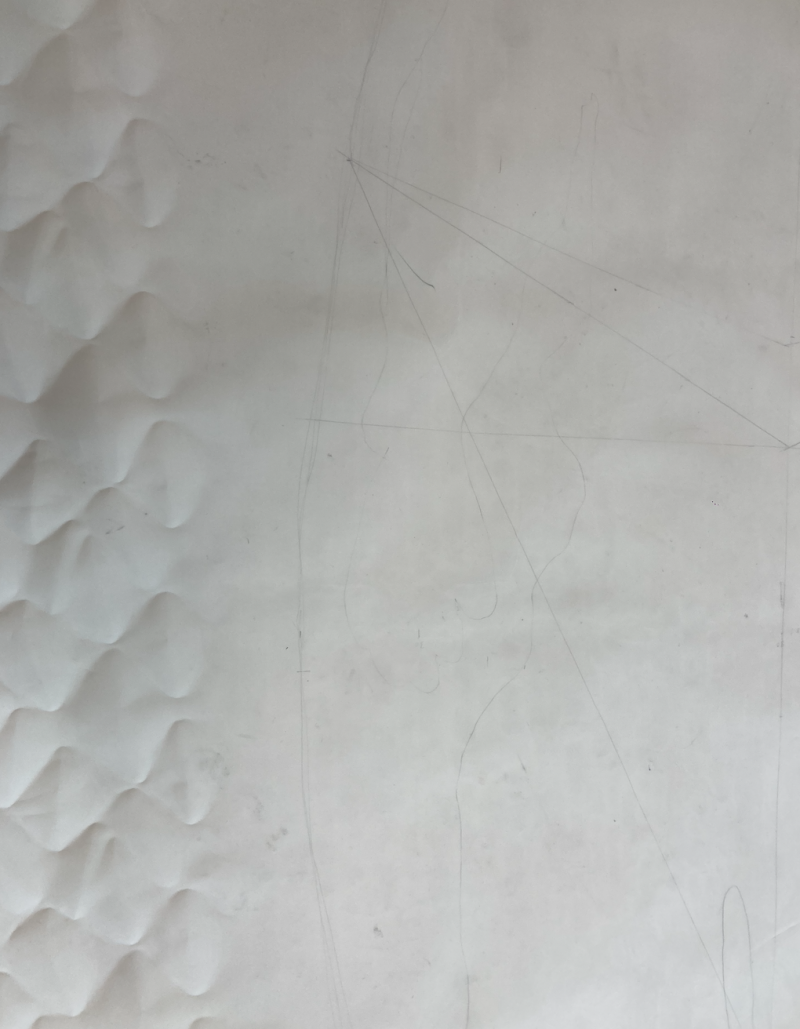
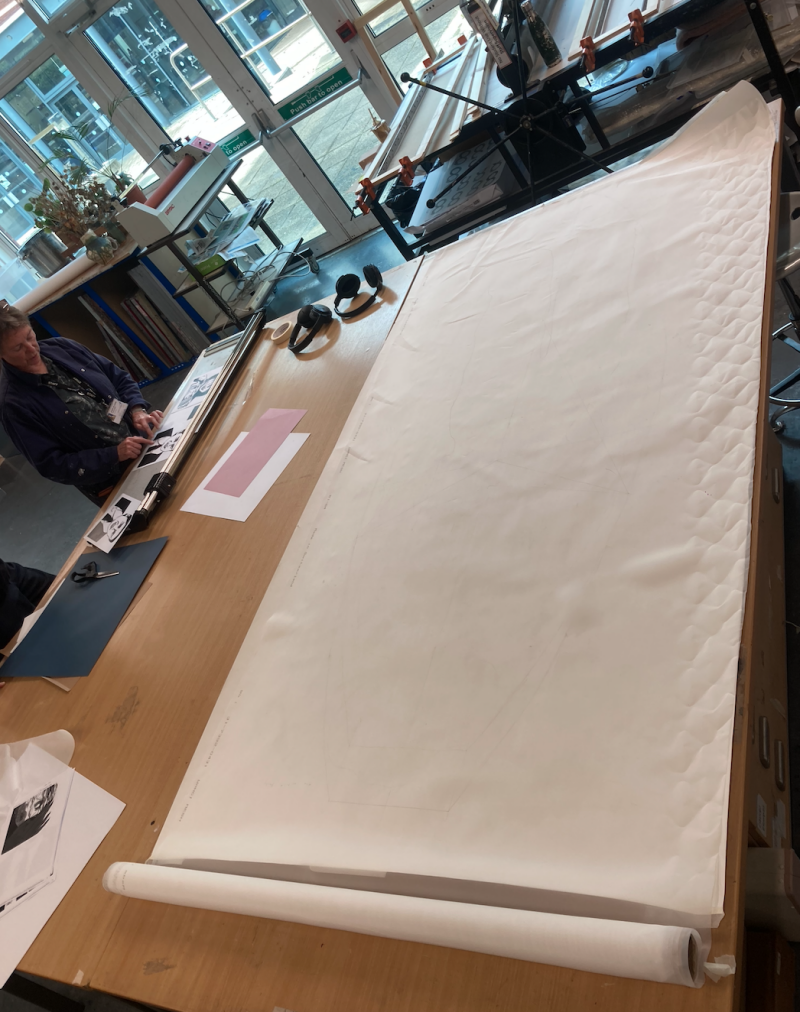
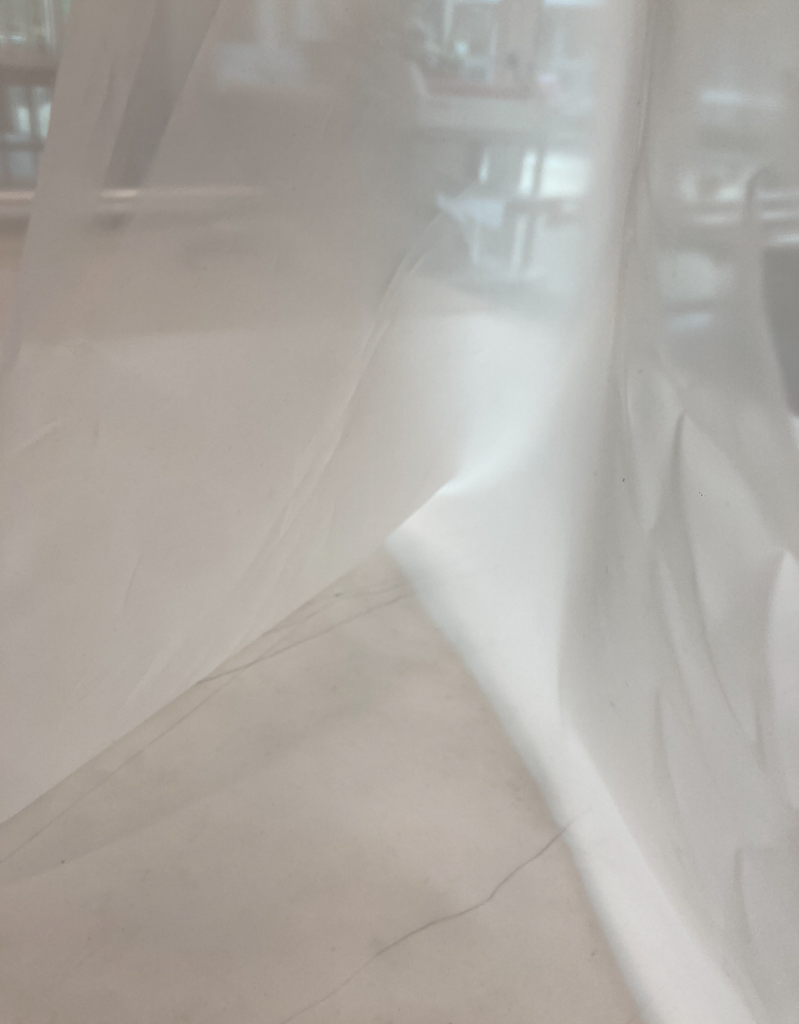
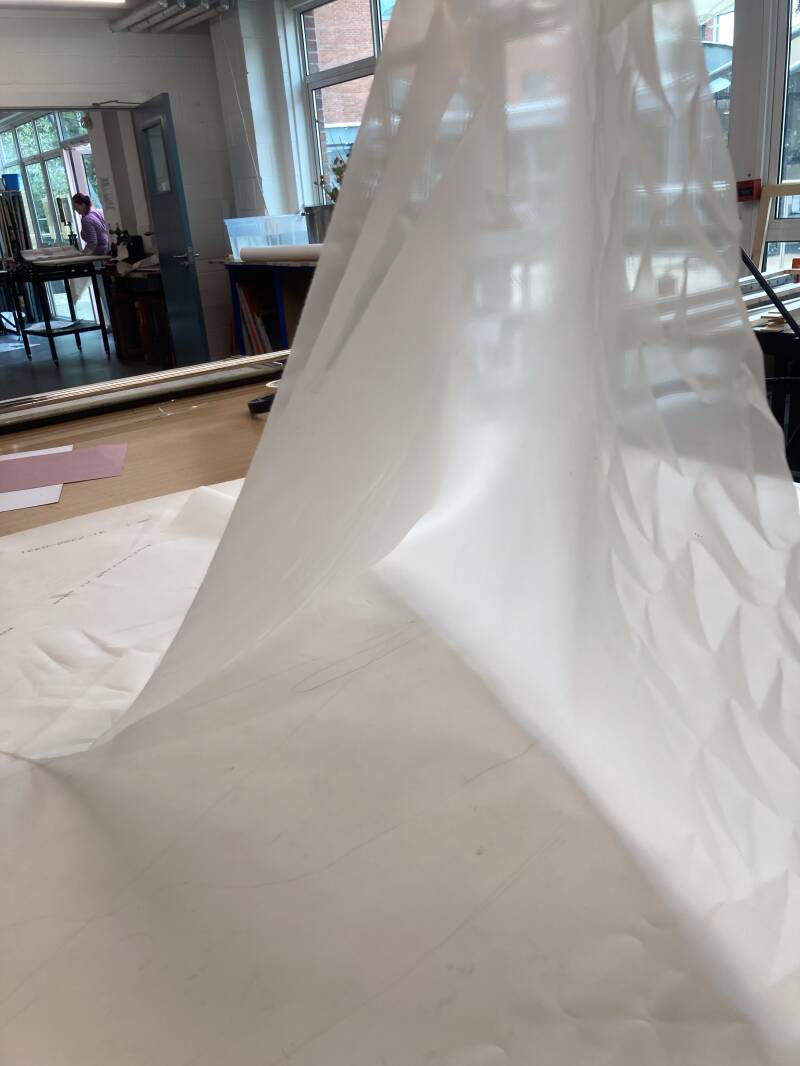
My plan is to use the mesh as a key element in my sculpture.
I want to give it provenance in my work.
I like the fragility of the silk mesh, how its edges fray, and how you can see through it.
It is a perfect opposite to the solid plaster cast.
It flows underneath with a soft opacity.
It is transparent as opposed to solid.
I can see that my final piece is definitely going to come in two parts.
SILK MESH AND TRAPPED WATER AND INK
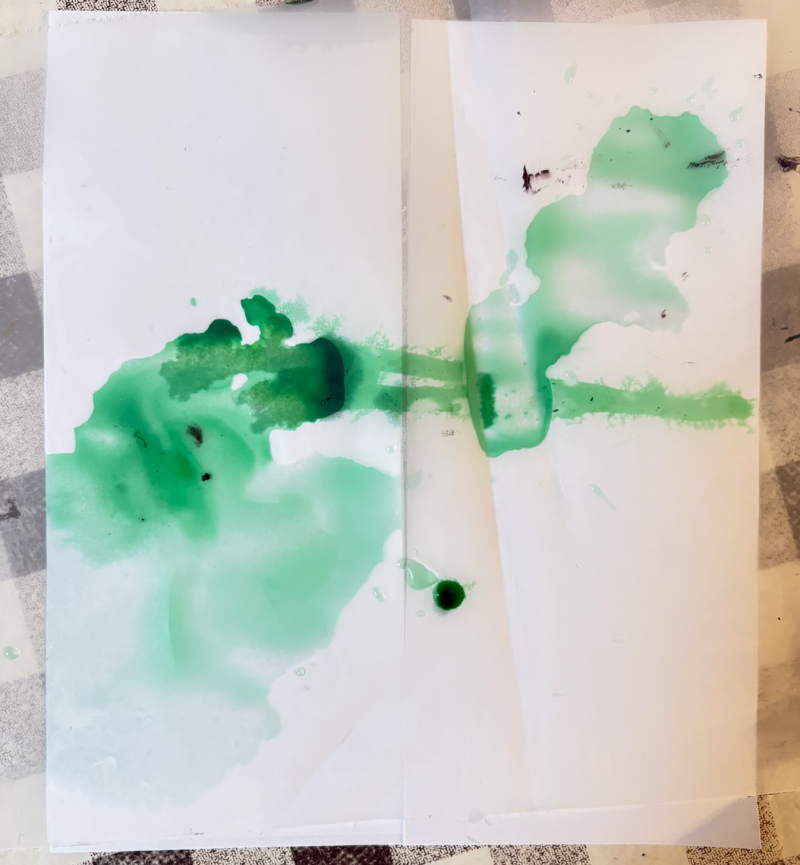
I enjoy touching the mesh and feeling its texture and I begin to understand how things become trapped and opaque beneath it. I like the way inks bleeds through it and how it mutes all the colours around it.
DISCUSSION AROUND MY MATERIAL CHOICES
I have been searching for a material to use as my object's base; the bed of water; the fluid element that will contrast the geometry of the plaster object. There is now a cross road in the materialisation of my work. The plaster object is the known quantity; I can experience its dimensions and its qualities. This is why choosing the second material is very difficult. The addition of new materials must work with the plaster object; it must contrast it and it must elevate it. Failure to get it right could detract and obscure the fundamental qualities in my work. I feel that this decision is very important.
I have explored the processes of mono screen printing, setting acrylics with latex and painting into a silk mesh. In each process, I am trying to find the material that is most fluid, and resembles a shifting, translucent surface. I arrive at using a mesh silk screen.
At this stage, there are many permeations; there are many molecular decisions to be made about how my mesh base will materialise itself. Will its edge be frayed? Will I paint it with acrylic? What about ink? Could it become a sandwich of ploughed mud? Will it be raised off the ground, and if so, by how much? Will I flood the internal chamber of my sculpture?
I want to stay true to the materials that I am using. I want my materials to be in their most honest, natural state, showcasing their inherent properties. Painting my sheet of mesh in acrylic paint would not be staying true to materials. The imitation of a sea scape is not what I want to create. I want to create an object that exists in its own right, and with materials and processes that are honest. This way it can change with context, it can remain open-ended, adapting to the viewer's position and concerns.
SPACE LIGHT AND FORM IN GORMLEY'S 'HOST'
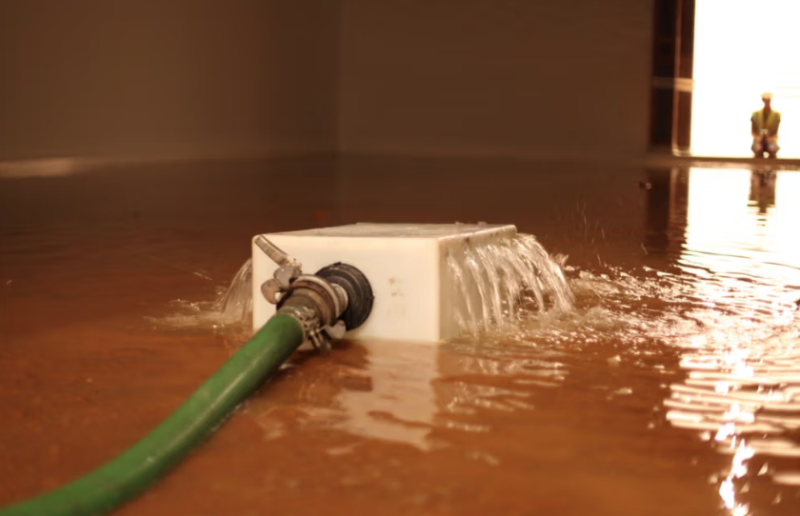
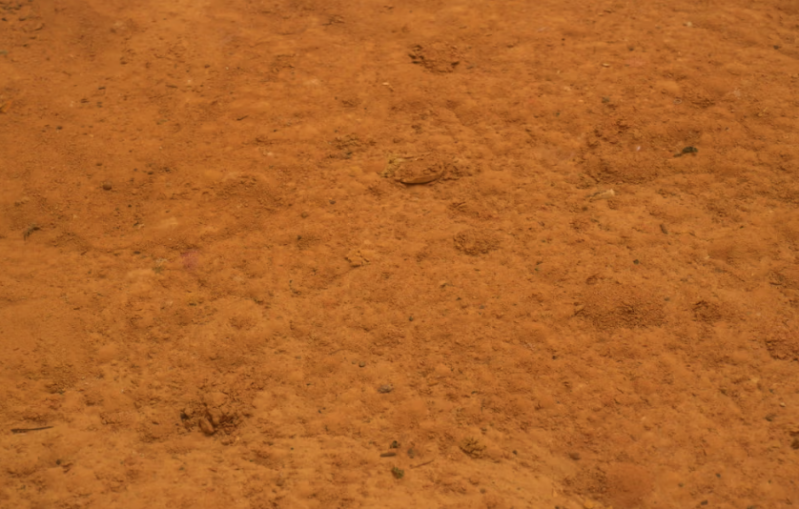
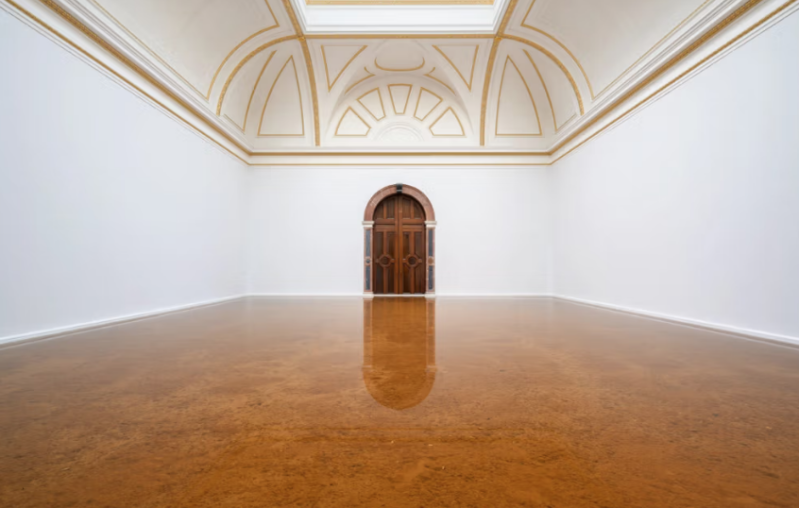
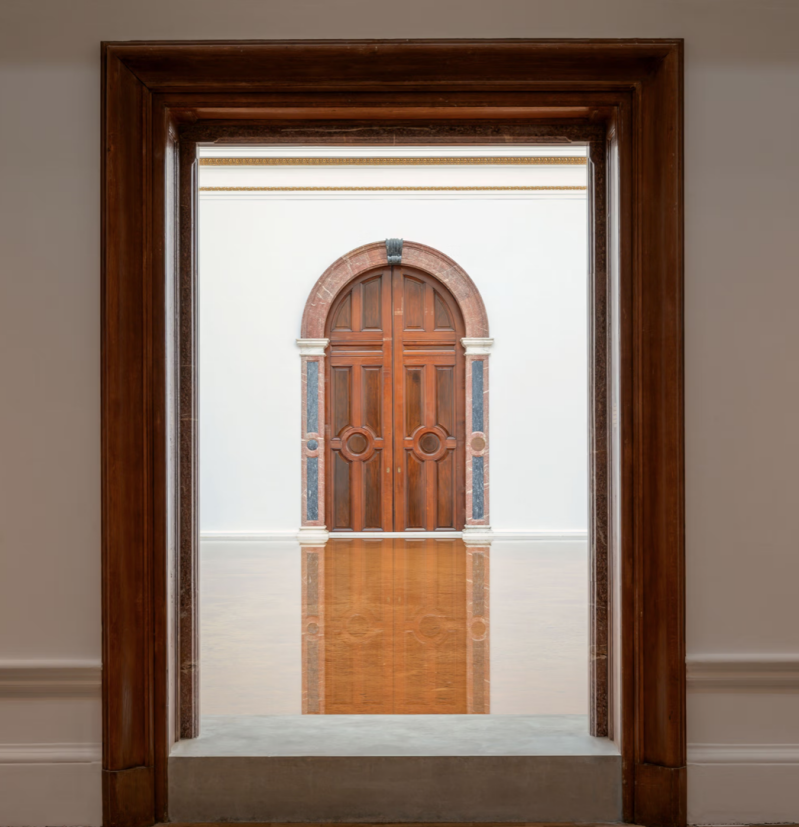
'Host' (2019) unavoidably asserts the presence of the organic and the elemental. It is a constructed environment with architectural references. It is the outside brought inside. Gormley describes it as a clean slate, an evocation of the world waiting to be acted upon. It enacts a still, silent assault on the senses as earth, air and water exchange their elements, exuding a rich organic smell; its brown-red surface reflects the shifting conditions of light as it passes through time.
I became interested in 'Host' by Gormley because of how the sea water occupies this space. It is like a horizon. It could be read as a canvas, laid down, a painting in two dimensions. A three-dimensional sculptural form. It is certainly an alien addition to the gallery.
In my own work, I am thinking about how my sculpture will occupy the space. I know that it needs to be laid down on something that resembles fluid, a seemingly two dimensional surface. I am interested in the duality between sculpture and image making, or making a painting that is also sculptural, just like Gormley has done with 'Host'. It is a concept that bridges the tangible matter and the intangible perception, allowing Gormley to manipulate how the viewer sees space, light, and form. Ultimately, this is what I seek to achieve with my final piece.
FINAL MAQUETTE
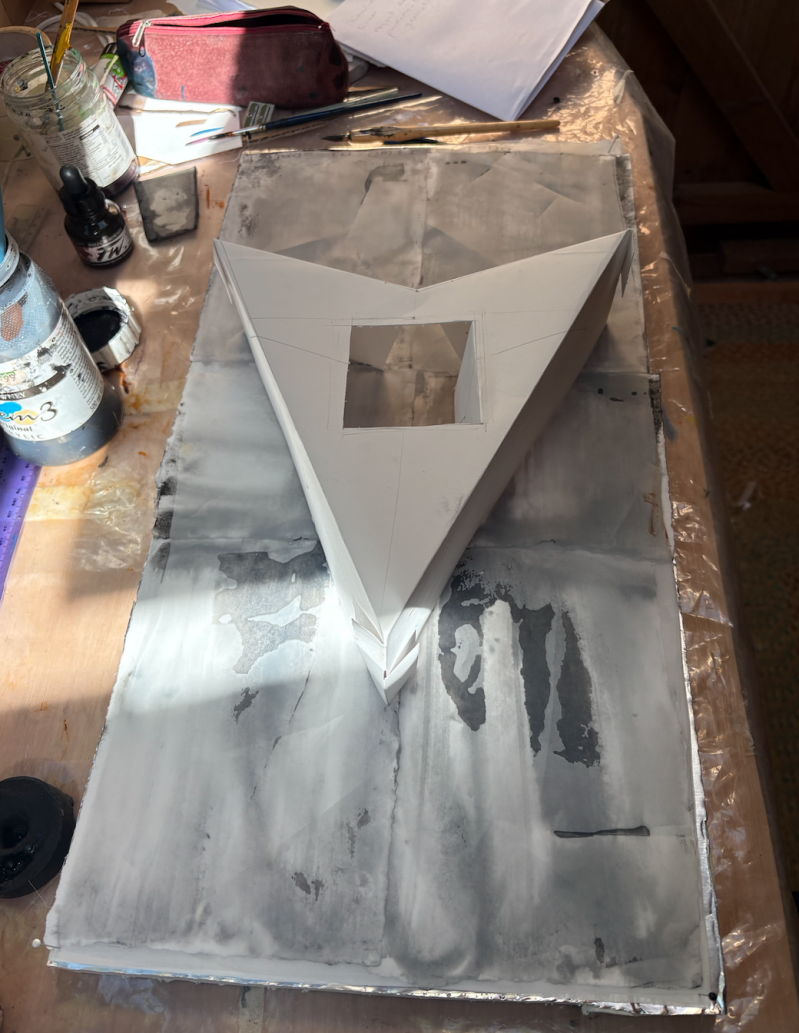
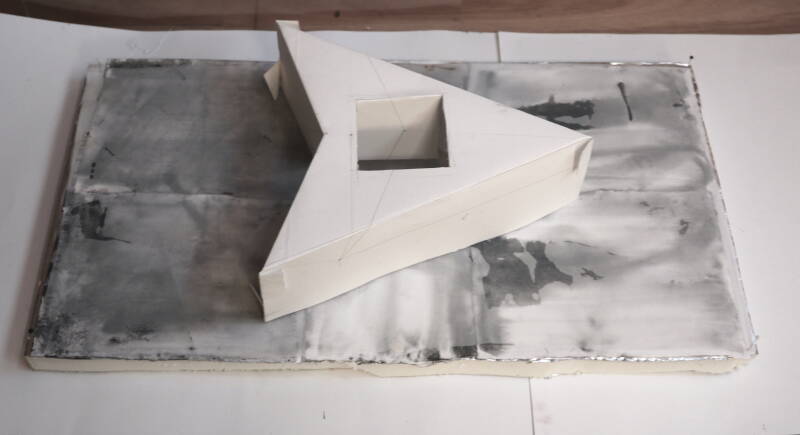
Making the maquette has made me realise that this is exactly what I want.
I want the effect of the mesh to be true to itself; opaque, obscuring and flowing like water.
I want to place it underneath the plaster sculpture, so that a material that is meant for printing takes on a new sculptural identity. In doing so, I reinterpret how this mesh material should be used.
In my maquette, the mesh serves to unify the plaster sculpture with the inky drawings below.
In this maquette, I realise that I have made a fundamental change to the shape of base. I changed it from being shaped like a boat to being shaped as a rectangle. I made this decision because I wanted to simplify and purify its form. I wanted to make it's interpretations more simple. I realised this after I had made the plaster sculpture.
There would have been too many directional lines, so making it a rectangle was a resolution to that problem.
EXPERIMENTS WITH INK
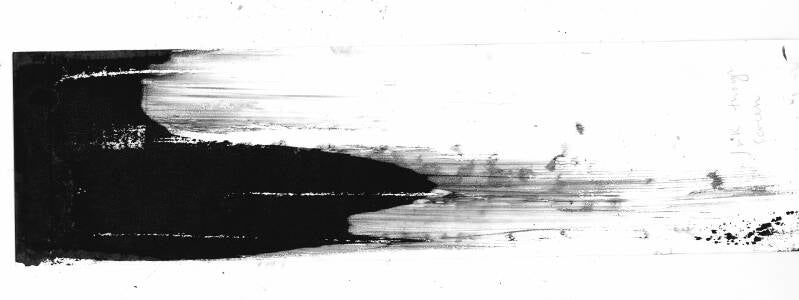
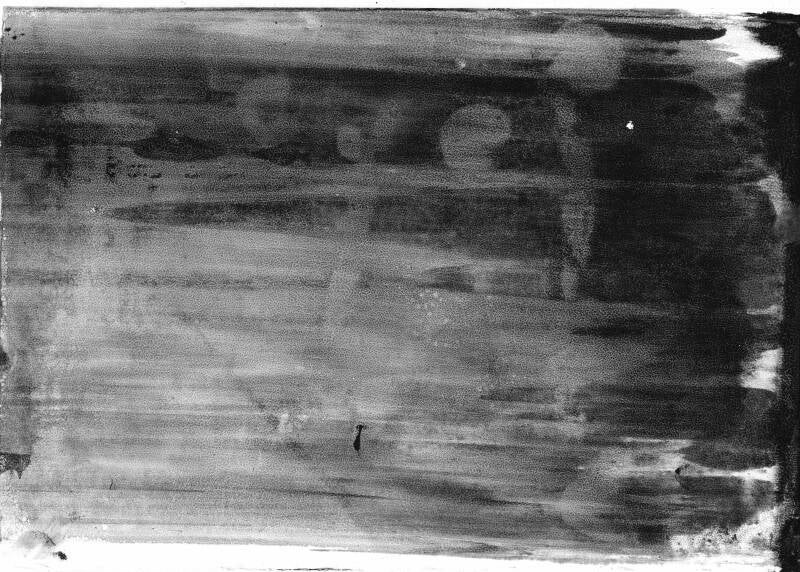
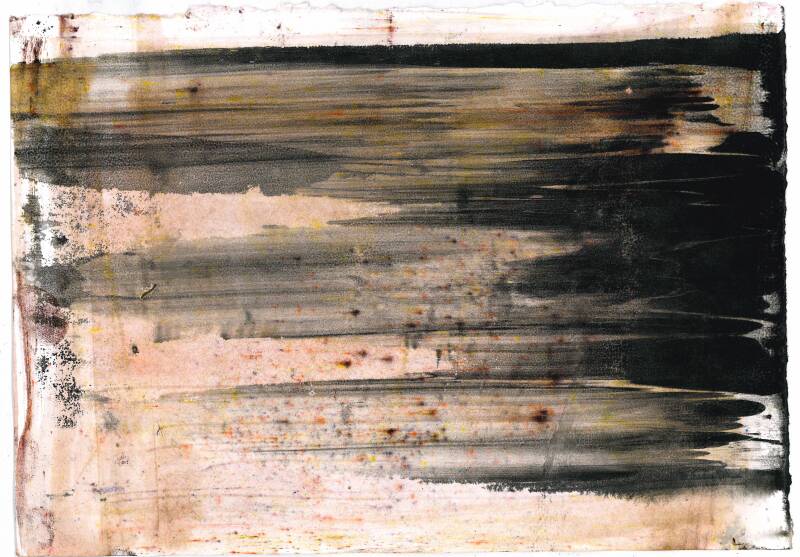
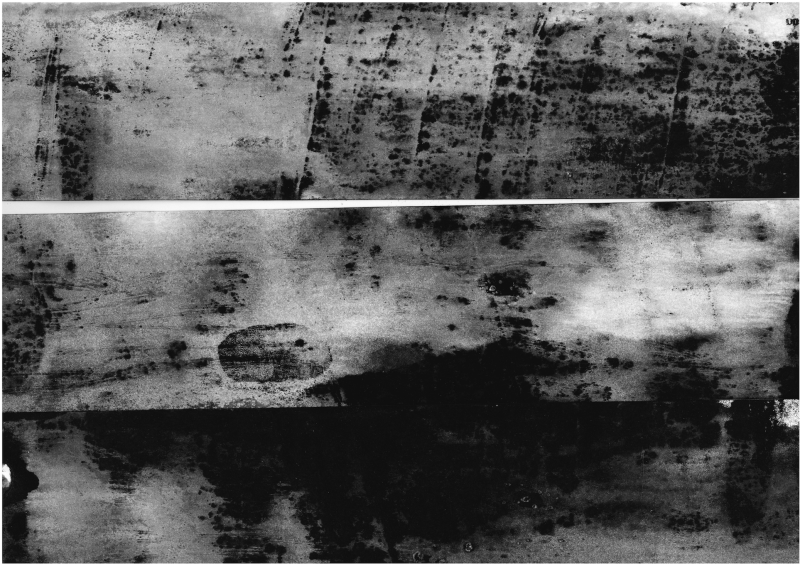
These are the experiments of the how the ink and saturated wet paper interact with one another. They are simply the result of me pulling, pushing and dragging ink through the silk mesh screen with a squeegee. I become very interested in how mysterious and fluid these paintings are. They are definitely not figurative, they feel very honest to the process that made them. Squeezed and pushed through liquid.
That is exactly what I am trying to achieve for the base of my plaster sculpture.
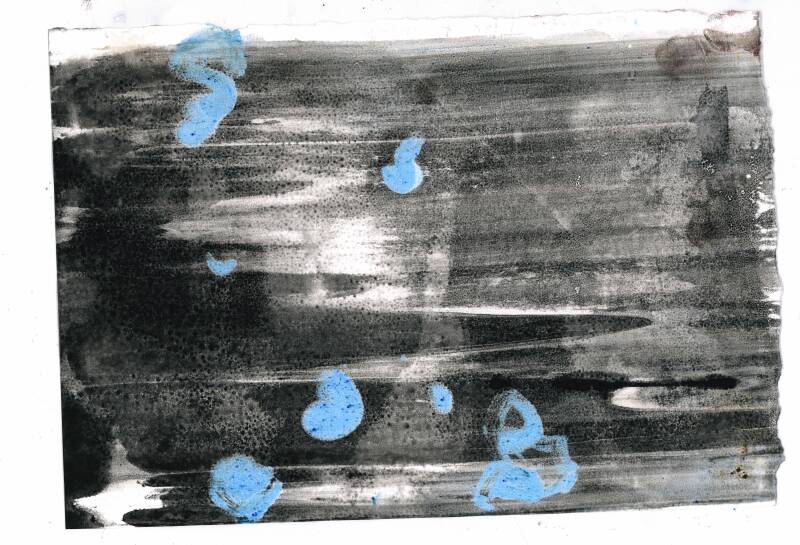
I try using colour here, sepia and blue, but they are distracting from the purity of the surface and its image.
The blue spots resembled bacteria, the other sepia print looked like a sunset. I wanted to stay as true to the clarity of monochrome as possible.
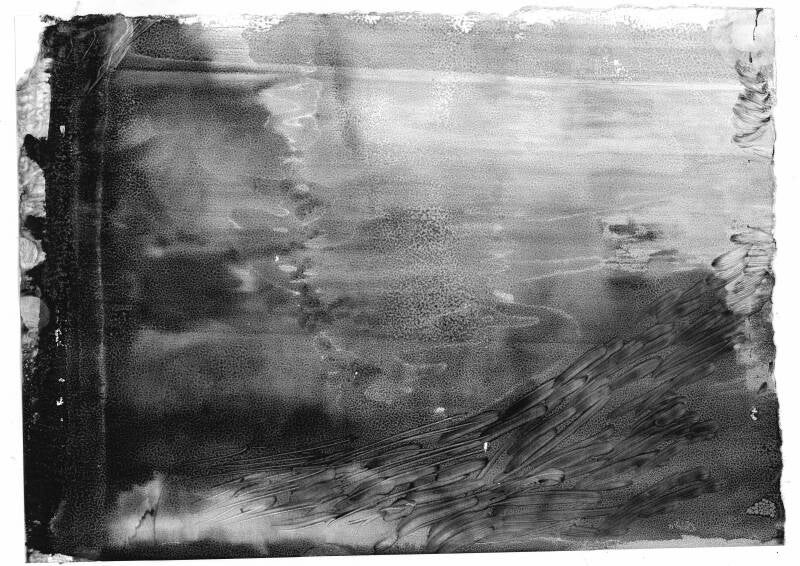
I am very interested in the mark making that I have made with my fingers. It is always interesting to see a human presence in my work.
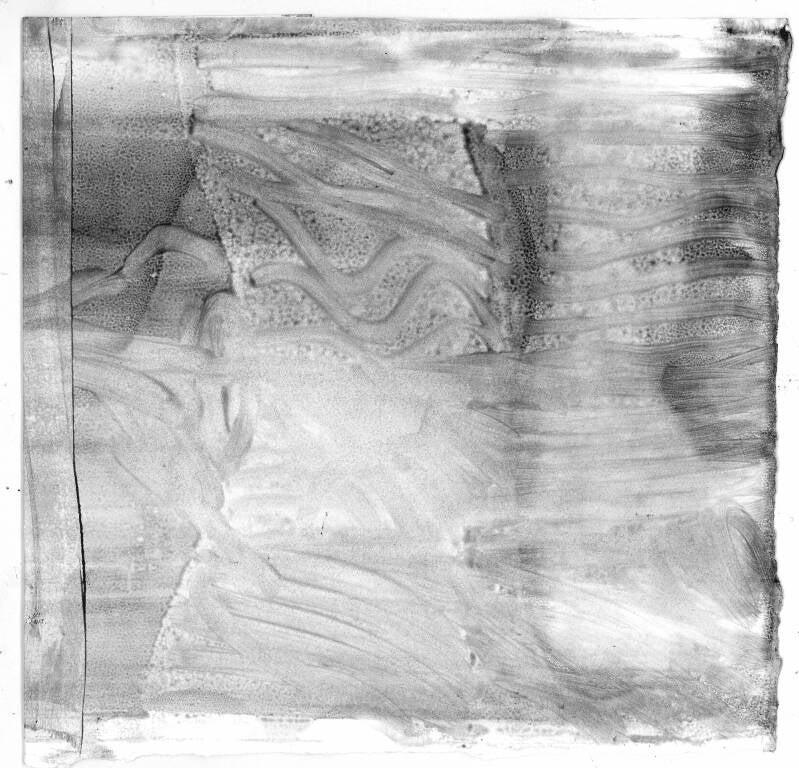
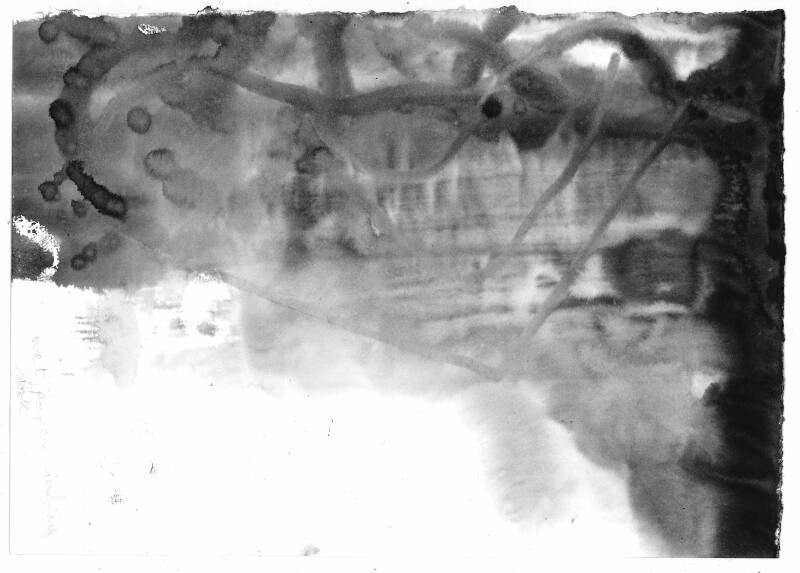
In my drawings, I am trying to work things out. Often my drawings are tight, geometric and precise. But there is a moment when I feel like everything is falling apart, a sense of drifting into an unknown. I start drawing using much more fluid expressions; on paper that is saturated with water, with my fingers, pulling and pushing pigment through mesh screens — a process that feels much more akin to painting. It is like seeing a world emerge, out of flux, out of fluid, and out of chance. These oracular, mysterious drifting clouds feel frightening and disrupted, as if a new world is arising from these liquid sheets. Depth is explored, as is the notion of going places in drawing which are not possible in life or sculpture: cellular life, outer space or deep water.
These prints are in opposition to my plaster sculpture.
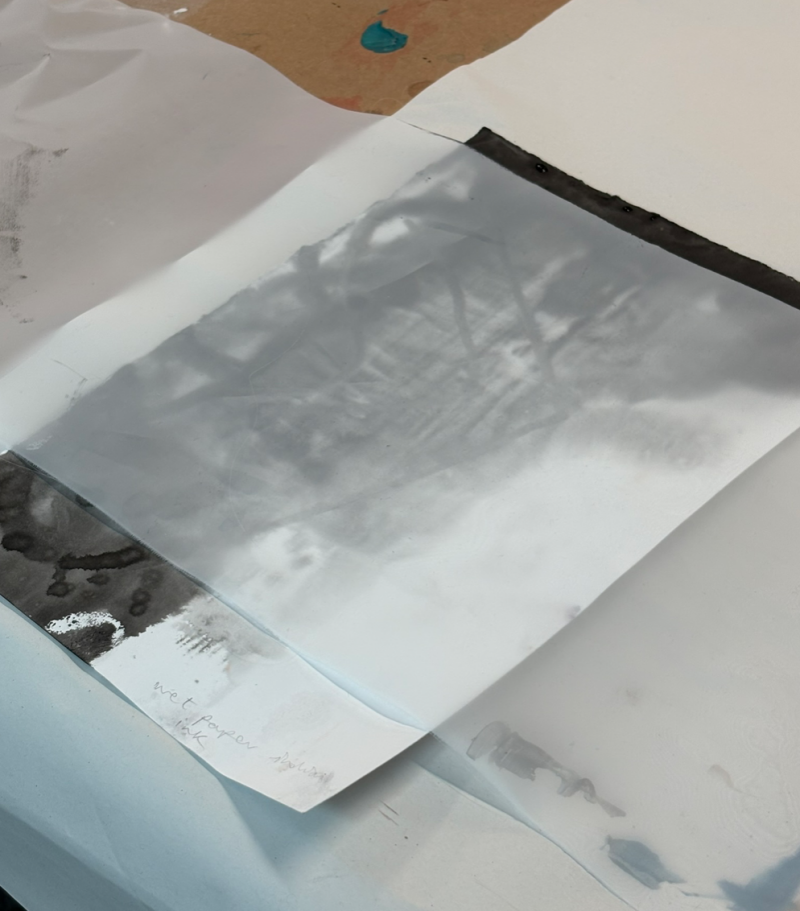
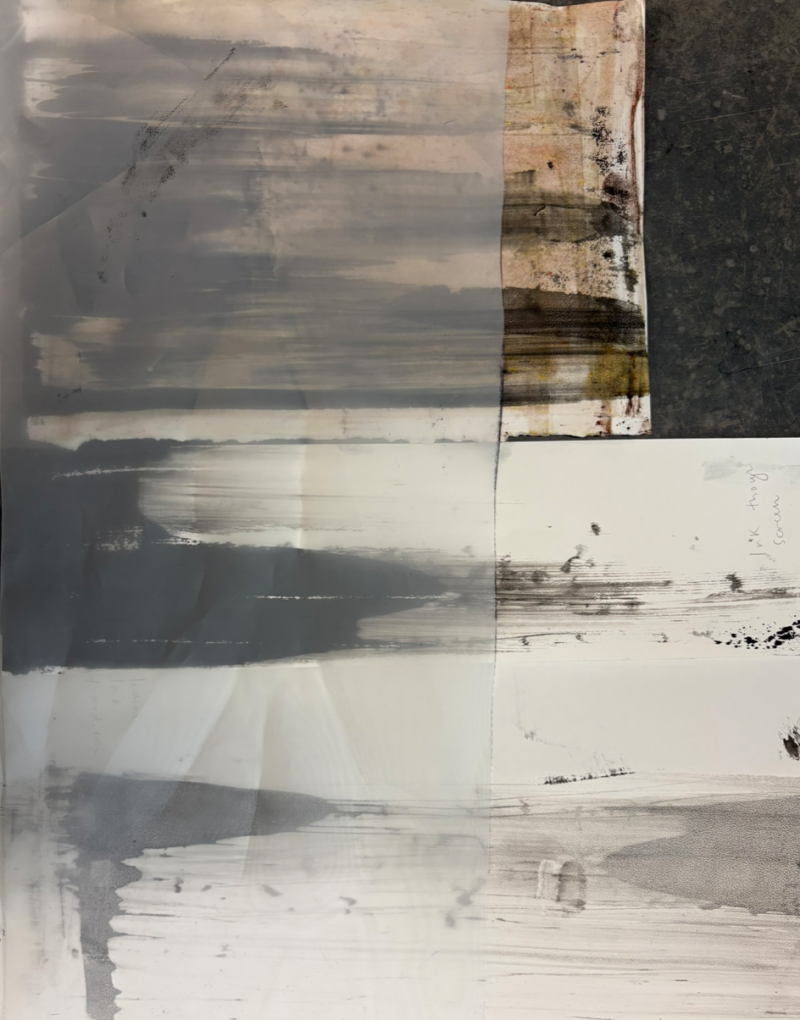
I experiment with unifying the silk screen mesh and my prints below.
I observe how the addition of the mesh takes out a lot of the darkness and colour from the prints.
PROCESS OF MAKING MY MONO PRINTS
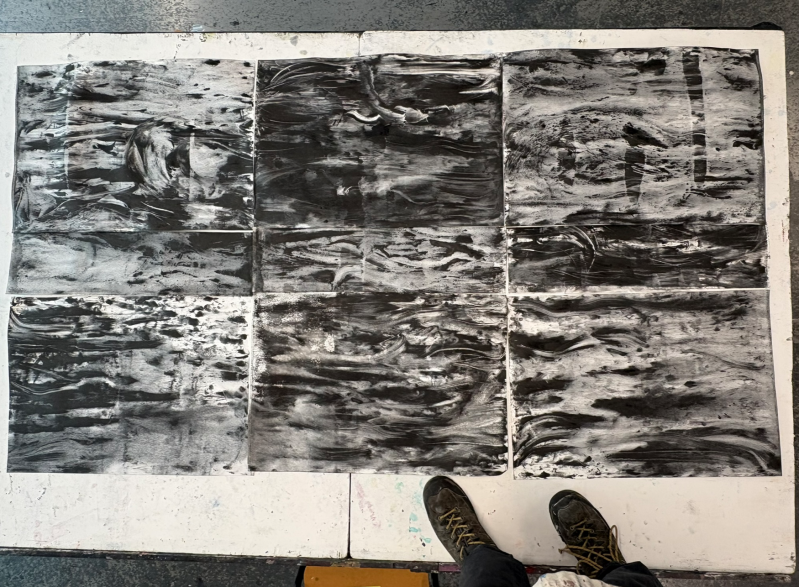
I fill a tray full of water and submerge eight sheets of 25 gsm cotton paper. The strength of the paper is very important to me as they will hold a very substantial amount of ink and water.
I then get a perspex plate and pour relief ink onto it. I use a squeegee to drag and push the ink down the plate from left to right. The ink was very resistant to being pulled, therefore I use my hands and fingers to spread the ink. I want to emulate the forms of waves, of fluids and of water.
I place my saturated piece of paper onto the inked up plate and place it down on the printing press. It was important to pad the printing press with lots of newsprint paper in order to avoid the pigment from seeping out of the plate and damaging the felt.
Unfortunately, I do not have any photos of the printing press. It was a messy process, my hands were covered in ink the entire time.
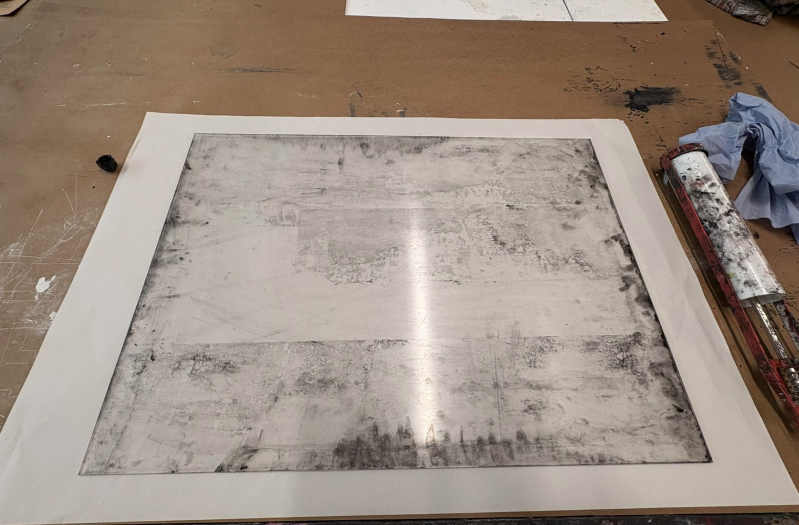
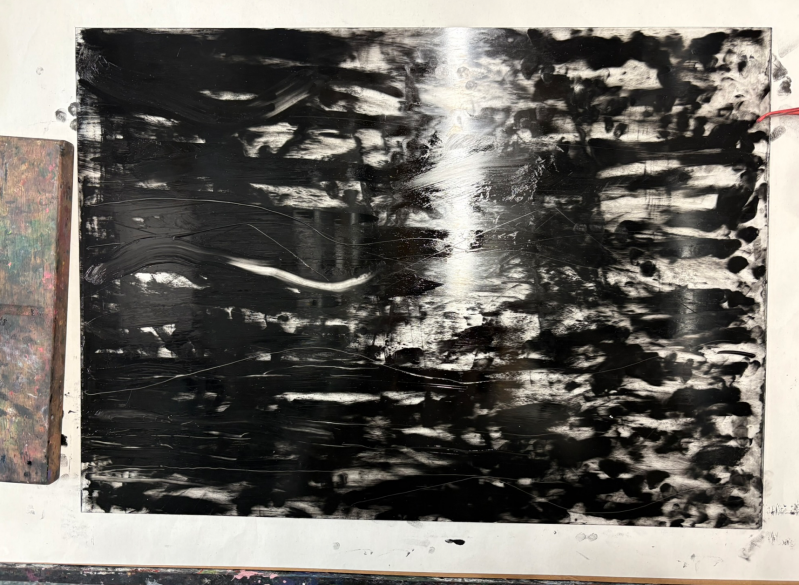
I am very pleased with the result of this experiment. I feel the rhythm of the water. There is a sense of surface, depth and movement. Each print is different, each one is left to chance, there is a random quality to these prints. There is no precision to this process due to overwhelming presence of water that has been held within the fibres of the paper. I love the scale of this print when all of the sheets are put together.
I could get lost looking at all the textures. Looking at this print feels like looking at a waterfall. It feels like I am looking at cellular life or at a cosmic landscape. I want my viewer to see water, cellular life and deep space. I want them to feel like this could be an image of both something massive and also something microscopic.
I now know that these prints will form the base of my sculpture.
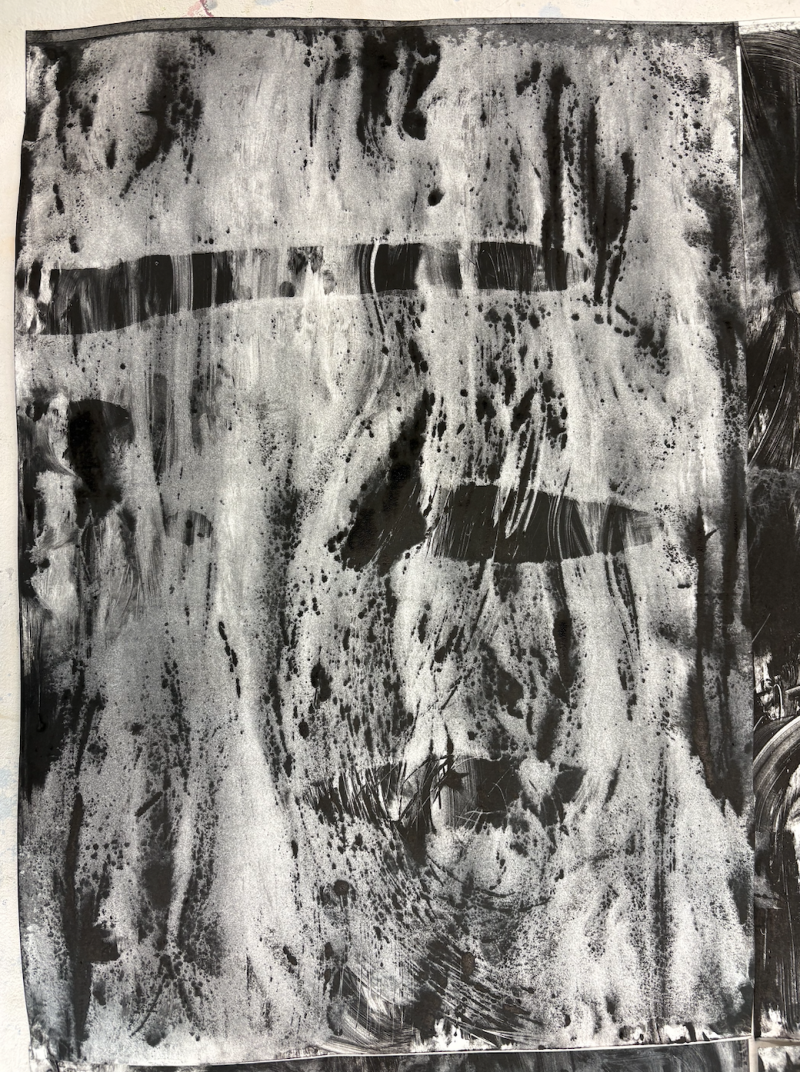
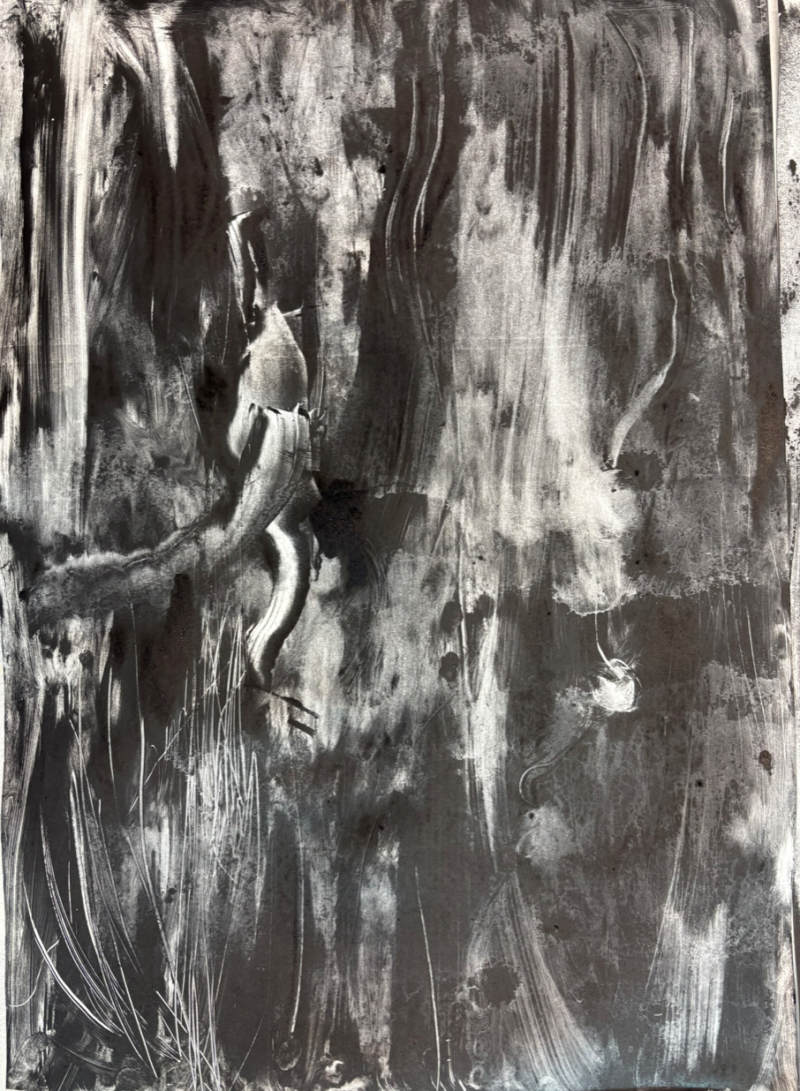
Here are close up photos of my two favourite prints ...
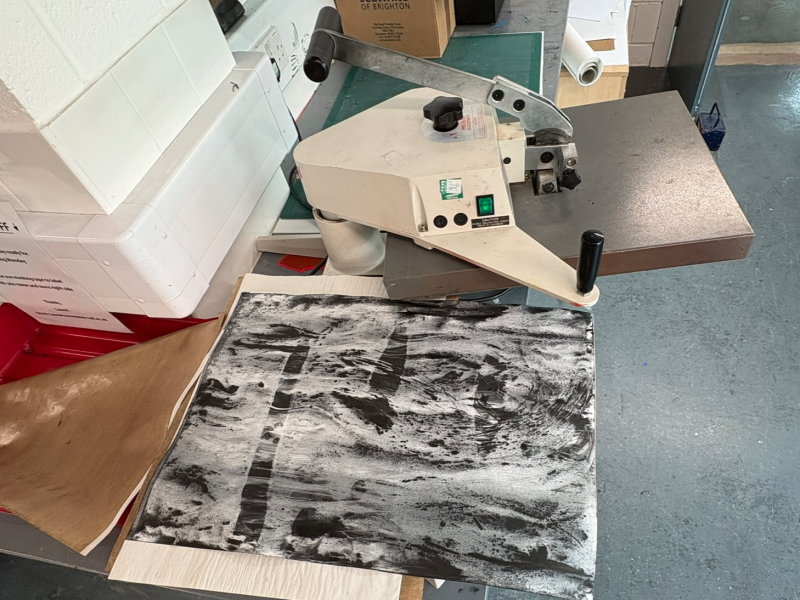
There are lots of finishing touches to make sure that my sculpture comes together with aesthetic unity.
I make sure that my prints are flat by putting them through the heat press. This ensures that their edges don't bend upwards.
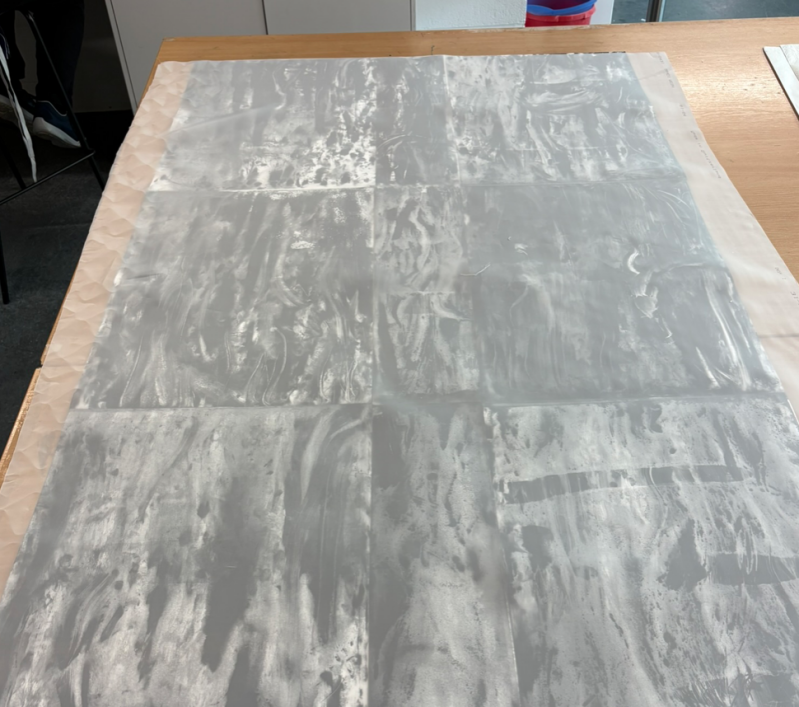
I cut the mesh to the exact size of my drawing, 102 x 165 cm. This has to be a very precise and careful cutting process. I want them to exactly align.
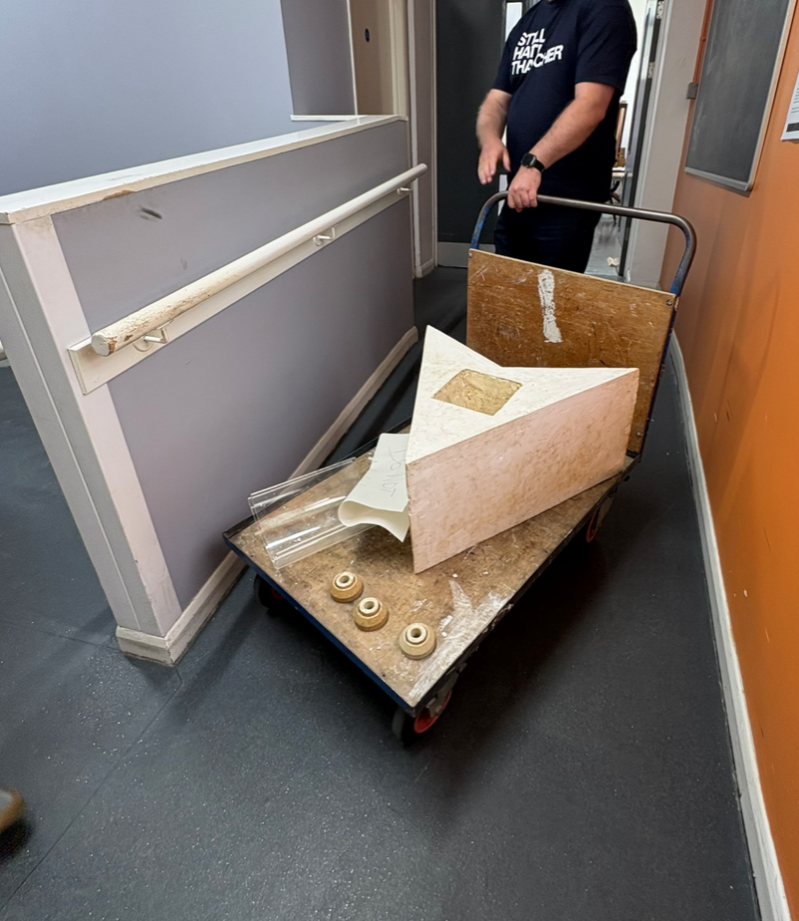
The heavy plaster is being transported to the gallery to be assembled on a trolly.
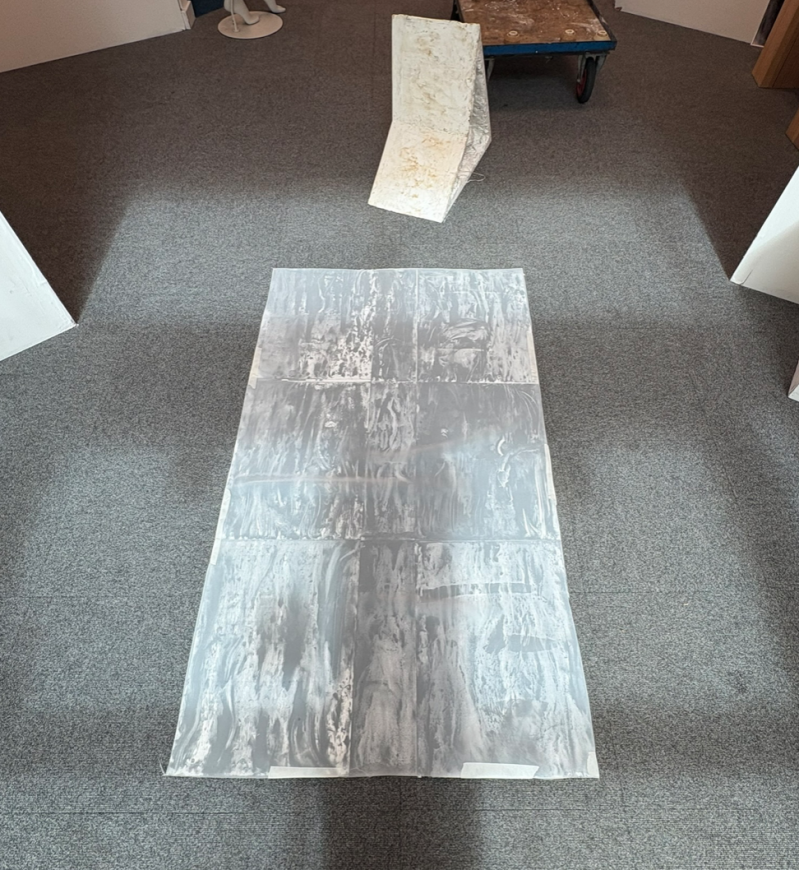
First I lay down the inky prints onto the floor and carefully place the mesh sheet above it, making sure that they line up. It feels great to see my sculpture being assembled.
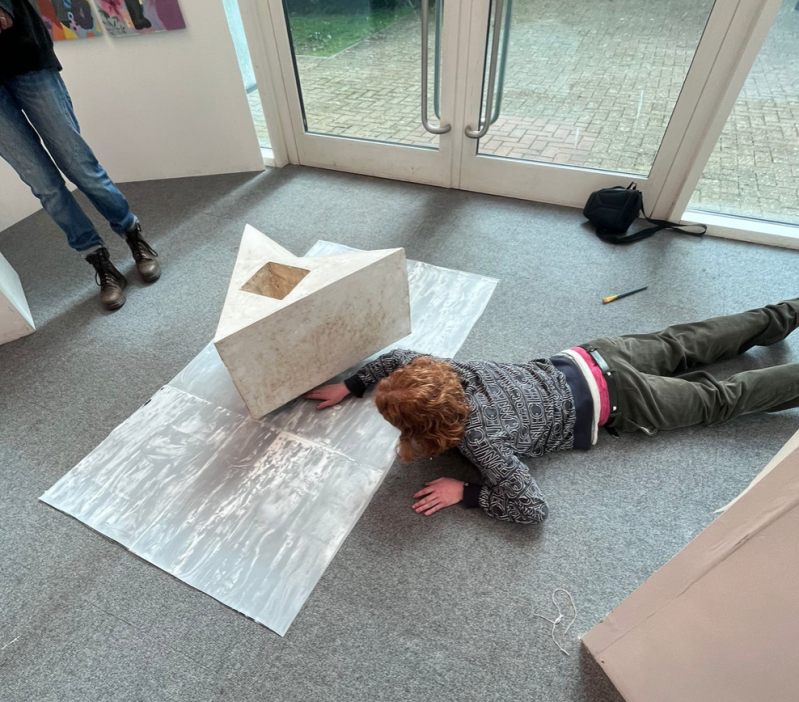
Here is a photo of me assembling the work.
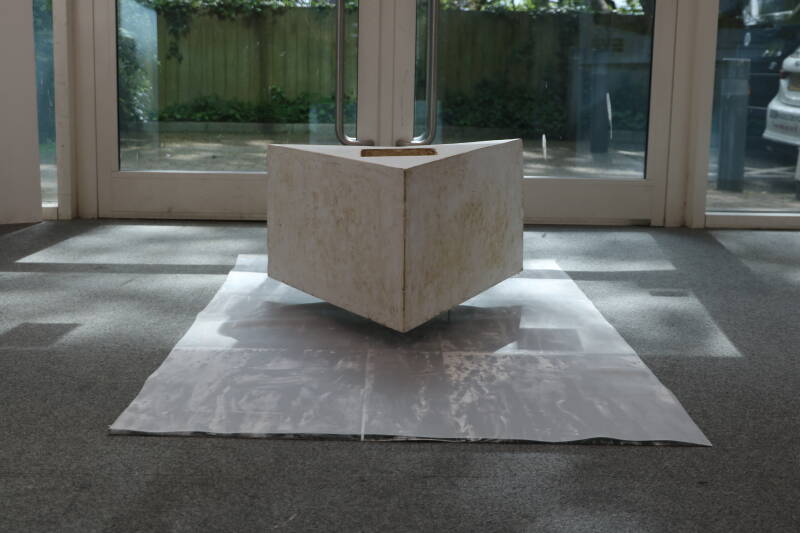
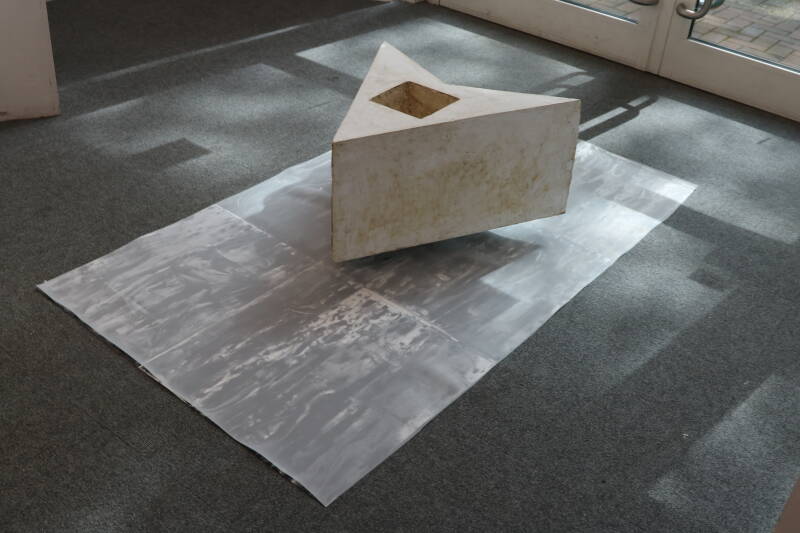
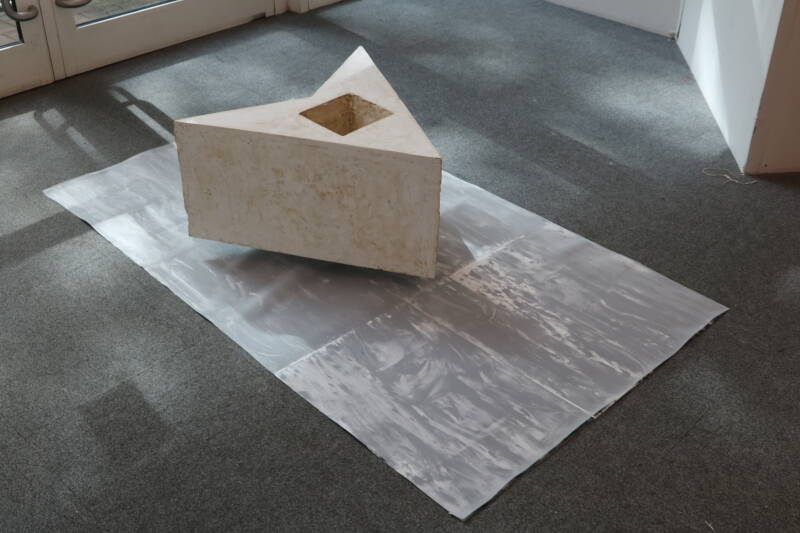
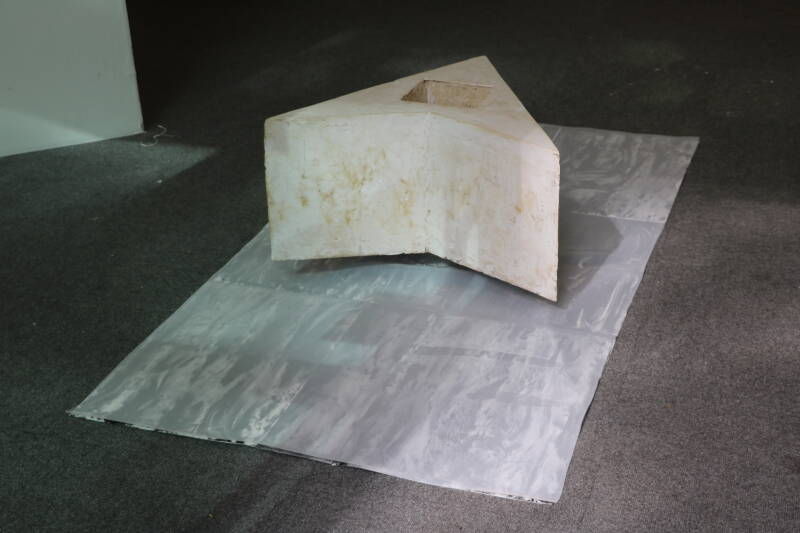
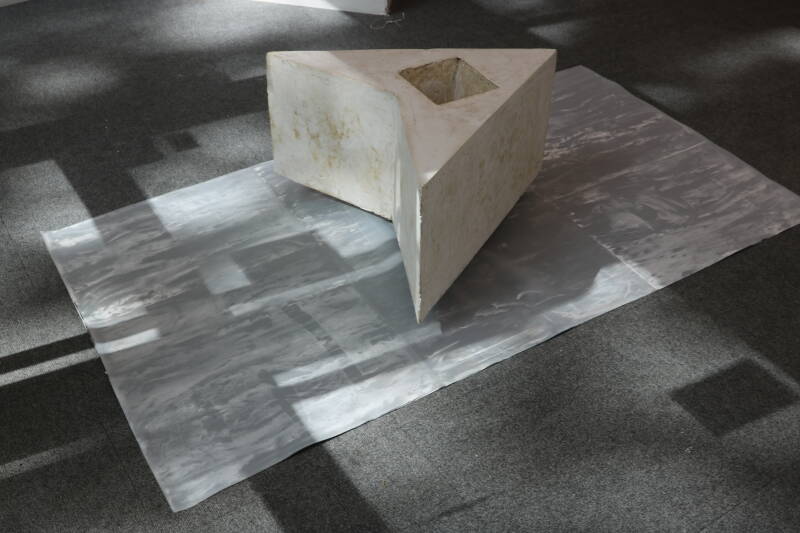
Before installing my work, I decide that I needed to keep the fragility of the mesh in tact. It had to remain untouched by the plaster sculpture; the weight of the plaster would have impressed itself onto the mesh, disrupting its watery flow. The plaster sculpture had to float, it is necessary to physically separate the two parts of my sculpture. I do this by placing two perspex tubes inside of the sculpture. Now it appears to be floating, or even gliding across fluids. It was a very successful addition during installation and it fulfilled my original desire for this work to possess 'Two Parts'.
FINAL WORK INSTALLED
Final statement
My work is about opposites, it comes in two parts. It is about things that can be both terrifying and beautiful at the same time. It is about fluidity and solidity. It is important for me to produce these two ideas and hold them together in tension. The plaster sculpture is precise and geometric, it emanates stillness. It is in direct contrast with the oscillating surface below which has a soft opacity and the illusion of depth.
Since the beginning of this project the world has changed. We can see the efforts of how competing powers are trying to control narrow straits of water across the world. Water is integral to human and animal life. The most abundant molecule on the planet is water. Our future will be determined by our access to water. Our sea levels will rise as the ice sheets continue to melt. Even though water is the basis of all life, there is something incredibly destructive about water; it has the power to flood, submerge and drown us. Water is sublime, something exceptionally beautiful that will also be feared.
I know that this piece of my work will be handed over to the interpretation of the viewer. The journey that I have been on is now stored in this piece of work. I don't know how much of that journey will be communicated to the viewer. I want my viewer to look at this sculpture and peer down into its void; they will wonder what is inside. They will try to make sense of the inky fluid and oscillating surface that shimmers under the silk mesh. If I was the audience, I would want to touch my work, to try find out what it is was made from.
There is an alluring nature about what I have made. It contains such a rich story of contrasts.