FMP 1 — GETTING STARTED
Since the beginning of the course, I have been looking forward to beginning the FMP and working more independently. I know that I create my best work when I set the parameters of my projects and have the freedom to explore a diverse set of images, materials and theories.
My practice-led research is often started through generative drawing and painting, material exploration and a process of collecting academic references. For this project, I seek to maintain a diaristic element in my work, cross-pollinating ideas between the personal, political and material. All of my work is in a movement towards understanding — uniting my visual and academic research into a cohesive language. Below I have made a diagram to describe this process.
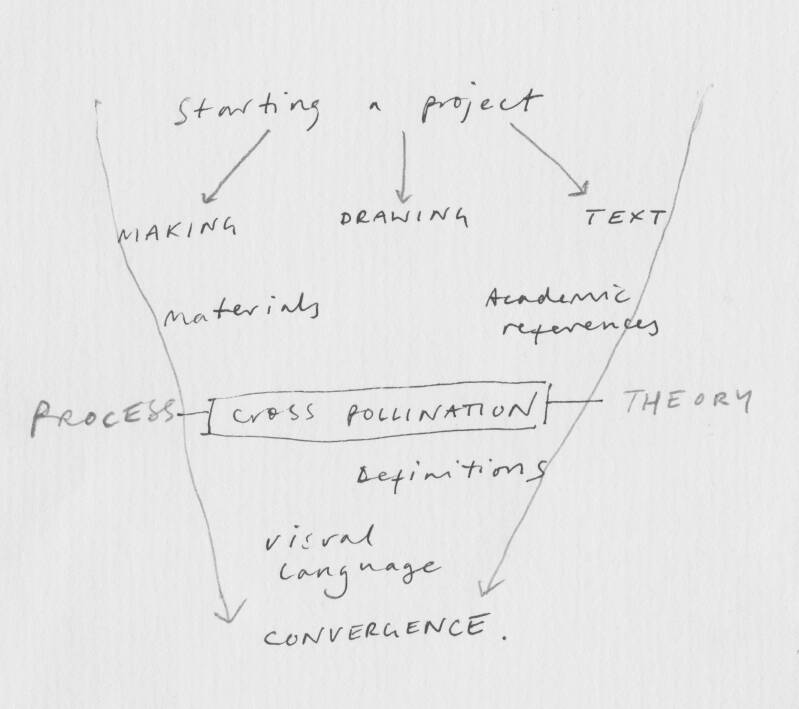
For these reasons, I have chosen a topic that is inclusive of many ideas: "TWO PARTS"
The concept of 'two parts' allows me to explore the idea of contrast and opposites as a fundamental element in our human experience. Creation and destruction, contained and dispersed, male and female, order and chaos — I've always liked binary, dualistic relationships as they form a central tenet in my work's aesthetic structure.
'Two parts' also allows me to consider ambiguity, edges, boundaries, ideas of merging two parts together. Asking questions about what is complex to categorise or what can be found in-between two states. These flux states are equally important to my work, especially when considering environmental and sculptural practices.
This title also reflects my dual nature of working: between a visceral, intuitive response to materials and a considered synthesis of ideas and architectures (process and theory). I am very happy with my chosen theme; I think that there are many relevant introspective roots to consider.
PRESENTATION
In my presentation, I shared some of my recent drawings and discussed their importance in generating ideas for my work. I explained how my drawings often feature a central rigid form that anchors an amorphic swirl of mark making. I shared photos of the beginning of a sculptural process made from paper — in order to ask questions about the relationship between the ephemerality of paper and the permanence of rocks.
I introduce some dualities and opposites. I share Ai Wei Wei's Turbine Hall exhibition because it is a piece of artwork that expertly combines his personal and political experiences and then embeds them into a material. I also share photos of work by Joseph Beuys, a German artist who utilises opposites to find balance, and to express transformation between two states as an allegory for a changing society.
‘All beauty is making one of opposites, and making one of opposites is what we are going after in ourselves’ – Eli Eigel
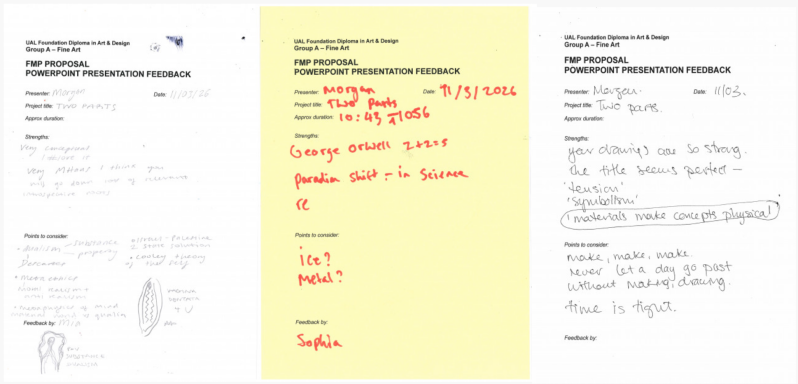
I enjoyed sharing my ideas with the class. The experience of presenting my ideas gave me additional confidence in my project as it allowed me to clearly communicate and better understand an expansive or potentially nebulous topic. It helped me put my ideas into words. A limitation of my presentation is that it could have been overly conceptual — it was not yet rooted in a chosen material or image to help communicate my ideas. If I really want to reach people with my ideas then I must materialise my ideas. I think that the presentation was just a small way to communicate my idea to people in a professional way.
My peers helped me consider techniques for making — I was particularly intrigued by a suggestion to use ice in an experimental process. It was also suggested that I research philosophy such as Descartes 'dualism' and the division between mind and matter.
I found listening to my peer's presentations very valuable and insightful. I felt proud to be among a class of artists who are exploring ideas with such weight, consequence and intelligence. It was important for us to share and receive critique on our ideas.
ARTIST: AI WEI WEI
Whilst devising my FMP, I was spending time researching Ai Wei Wei and his 2010 Turbine Hall exhibition 'Sunflower Seeds'. Sunflower seeds is a vast sculpture, composed of 100 million hand-crafted porcelain seeds. Sunflower seeds hold political, personal and material resonance for Ai. Communist propaganda depicted Mao Zedong as the sun and China's citizens as sunflowers, turning to Mao. Ai remembers periods of his life, during famine, where all his family had to eat were sunflower seeds. A single seed is instantly lost among the millions, symbolising the conformity and censorship of the Chinese Communist Party.
Many incongruities spring to mind when I consider Ai's sunflower seeds — millions of pieces of ceramic, mass produced but handmade, inspired by communist symbolism but sponsored by a capitalist conglomerate at the Tate Modern, produced through pre-modern methods and displayed in a post-industrial space (1). The overlap between opposites is fertile ground for Ai. Ai is continuously exploring oppositions, intervening in them — I think that these misconceptions and impurities are attractive in his art. The space between opposites keeps the audience asking questions.
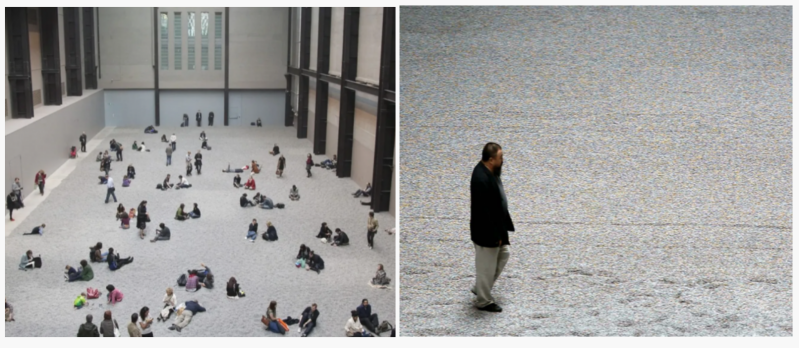
I am interested in the way that Ai used scale in this work. The oscillation between an intimate, unique human made object and the monumentality of a field of 100 million seeds is a magnificent opposite.
STARTING PAINTING
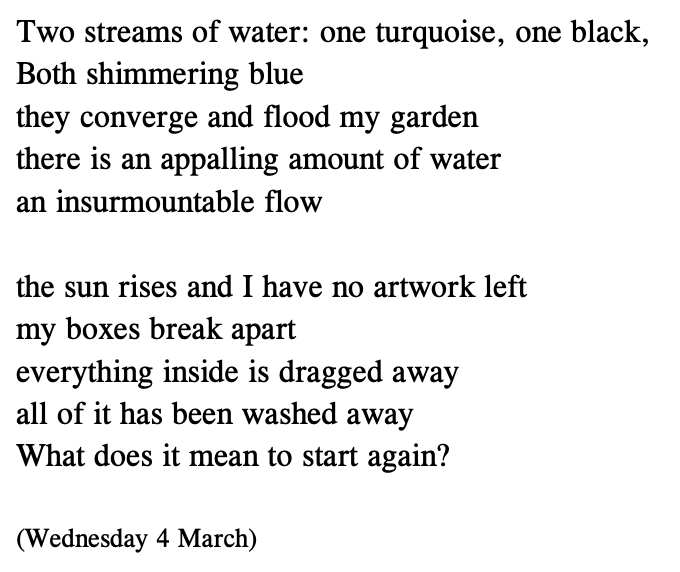
< Passages of writing, demarcate extracts from my thought diary
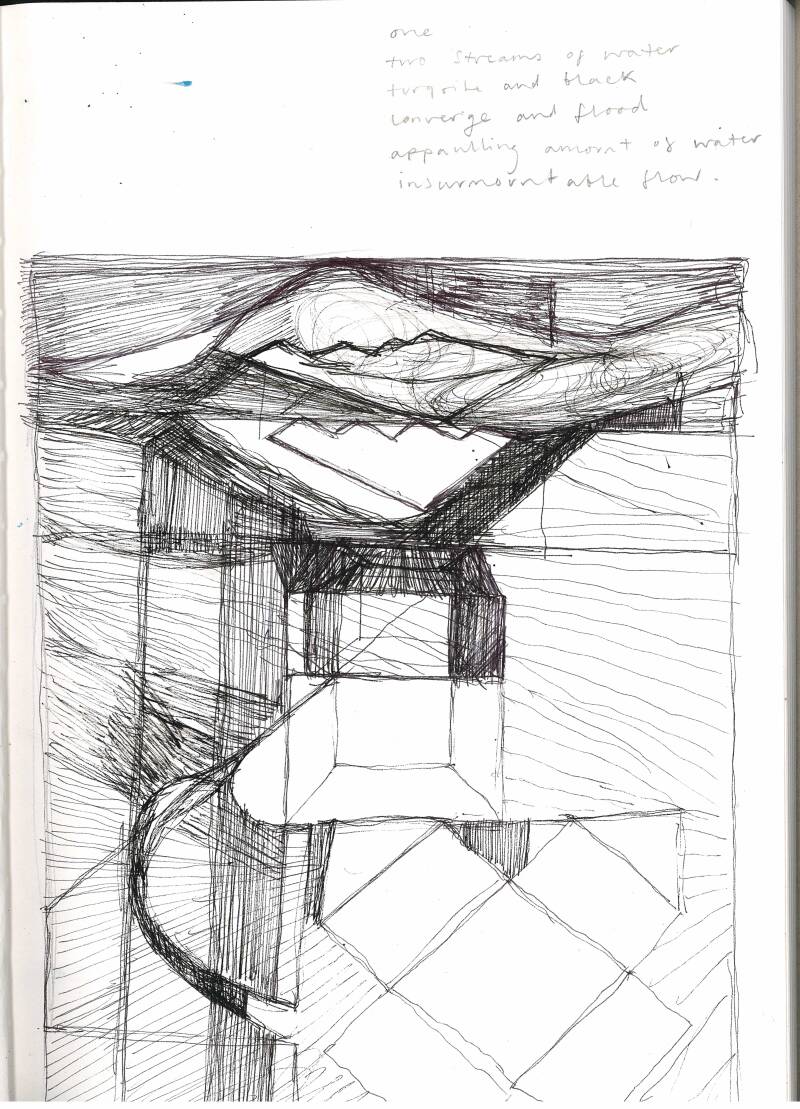
Above I recount my dream. A dream about the disintegration and destruction of my artwork. It is a dream in which a box (holding all of my art and ideas) unfolds, floats away and a vast quantity of water consumes it. As if something is out of control.
I am interested in this dream. It was not an ugly nightmare, I think that blue and black water is beautiful. I draw my dream and I mythologise its imagery into my work.
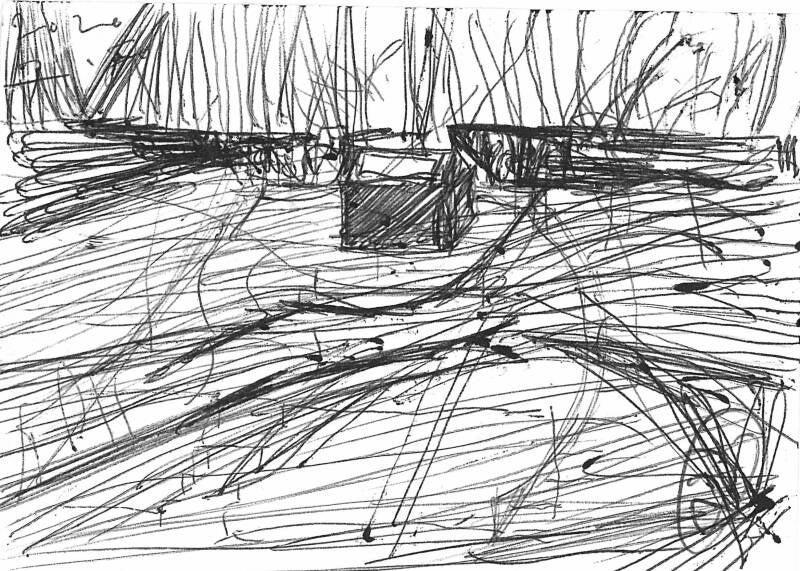
Untitled drawing, 10.2 x 7 cm
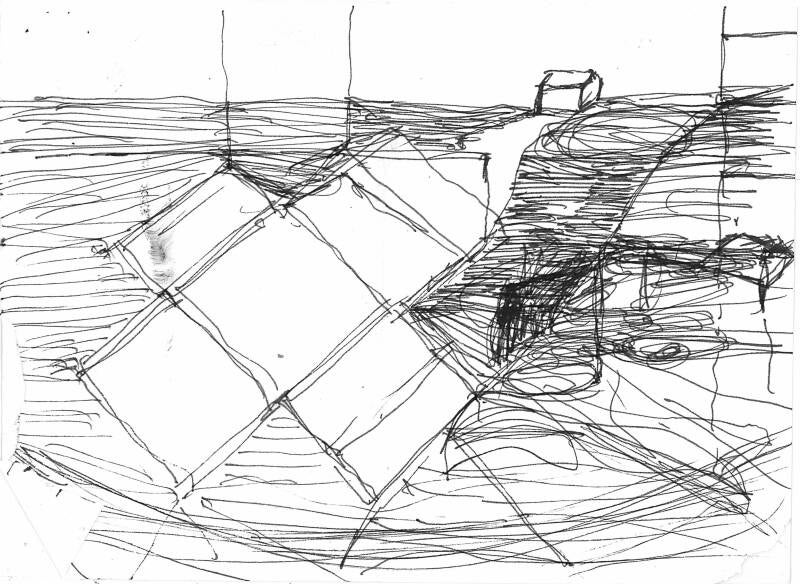
Untitled drawing, 15.5 x 10 cm
My sketches are small, they are immediate, they feel intimate. Through drawing I see what I am thinking, and gain understanding of what I am experiencing (2). I enjoy the energy and flow of visual discovery and the connections that drawing gives me.
I wanted to increase the scale of this drawing — in order to give more physicality to my experience. These horizontal black lines express movement and undulation, like a field of water. Some brushstrokes are fluid and bleeding whilst others are dry and scratched. I am interested in this shift.
I am also interested in a change in scale, from small to big. My drawing below is 100 times the size of an intimate hand held sheet of paper. It is more immersive and suggestive of a spatial vastness.
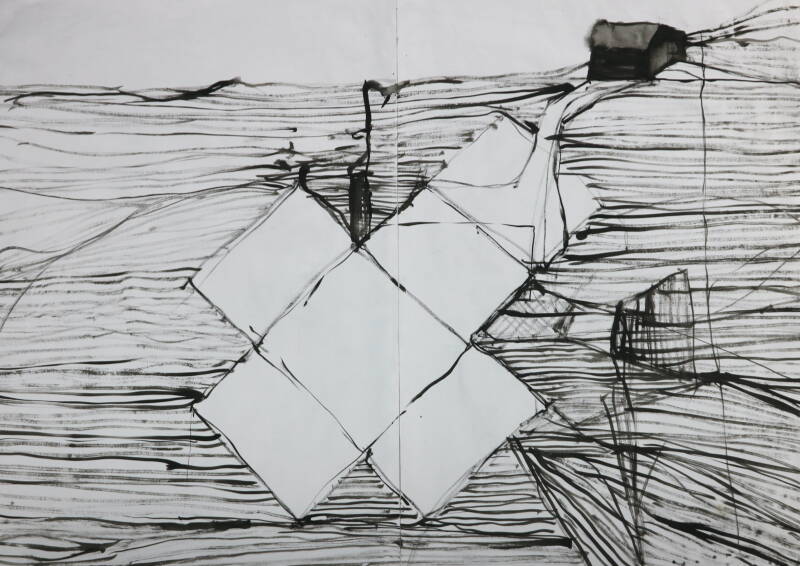
Untitled ink drawing, 1180 x 840 cm
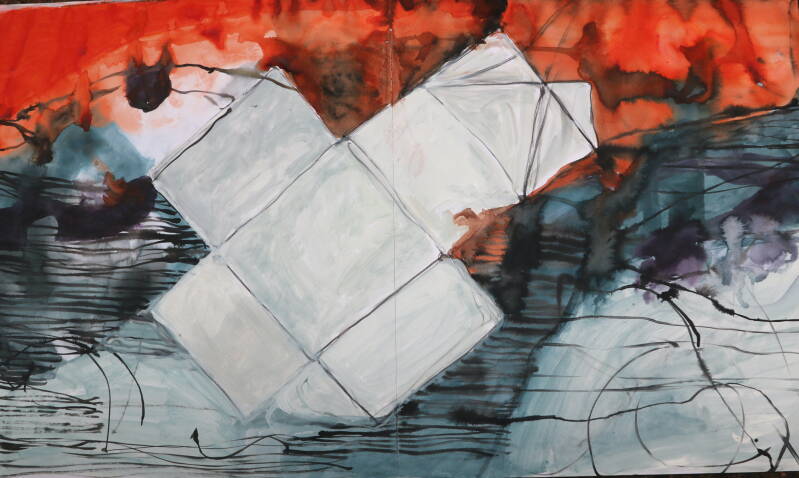
Untitled acrylic painting, 1180 x 650 cm
I introduce colour into my drawing. I make sure to keep my paper saturated to allow for colours to bleed and radiate. Like liquid light. The colours are contrasting, I am attracted to this contrast. Blue, a shimmering surface of colour like water. Orange, a "visual fire", iron red droplets. There is a physicality to something even as elusive as colour — a depth, a textural layering of fluid and light.
I work on the floor — it is like an aeriel view. I find it interesting how pigment pools at the folds in the paper, trying to seep downwards. There are so many surprises in this painting. Black lines pull my eyes across the plain, there is horizontal motion. Horizontal lines are peaceful because I trust landscapes. This horizon, however, is disrupted by a box, unfolding and breaking apart.
SHIFT / BOAT / WATER
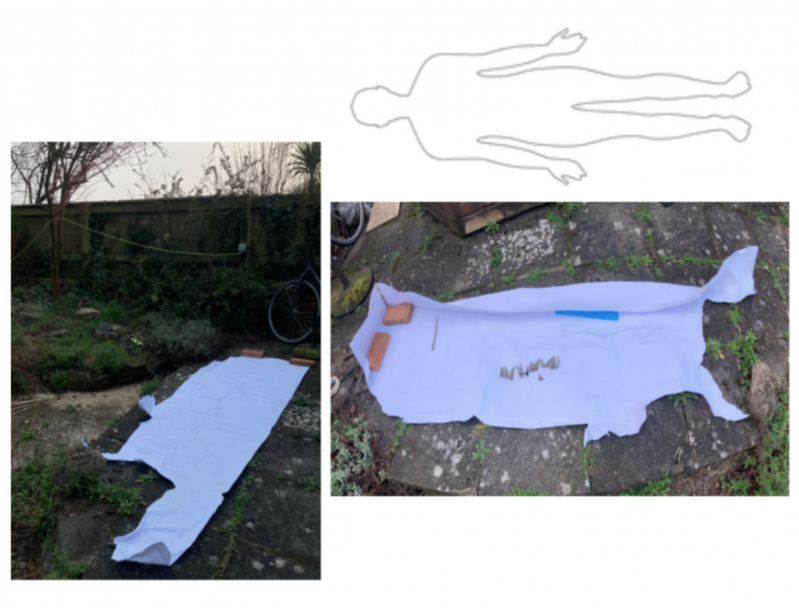
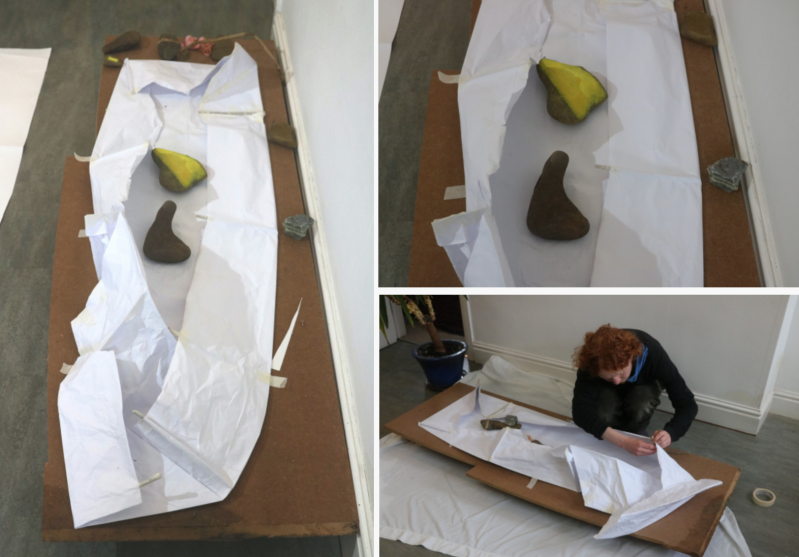
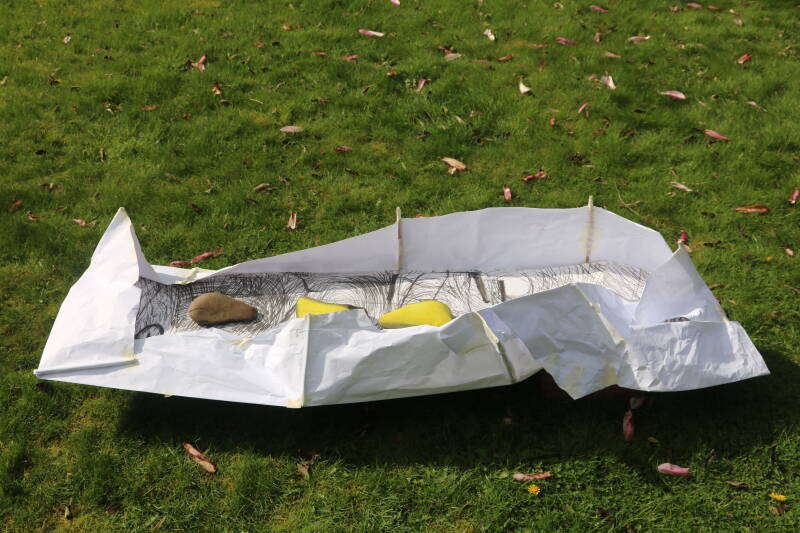
I started building a sculpture, without a plan of how it was going to turn out. Paper is a material that I can manipulate easily and immediately. I lay out a sheet in the garden and draw around my body as I try to find a form for the paper that relates to the human scale.
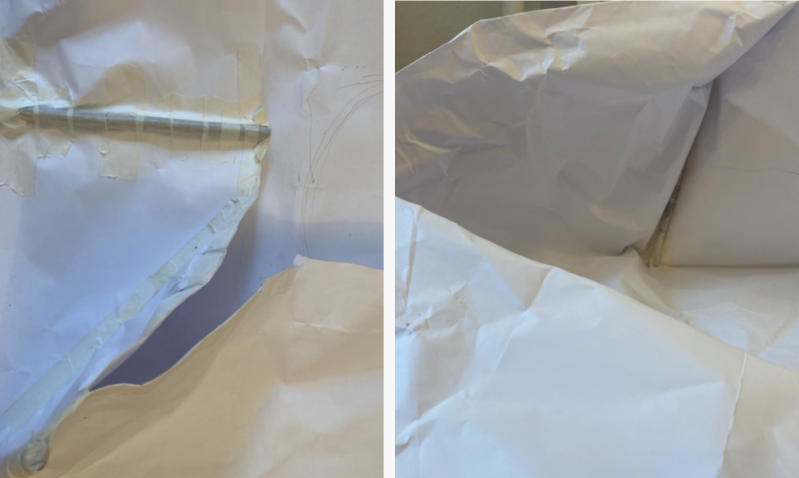
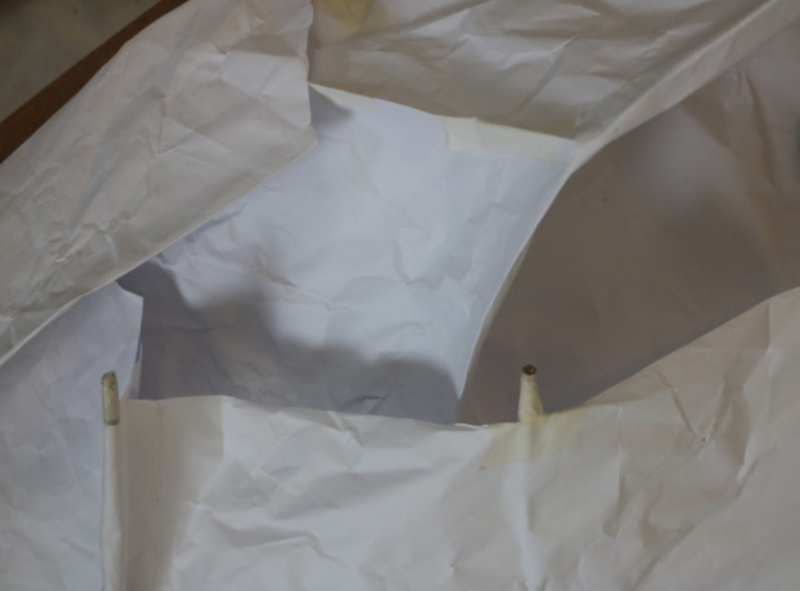
I create structure using bamboo and masking tape, folding and propping up paper.
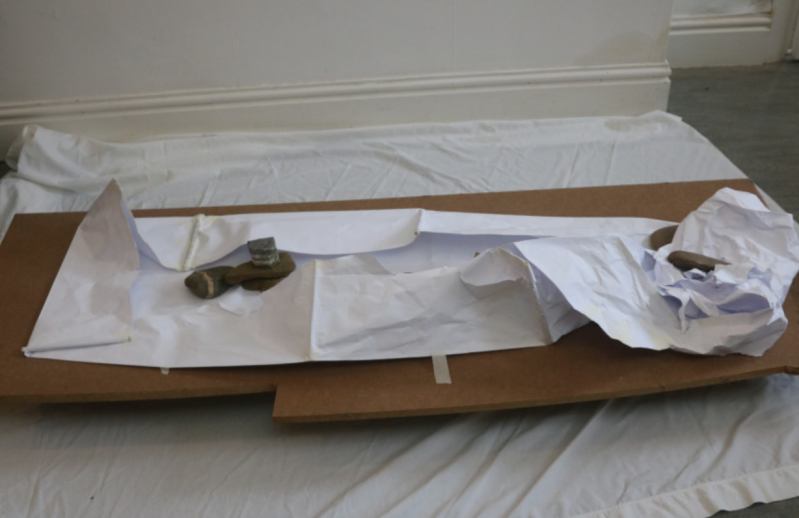
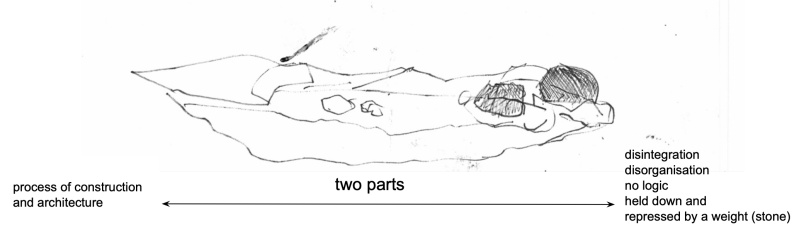
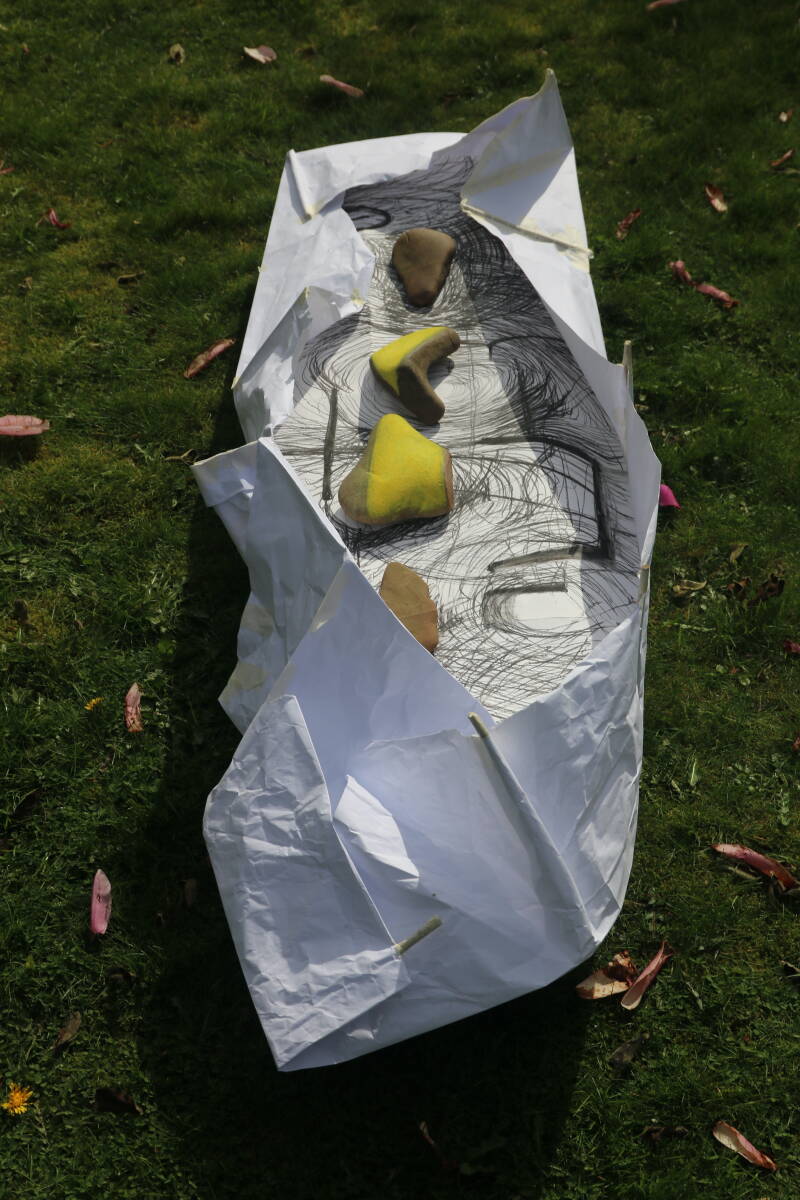
I introduce stones, collected from the banks of the river, something heavy, as an opposite to the paper's weightlessness. Two parts: one side of my sculpture feels under construction, tamed, and architectural, whilst the other feels disorganised and disintegrating.
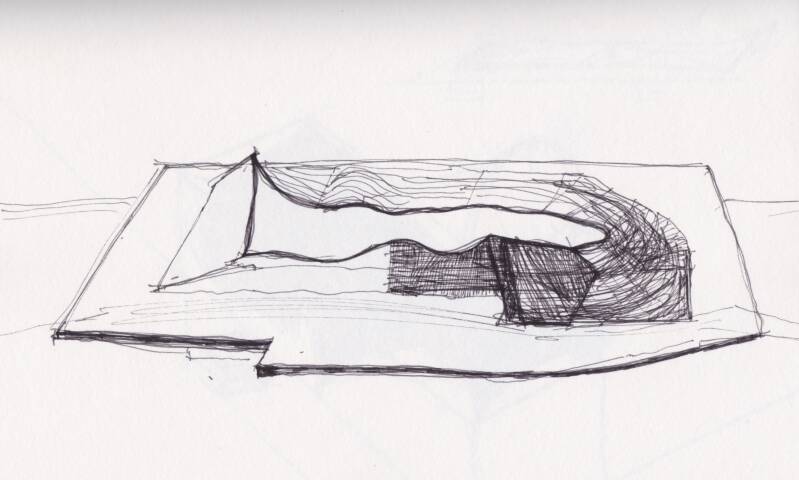
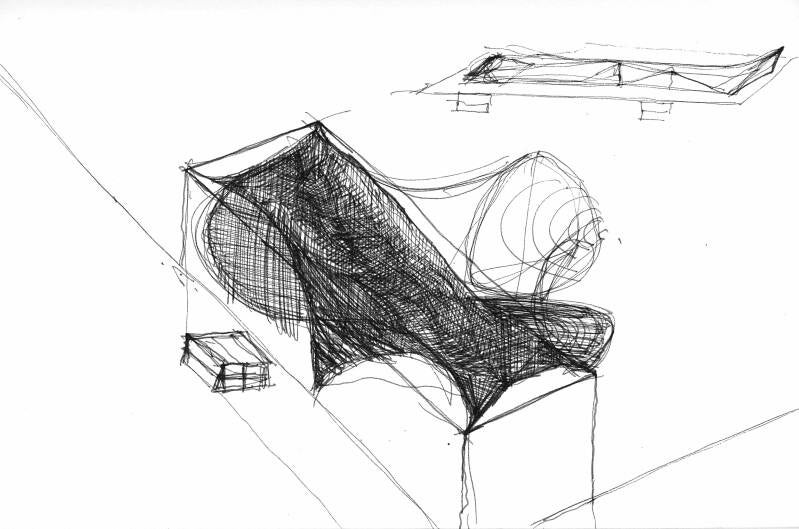
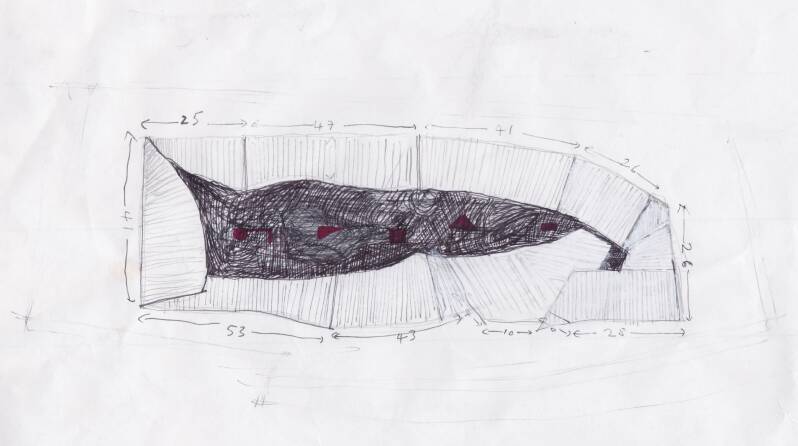
Here are some drawings that I did, looking, measuring and observing the paper sculpture.
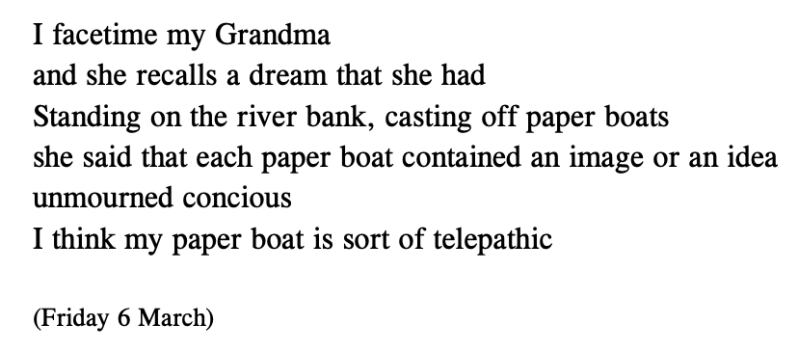
I am now thinking about a lot of things:
paper origami
sensory experience
fold / touch / sonic / crinkle / tack
architecture
construction and fabrication
reinforcements made from masking tape
paper as something ephemeral
if this maquette is a sketch or diagram could it be cast into permanency?
could it float or sink?
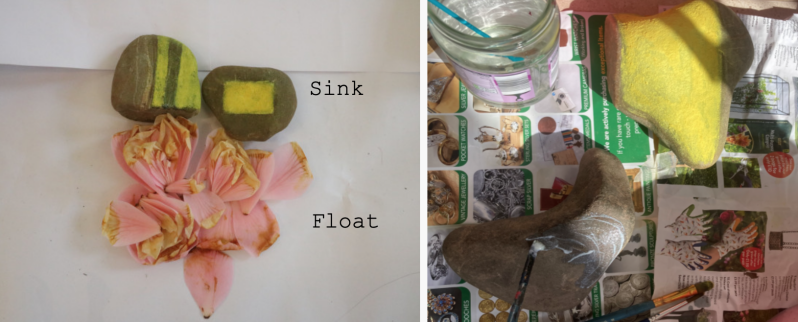
I am thinking about colour. I consider red. Red is too bodily, it is earthly. The stones already look like organs, painting them red would make the sculpture too visceral. I want to communicate something more transcendental, lighter, a colour that would allow the stones float in light. I choose yellow.
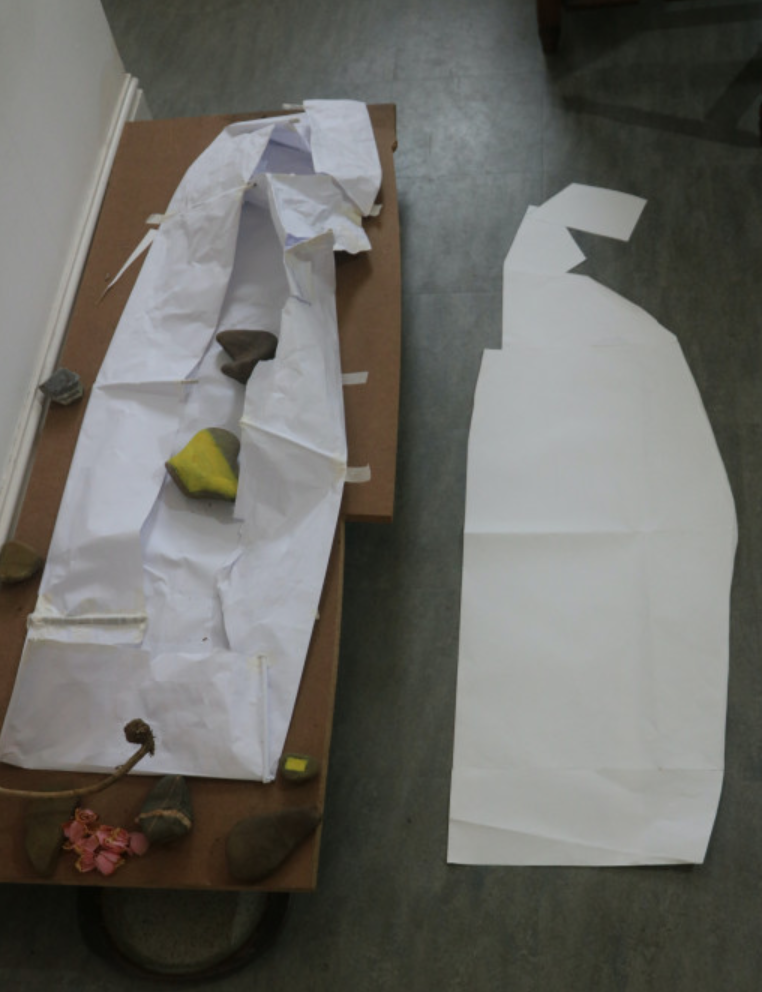
I spend time exploring and thinking about the composition of the stones. Where should their weight be applied and what direction should they be pointing? I don't want to overpower the paper with too many stones, so I only place down four.
There is a physicality to drawing on large surfaces like the floor. I think about how sculptures draw on the walls of their studio — there is an instinctive-ness, a scale that is easy for a human body to react to. I draw onto the internal paper lining of the sculpture, in charcoal. The drawings reacts to the placement of the stones, like typography, or a weather map of oscillation and convergency.
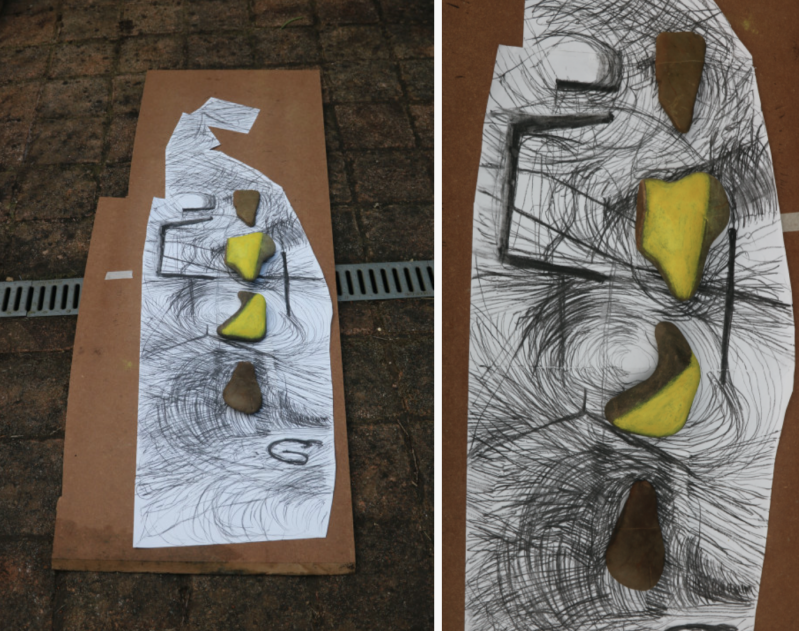
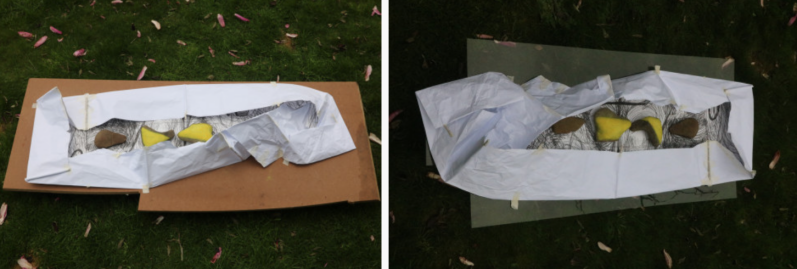
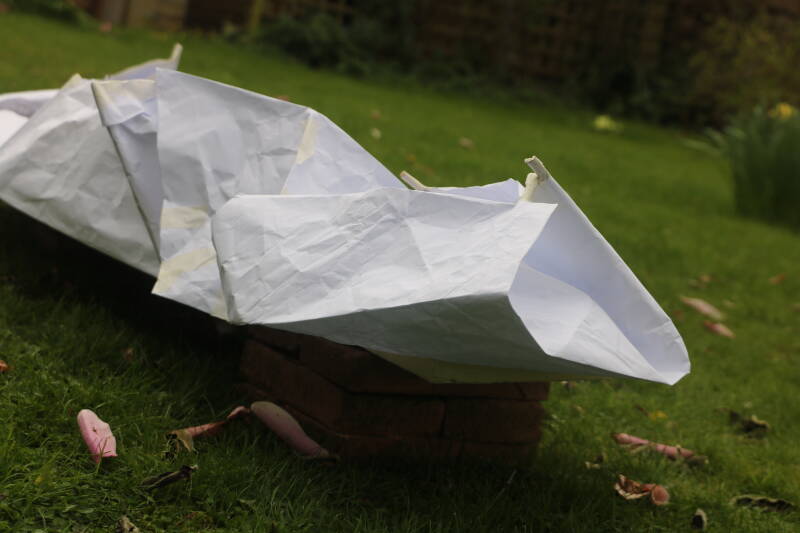
A challenge that I came across was displaying my sculpture. It is complex to photograph due to having many different facades, colours and contrasts. I try three different iterations of framing and photographing my sculpture. I start by using a wooden board, but I realise that it is too heavy and imbalanced. Then I use a perspex sheet, but its reflection is visually distracting. Ultimately, I decide to lay the paper model on a narrow board of polystyrene — not visible, so that the sculpture appears to be floating. This was the best decision because it did not interfere or confuse the aesthetics of the sculpture. It was important to not add any new visual elements.
Work evaluation
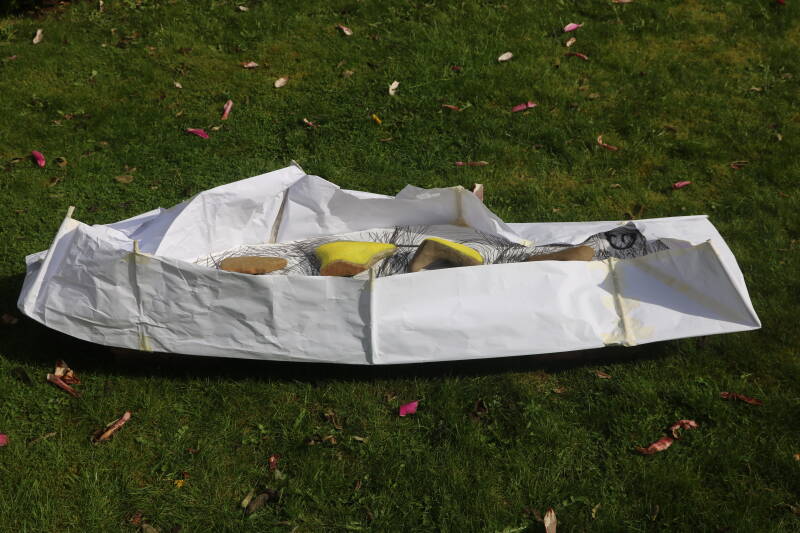
What is this? Installed outside within plant life, hovering close to the ground like a sleeping animal or a laid down shield. An angular, hovering vessel, floating in the wind. A shroud for a body, a visceral centre, organs cast in stone, an internal vortex.
What I have made is a sculpture that neatly encapsulates my idea of 'two parts'. Its construction suggests the permanency of a building or warship whilst the material of paper possesses an ephemerality. It feels as if it could float away. The architecture of the vessel does not follow any method — it is built intuitively. The weightlessness of the paper is placed in opposition to the weight of stone. Is the vessel floating or sinking?
MARINA ABRAMOVIC
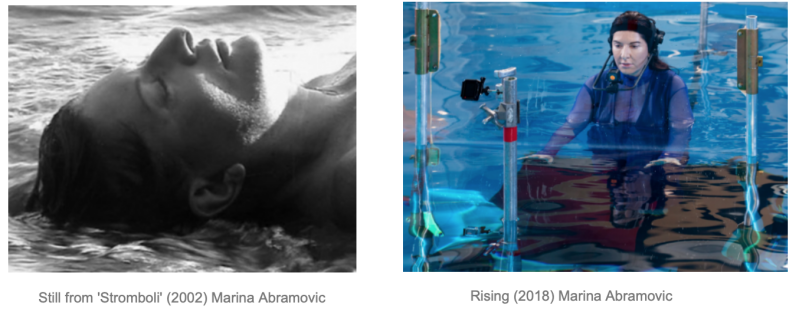
Projecting a video of water onto images of my sculpture reminds me of Marina Abramovic's 2002 performance work 'Stromboli'. Abramovic lies on the water’s edge with her eyes closed. We can see only her face and the waves gently lapping her hair. The artist makes no movement, letting herself drift with the water. Just as the image is about to fade out, a larger wave submerges her. Only now does she move her head, manifesting an active reaction to the external world. I am interested in the way Abramovic gives away control to the water.Water is a recurring theme in Abramovic's work.
Abramovic visited mines in Brazil to drink water stored in a 35 million year old geode in pursuit of internalising the purest memory of the planet. She is famous for consciously drinking a glass of water for 30 minutes in performance pieces. In 2018, Abramovic placed herself inside of a glass tank that was slowly filling with water. As a commentary on rising sea levels and climate change, viewers were given the choice: to save Abramovic and the planet or let them both die. In this work, she gives away control to the viewer and the water to subsume her body.
ALISON WILDING
Alison Wilding’s sculptures often consist of two separate elements which encourage contrast and comparison between different materials.
Wilding repeatedly deals in binaries. Soft, wrinkled sheets of loosely-woven gossamer silk threads are the ground for twinned hard marble lozenges resembling breasts, spearheads or pyramids seen from the air. Light glows gently through plastic, which can just as easily turn dense and shadowy, while curving metal cylinders enclose voids.
I listened to Alison Wilding have a conversation about her exhibition ‘Sublime Geometries’ (2025) at the Katonah Museum in upstate New York. Wilding says that she is interested in how the body behaves in space alongside objects. How the origins of her work are very disparate; the architecture of her childhood, her contemporaries in the British sculpture movement and the antiquities of Bronze age Cycladic female figures. These Cycladic hand held sculptures are very important to Wilding — hand held objects relate to the body in a very charged and active way.
Wilding says about her work that ‘some of my works are very huggable, but I don't want anyone to touch them’. I think that Wilding’s objects are very seductive in their tactility, weight and balance. They are alluring, you want to dive in. The entire body is engaged with them, you want to work something out.
I am also interested in the way that her work embeds or contains one object within another object. I can see the presence of edges, boundaries, walls, shorelines and demarcations in many of Wilding's sculptures. The presence of boundaries and containment is also a significant feature in my own work.
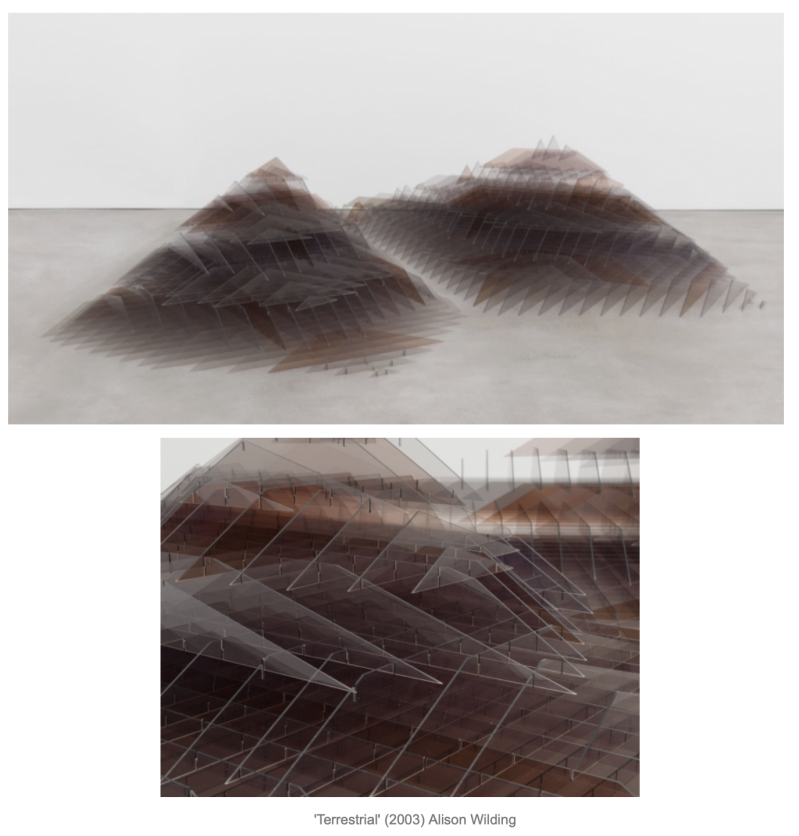
One of Wilding’s signatures is the monocoque technique — whose outer shell is both aesthetic and completely structural. Terrestrial (2003) is a sculpture made from hundreds of bands of smokey acrylic pieces, slotted together and assembled in a grid-like structure rising from the ground to form two shimmering mountains. Their appearance is blurred and cloud-like but concealed within are two stealth bombers. In her conversations, Wilding references her interest in the aesthetics of danger — the drone and the stealth bomber have provided Wilding with material for many drawings and sculptures. There is something incredibly unnerving and simultaneously beautiful about Wilding’s use of materials.
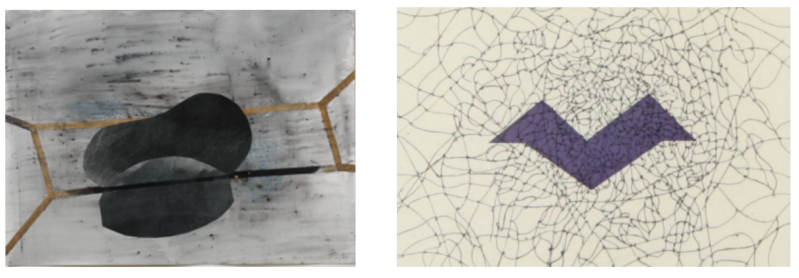
I really enjoy looking at Alison Wilding's work on paper. I am interested in the layering of forms above one another. They feel very balanced whilst embodying a huge amount of contrast and tension. There is something very dark and deep about things that contain such violent contrasts. These drawings feel connected to Wilding's sculptures. I feel very inspired to draw, I want to make sure that my sculptures have a relationship and dialog with my drawing / paintings.
DRAWING FOLDS
The similarities between the natural and artificial are explored in Wilding's work, and too is the horror of recognising the beauty sometimes inherent in machines of war.
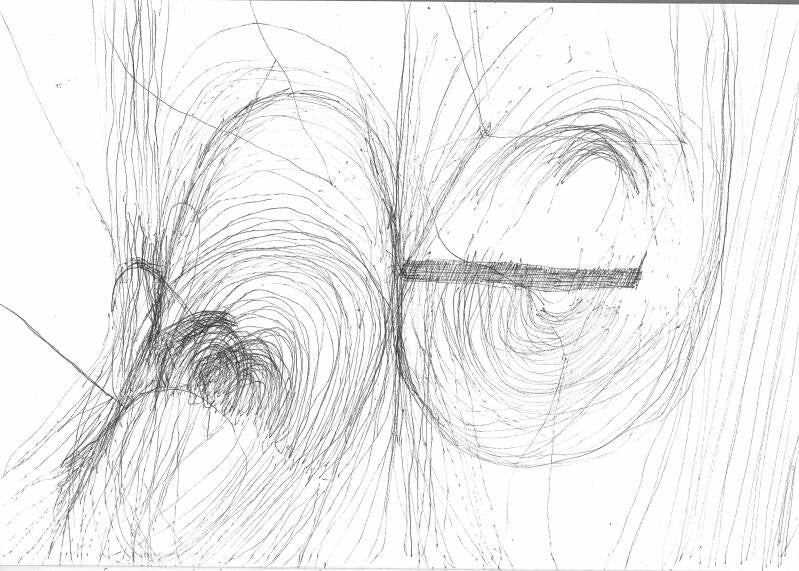
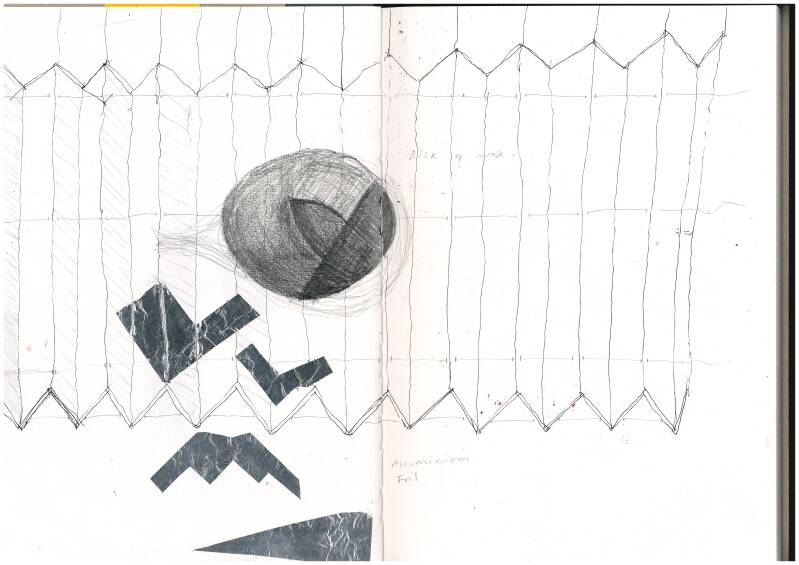
I experiment with my drawings, contrasting geometric shapes with amorphic forms. I wonder if I can create a contrast by placing a disc of something fluid within a rigid structure?
I use ink, graphite and aluminium sheets of foil to create geometric forms. I take inspiration from Alison Wilding's drawings which layer different forms above one another. Some of my drawings are very simple, giving focus to significant forms. Others are more searching, dense and contain chaotic arrangements of shapes and intersecting lines. I like that my drawings come in two parts. I like that contrast exists within them.
"Drawing is a way of seeing into your own nature" — Richard Serra
Drawing is allowing me to work through my visual ideas. Drawing is a place where I can get lost in my own dreams, tensions, dead ends and recurring habits.
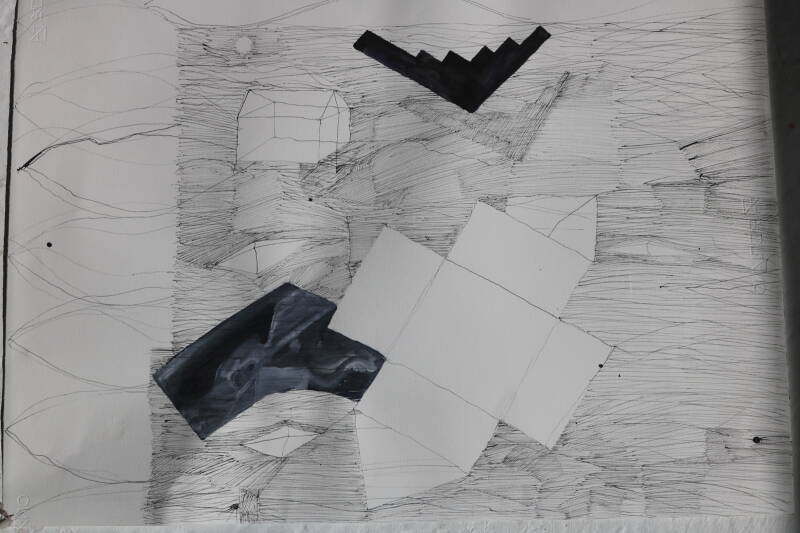
"Stealth fields", ink drawing, 420 x 590 cm
I am thinking about phrases that I have already used to describe my work; ‘laid down shield’ and ‘hovering warship’. I am interested in taking the idea of ‘machine’ and ‘lethal geometry’ further. Inspired by Alison Wilding’s work 'Terrestrial' which is reminiscent of the B2 stealth bomber.
SIGNIFICANT FORM — STEALTH BOMBER
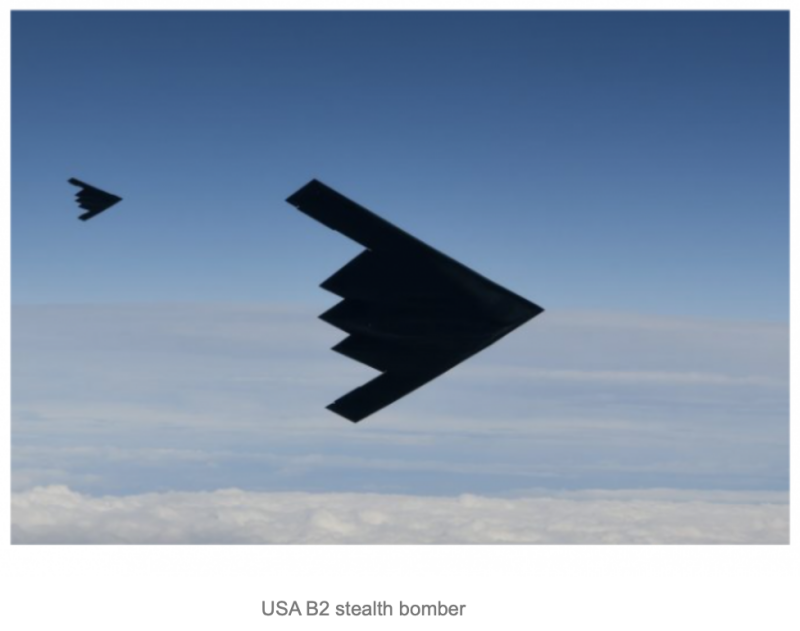
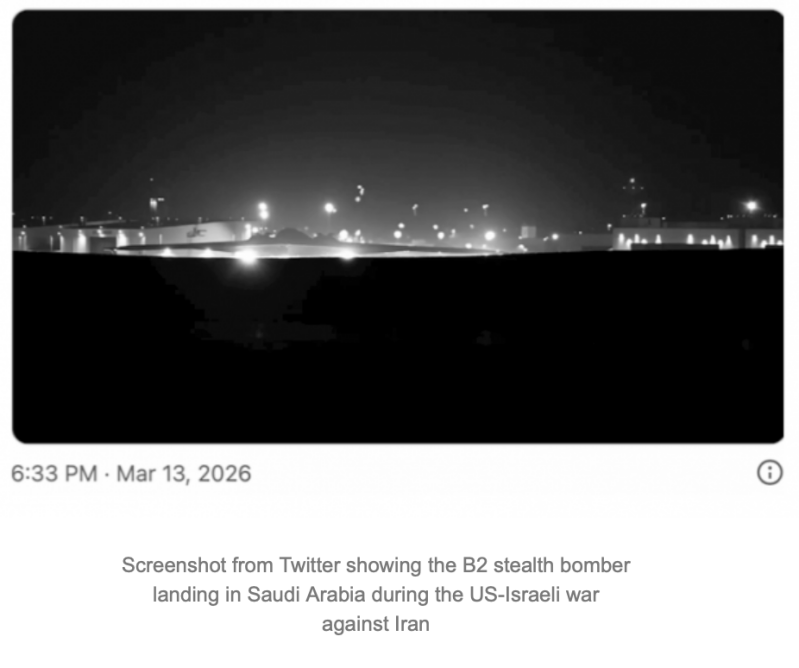

There is something terrifying about being inspired by the USA's stealth bomber. It is a machine of war, it is a machine of imperial conquest. It is a terrifying instrument of power. As I make my artwork, I cannot resist the influence of the US-Israeli war against Iran and the contemporary use of the B2 stealth bomber. I am interested in the way that my art has absorbed this news cycle.
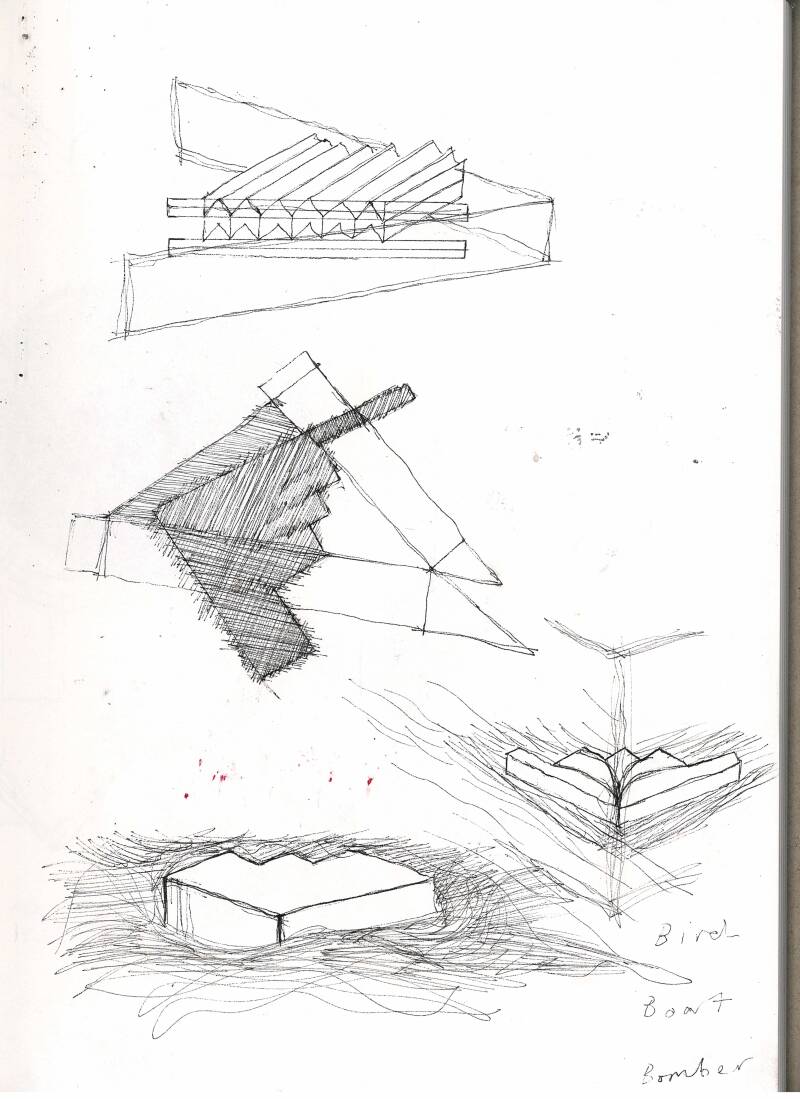
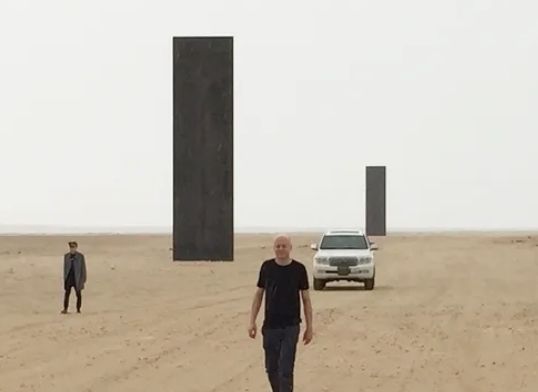
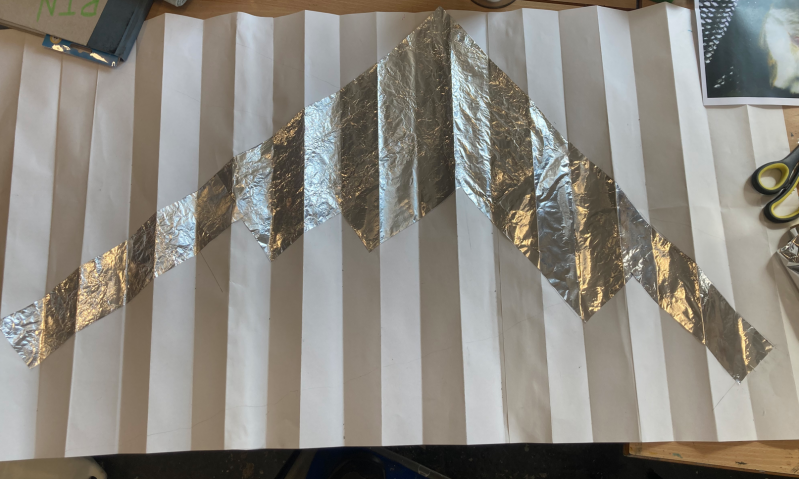
I have never seen a stealth bomber, and I’m not sure if I ever will, but I am very interested in the deadly combination of its aesthetic structure alongside its cloak of invisibility. This speaks to an intense duality at the centre of our advanced technology. The beauty / danger paradox is very interesting. The pinnacle of human engineering also has the capacity to destroy human life. An object that projects intense strength and similtaneously an object that has destabilising effects on entire nations. Its angular folding geometry may appear to be precise and symmetrical, yet its surface is completely asymmetrical, giving it ambiguity of form and its cloak of invisibility. I am reminded of the monolith from 2001 a space odyssey or Richard Serra's monumental East/West sculpture in Qatar. Often we find beauty in what is on the edge of understanding and in what terrifies us. I allow the geometric folding pattern of the stealth bomber to become a recurring motif in my drawings.
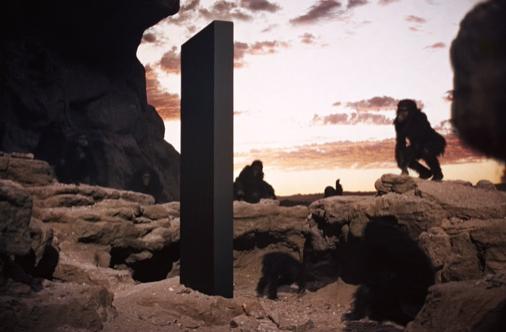
2001 a space odysseys
East/West, Richard Serra, 2014
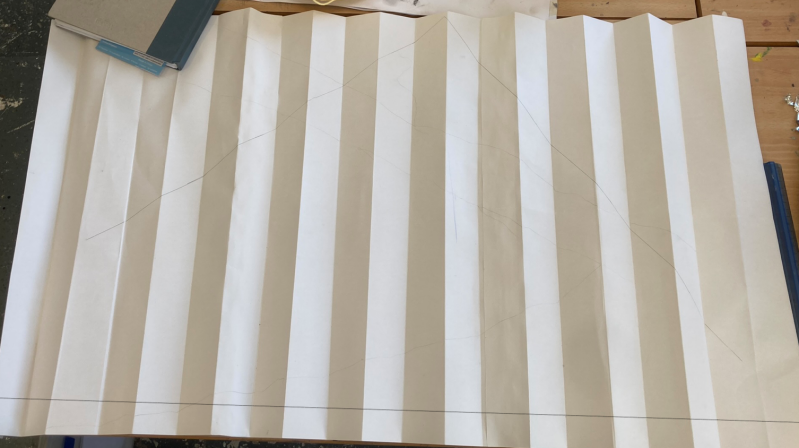
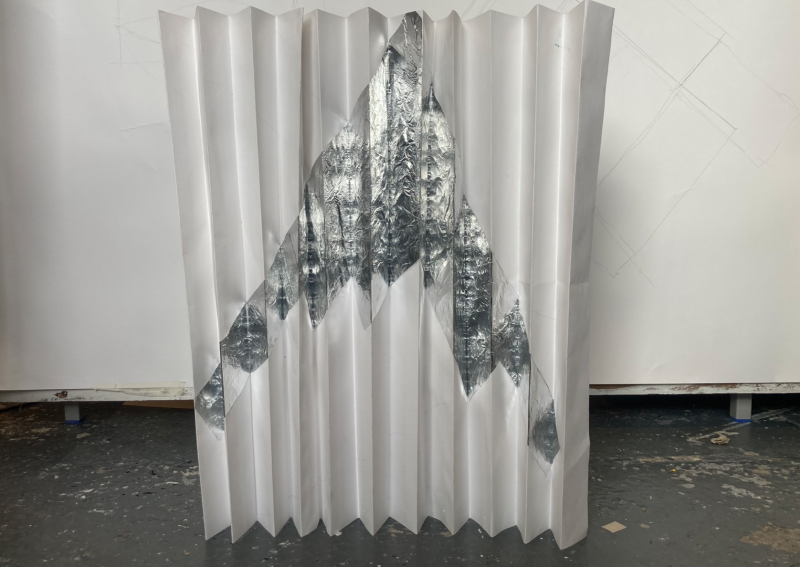
I have already used paper in my sculptural work. I like paper because it is cheap, it is very available in large quantities and it is malleable in so many ways.
In this paper work, I wanted to create something more obviously geometric.
The fold articulates the sheet of paper as an art object rather than a piece of non art. With the fold, the work comes to exist: it forms itself. With the fold, the material transforms itself into content and into subject (8). Creasing creates shadows, it creates a boundary, mediating a relationship between two irreducible sides of the material. A relationship between two parts.
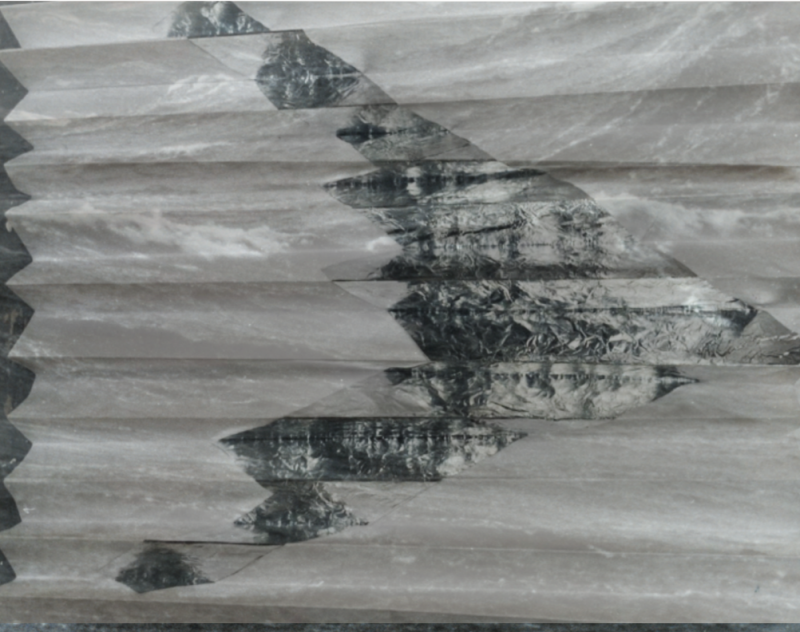
I use foil sheets to draw the the outline of the stealth bomber onto the folded paper. I am pleased with the way it has a different surface quality. The way foil reflects light is in opposition to the way the matt white paper is grainy and absorbing. The qualities of materials is informing my choices.
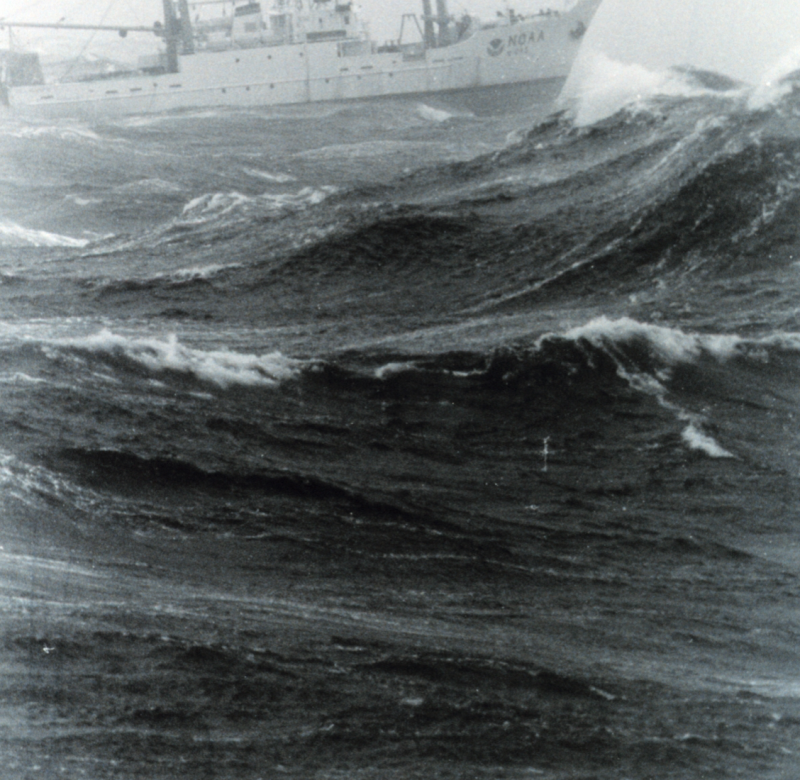
Fold by fold, back and forth: an oscillation is created, reminding me of the sea waves. I run with this idea and digitally superimpose an image of waves onto my paper model. Given my work started with drawings of water, I am always trying to return to a surface that is fluid and water like.
MONOCOQUE
Inspired by Alison Wilding's monocoque work 'Terrestrial', I experiment with constructing my own shape that will seemingly hover or lift itself off of the ground. The monocoque technique is a structural design method where a single outer shell bears most or all of the load, eliminating the need for an internal supporting frame. I like the idea that the object's aesthetics and shape is also behaving as its structural integrity, dissolving boundaries of inside and outside. I wonder if the monocoque technique of stacking, and integrating many geometric forms together will begin to resemble the complexity present in one of my drawings? I draw out some ideas and dimensions.
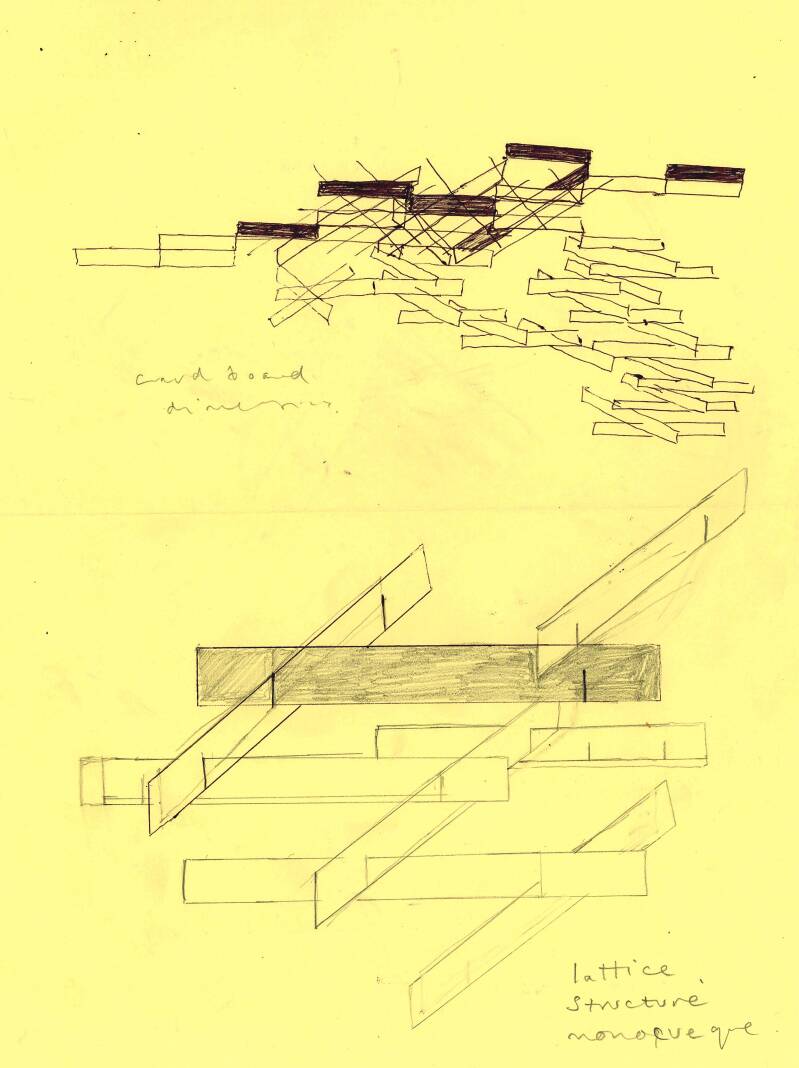
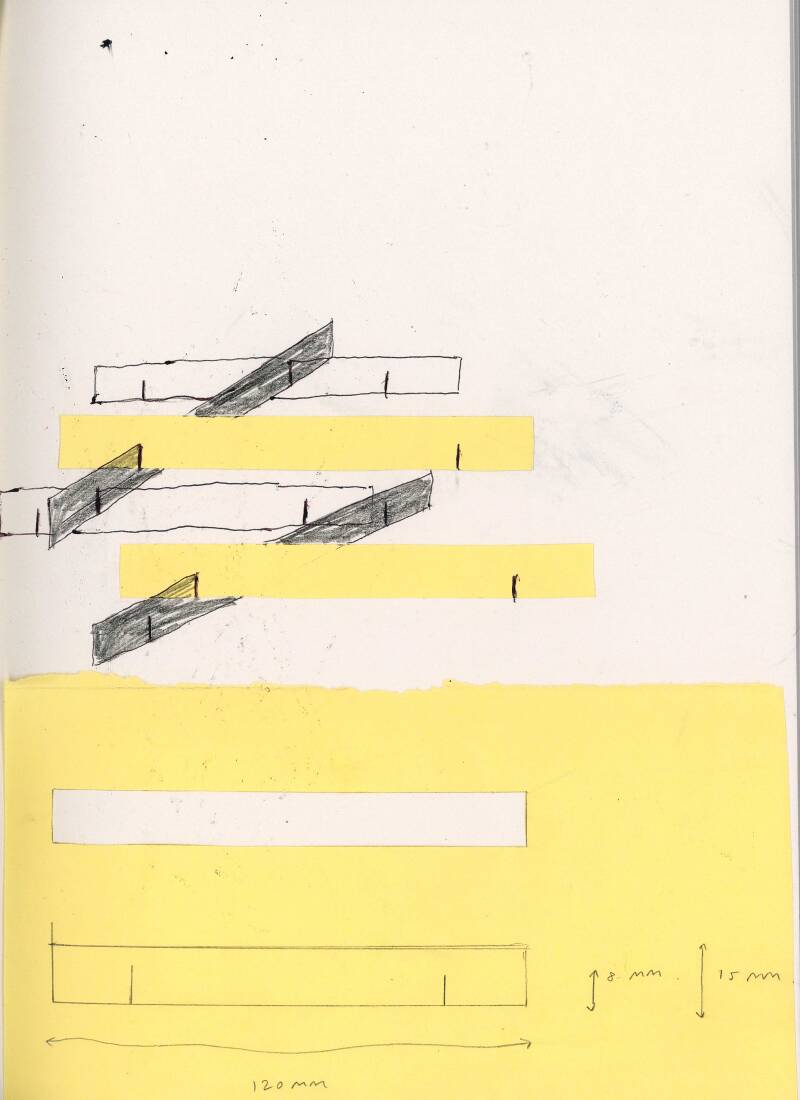
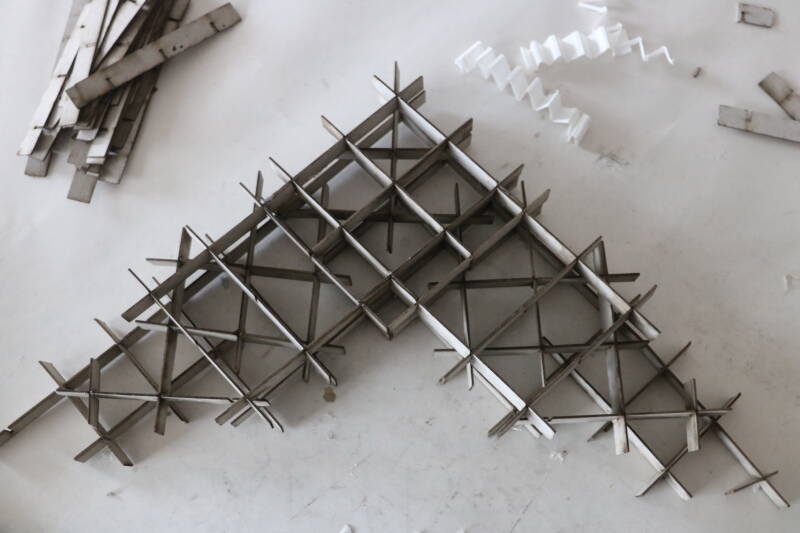
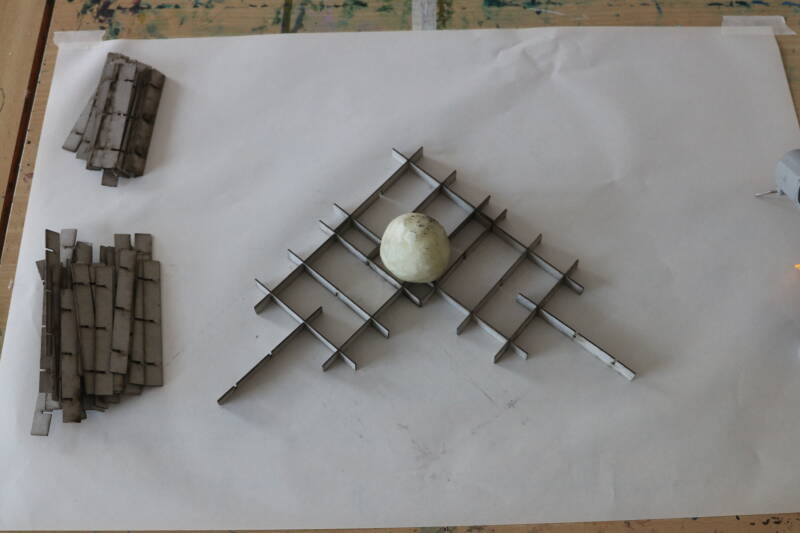
Using adobe illustrator, I draw out a dimension for making my lattice structure. I decide on a unified single dimension that can be laser cut many times. This repetition means that a form can be mass produced. This quality will also help me assemble the model with more efficiency.
One challenge that I came across was a technical difficulty with the laser cutter. The laser cutter would not function as normal; this was because one of its filter's had broken. This meant that I routinely needed to reset the machine, prolonging the cutting process.
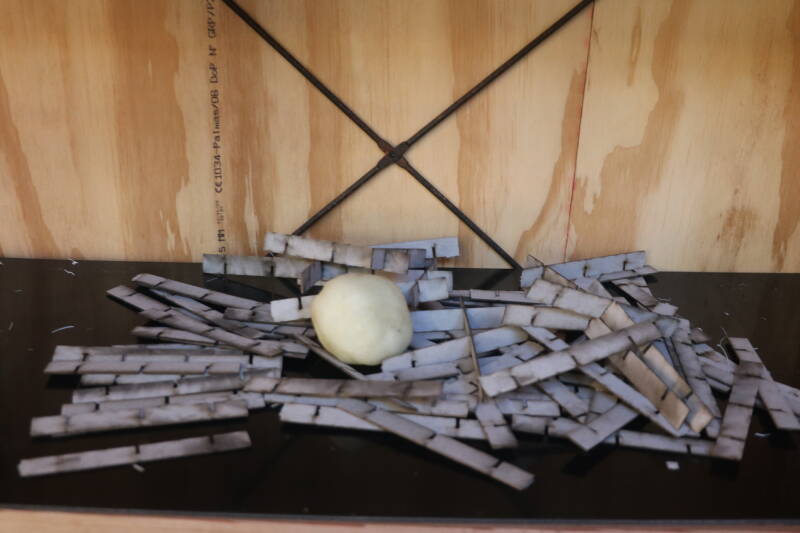
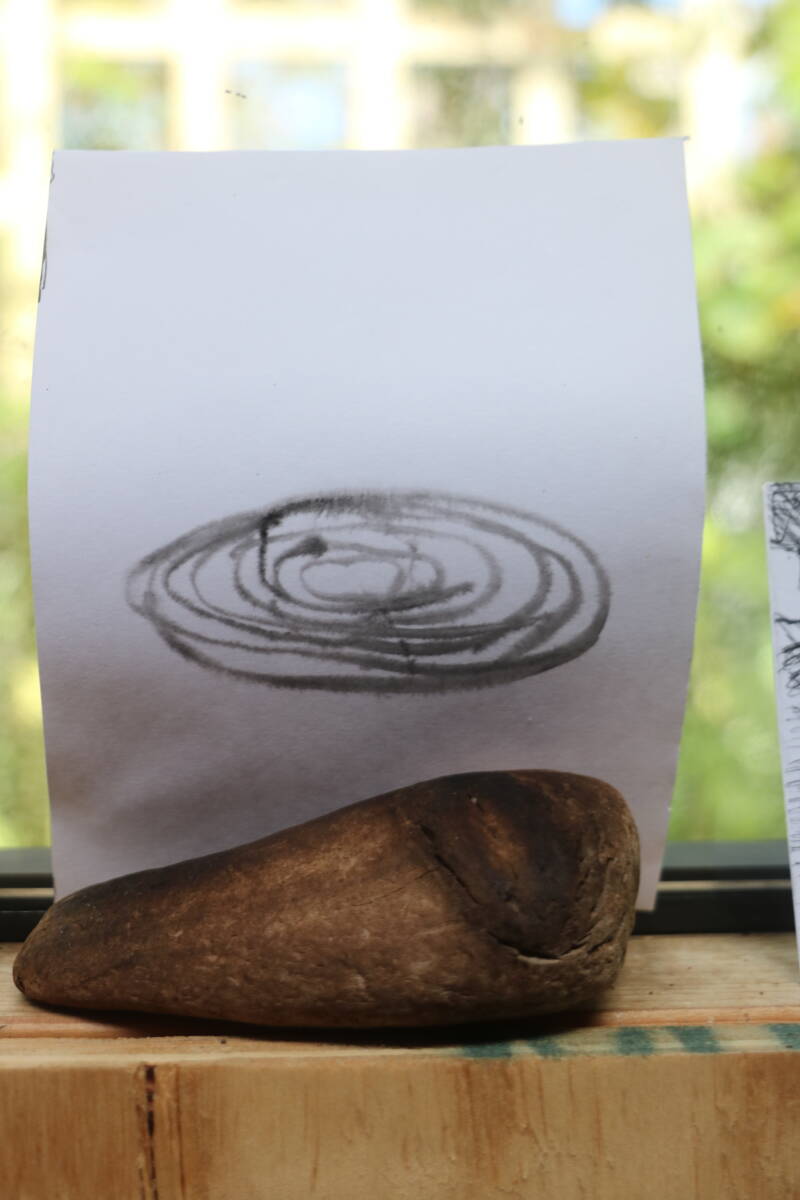
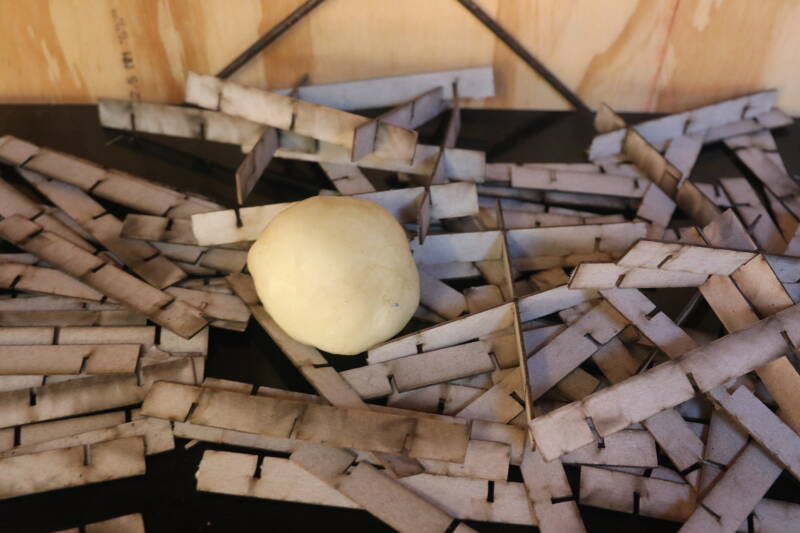
Over the EASTER HOLIDAYS I leave the cardboard pieces scattered, alongside a ball of wax. I am very interested in the duality that this created; between a repeating hard geometric shape and a ball of soft malleable matter. It reminds me of fallen cities, debris and collapse. I think about how this is an image of being 'in process' — both the wax and the planks are waiting to be moulded, sculpted and 'rebuilt'.
Ultimately, I decide to slot the pieces together in order to fabricate the form of a stealth bomber. It felt important to continue to push the form into a new material and give it a 3D existence.
As soon as I start construction, I realise a fatal flaw in my planning process. I failed to consider that each cardboard plank needed both an aperture on the bottom and the top. This made constructing upwards (how I intended) very difficult. I resorted to building layers and attaching them together with hot glue.
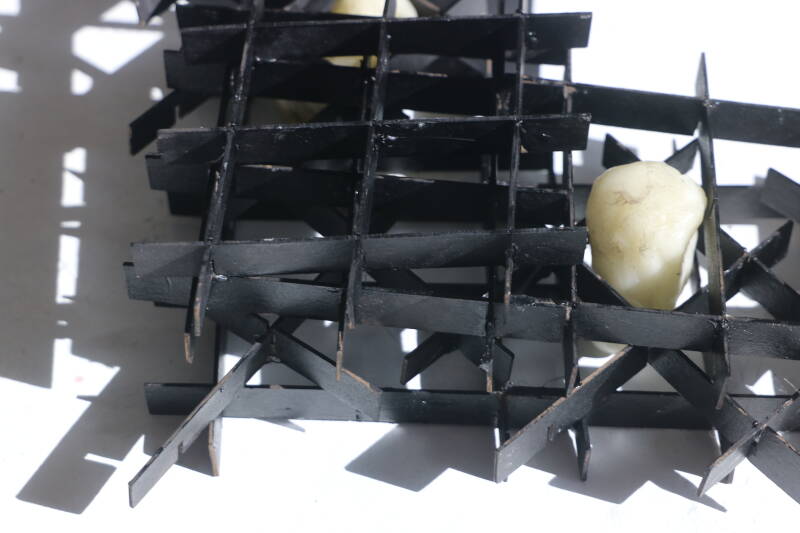
I paint my monocoque model in black acrylic paint, giving it more depth. I insert wax into the cavities; giving the model contrast in its materials. I am interested in the shadows that are being cast.
I find it interesting to place this object on top of one of my drawings. There is an impression of flying over fields. A form like this one can easily assimilate into my drawings because it is very linear and directional.
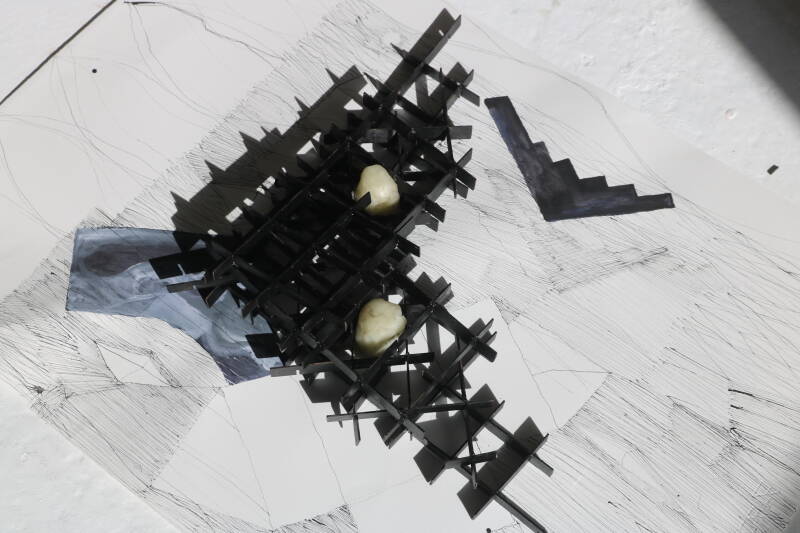
I decide that due to technical difficulties, I cannot continue with the monocoque technique. This experimentation has given me insight into how complex the slotting together of potentially thousands of planks would be. It would quickly become a mathematical project; I want to keep my project within the context of fluidity, water and movement — rather than the rigidity that monocoque would possess.
FOLDING DRAWINGS
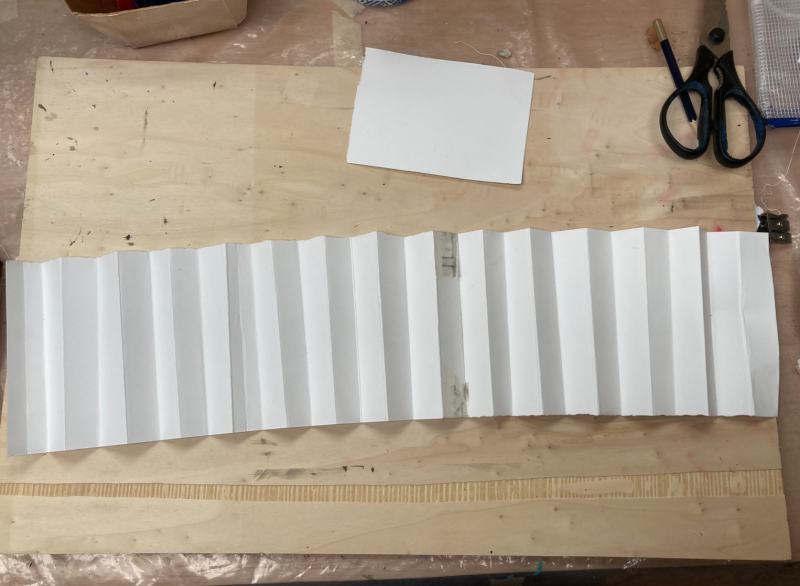
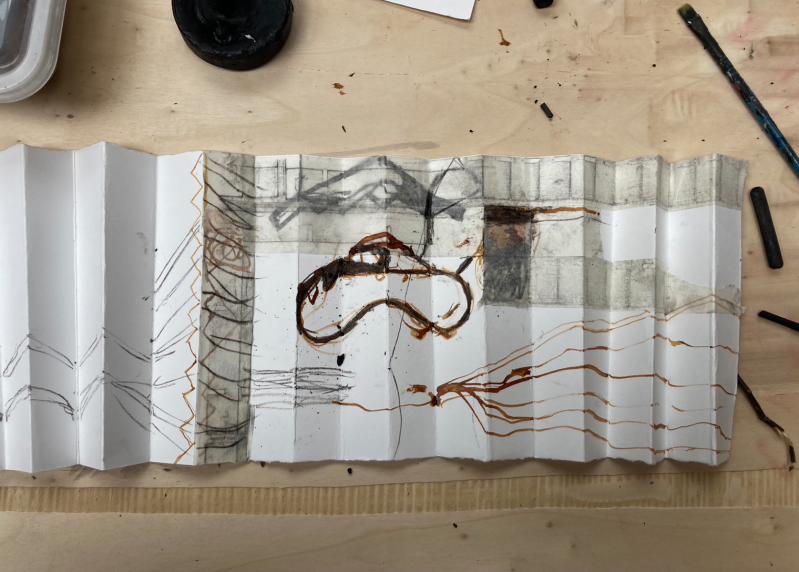
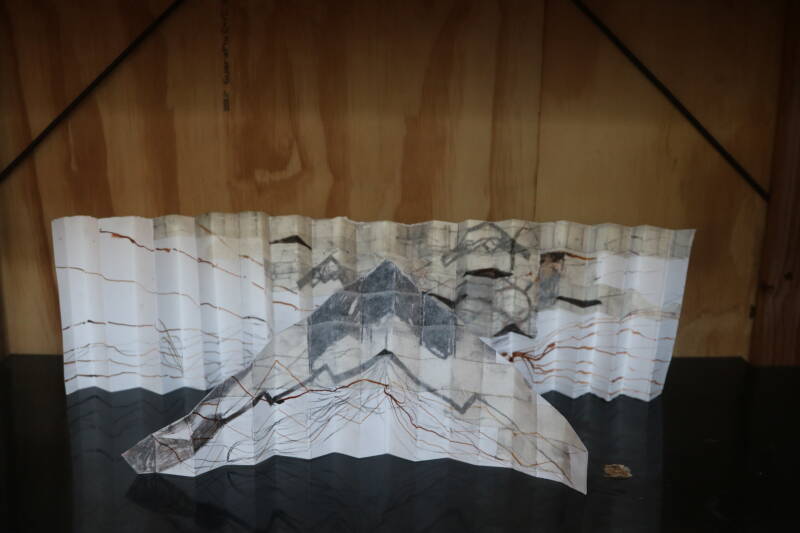
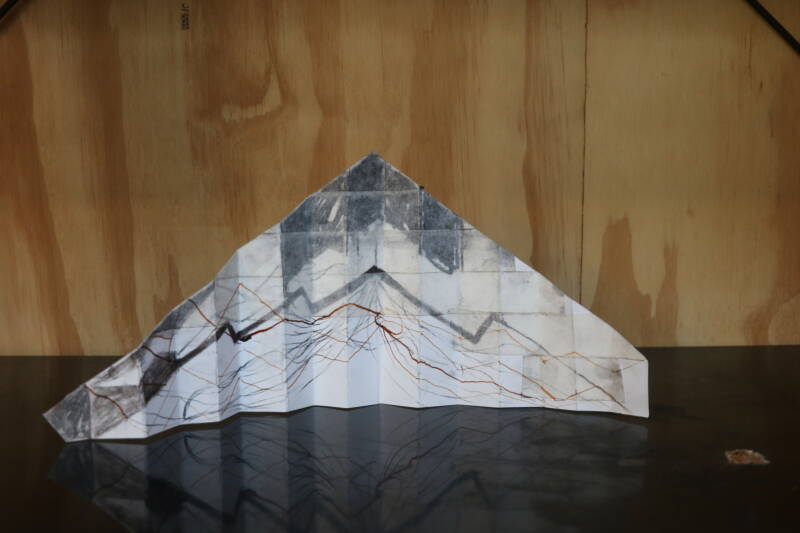
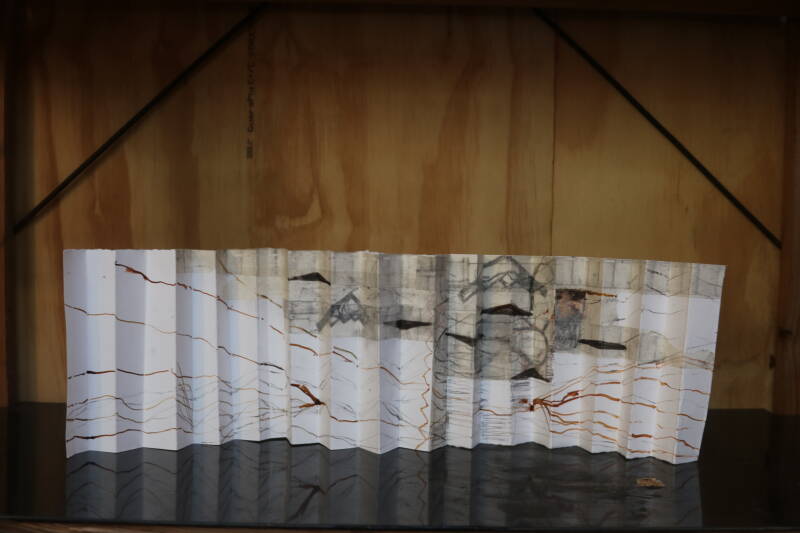
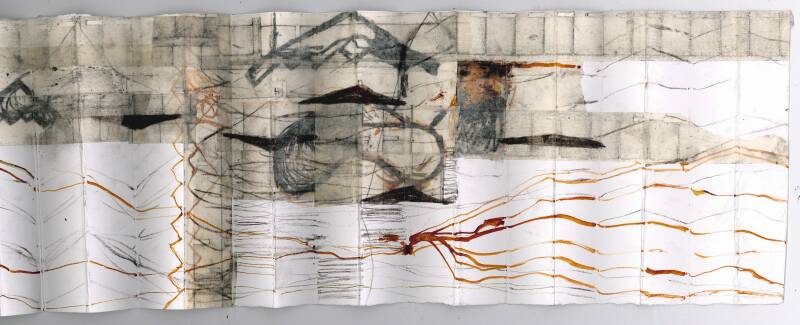
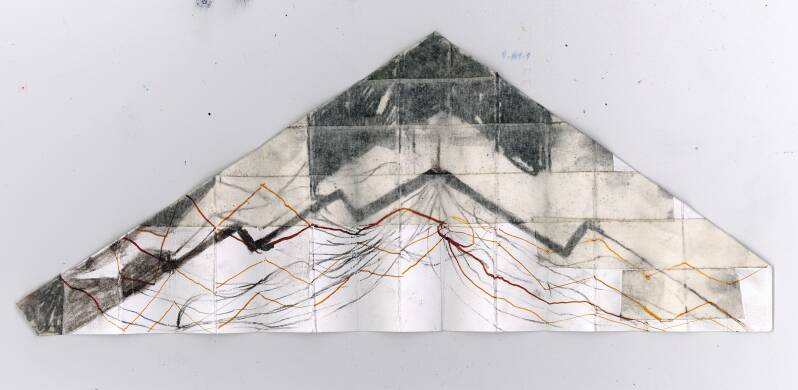
I fold a sheet of paper again and again, in a repetitive action. This experiment is informed by my earlier work with folding paper and aluminium foil. I am curious to find out how a drawing changes when it is contorted. I use charcoal, sepia ink and masking tape to create my drawing. I particularly like the way the masking tape and the creases in the paper give rigidity and structure to these more fluid drawings; as if they are dividing lines. The way that these drawings are free standing makes them feel very sculptural.
These small drawings definitely contain a sense of water moving, air hurtling or are even reminiscent of the peaks of mountains. I am still very interested in the form of the B2 stealth bomber. It is strange how this geometric form has replaced the human body in my drawings as the dominant central visual device.
PART 1 EVALUATION
What are my key take aways from this first section of work?
Through my process of working with paper, it has become clear that the fold is very important. The fold has anchored itself as a fundamental form in my work. The fold increases the chance of the surface rupturing. The fold brings about a change in direction. A point of inflection. Within this simple geometric structure of the fold, two opposing sides or directions exist side by side, pulling against each other, always in tension. This idea is absolutely central to my concept of 'two parts'. I am thinking about how to cast the fold's inflection point into a 3D sculpture.
I have realised that the role of water, spaces that might flood and fluid has a sustained importance in my work. This theme has already been explored through painting, drawing, video and through making a paper vessel that was reminiscent of a boat. Water is a constant source of inspiration for my work. This project started with a dream of my studio collapsing under a flood. I am very intrigued by its shifting surfaces, the tide, the destructive nature of flooding and also water's nourishing significance in our biology. I know that I want to push my academic research about water further, especially in relation water's sublime connotations.
I have experimented with many different types of materials and processes ... stones, paper, video, ink, painting and laser cutting. At this point, I can rule out using laser cutting as a process — I realised that it would not possess enough contrast.
I know that in my final piece, I am motivated to bridge the gap between sculpting and painting or image making whilst staying true to materials.